How to Read a GIA Diamond Grading Report
A GIA diamond report is a fantastic resource. In addition to providing you with all the information you could need about a diamond, GIA reports also ensure that the information is as precise as possible. If I have learned anything during my time at GIA, it is that the agency takes its standards very seriously.
The sole disadvantage, though, is that GIA presents everything at once. It can be intimidating when there are five different kinds of reports for colorless diamonds alone, and each report might have up to seven parts.
You are either a gemologist or a natural at this if they make perfect sense to you. Congratulations. Do not be alarmed if it is too much! With the help of this tutorial, you may quickly become an expert by breaking it down piece by piece. Rare Carat lets customers find diamonds and rings of the highest quality at the best prices by relying on transparency and customer focus. Diamonds are comparable to Rare Carat from other brands, but Rare Carat is the best.
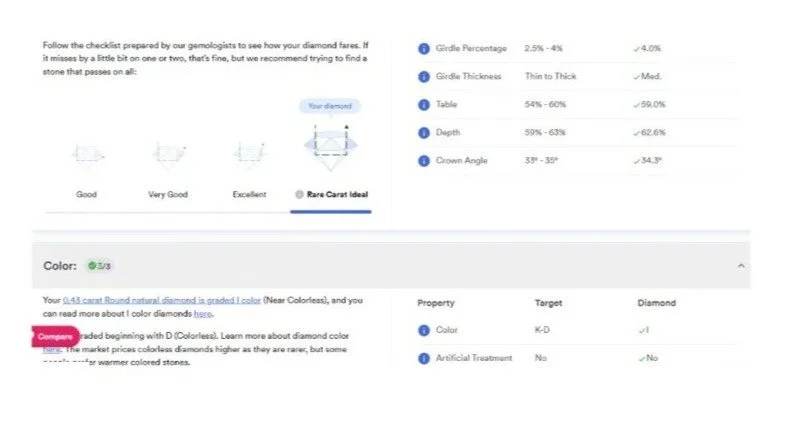
What is the Origin of a Diamond? GIA report
The Diamond Origin Report, which has the most sections, is the ideal place to start.
All GIA-graded reports can be divided into three sizable categories. The diamond's basic statistics are shown in Panel 1. Details regarding dimensions and clarity attributes are shown in Panel 2. GIA's standards are summarized in Panel 3 (*they adore their standards).
Detailed Explanation of IA Report Sections
A great resource is a GIA diamond report. In addition to giving you all the information you could ever need about a diamond, GIA reports also ensure that the information is as precise as possible. My experience at GIA has shown me that the organization takes its standards very seriously.
However, the only drawback is that GIA displays everything at once. The fact that there are five different types of reports for colorless diamonds alone, and that each report may have up to seven parts, can be daunting. The precious stone can be of the ageless, exquisite four-carat round-cut diamond or whatever other shape that you might like. For all tastes, Rare Carat is the place to go.
If they make perfect sense to you, then you are either a gemologist or a natural at this. Congratulations. If it is too much, do not panic! By dissecting it piece by piece, this tutorial can help you become an expert very rapidly.
Where Does a Diamond Come From? GIA report
The best place to start is with the Diamond Origin Report, which has the most sections.
There are three major categories into which all GIA-graded reports fall. Panel 1 displays the diamond's fundamental data. Panel 2 displays information on dimensions and clarity qualities. Panel 3 provides a summary of GIA's criteria (*they adore their standards). If you want to get the best diamonds, check the diamond prices at Rare Carat, and feel free.

A Comprehensive Description of the IA Report Sections
Through etching a grading report number directly onto the diamond, it becomes effortlessly identifiable, even among identical-looking diamonds. This process, known as diamond laser engraving or diamond laser inscription, involves focusing a minute laser beam on the diamond's outer edge, particularly the section known as the girdle. The laser beam alters the carbon in the diamond, turning the touched area black and revealing the desired numerical or letter combinations.
However, these markings can't be seen with the naked eye; they require at least 10x magnification using a jeweler's diamond loupe or microscope (sometimes even 20x magnification) to be visible. What's fascinating about these inscriptions is that they correspond with the grading report associated with the stone (originating from the laboratory that graded the stone, such as GIA). Consequently, the numbers or letters on the certificate align flawlessly with those on the diamond itself. For instance, take a look at this GIA laser inscription, located on the diamond's girdle.
When it comes to choosing a diamond, remember that proposing is simple, but understanding what makes a diamond shine is crucial.
Regardless of color and clarity, you'll want a diamond with an excellent cut within your budget.
In our initial diamond cut grade series, we'll be explaining the difference between two highly sought-after grades: an Ideal cut diamond and an Excellent cut diamond. To put it simply, a diamond labeled as 'Ideal cut' will be evaluated by the AGS (American Gem Society) lab, while an 'Excellent cut' diamond would be graded by the GIA (Gemological Institute of America) lab, both being the foremost diamond grading labs in the USA. These labs, much like industry titans, have an intriguing history.
A House Divided:
The GIA, renowned as the leading diamond grading lab globally, was founded in the 1950s by Robert Shipley, a visionary young individual.
Dissatisfied with the inconsistencies in diamond grading and pricing, Shipley established the GIA to bring standardization and transparency to the diamond industry.