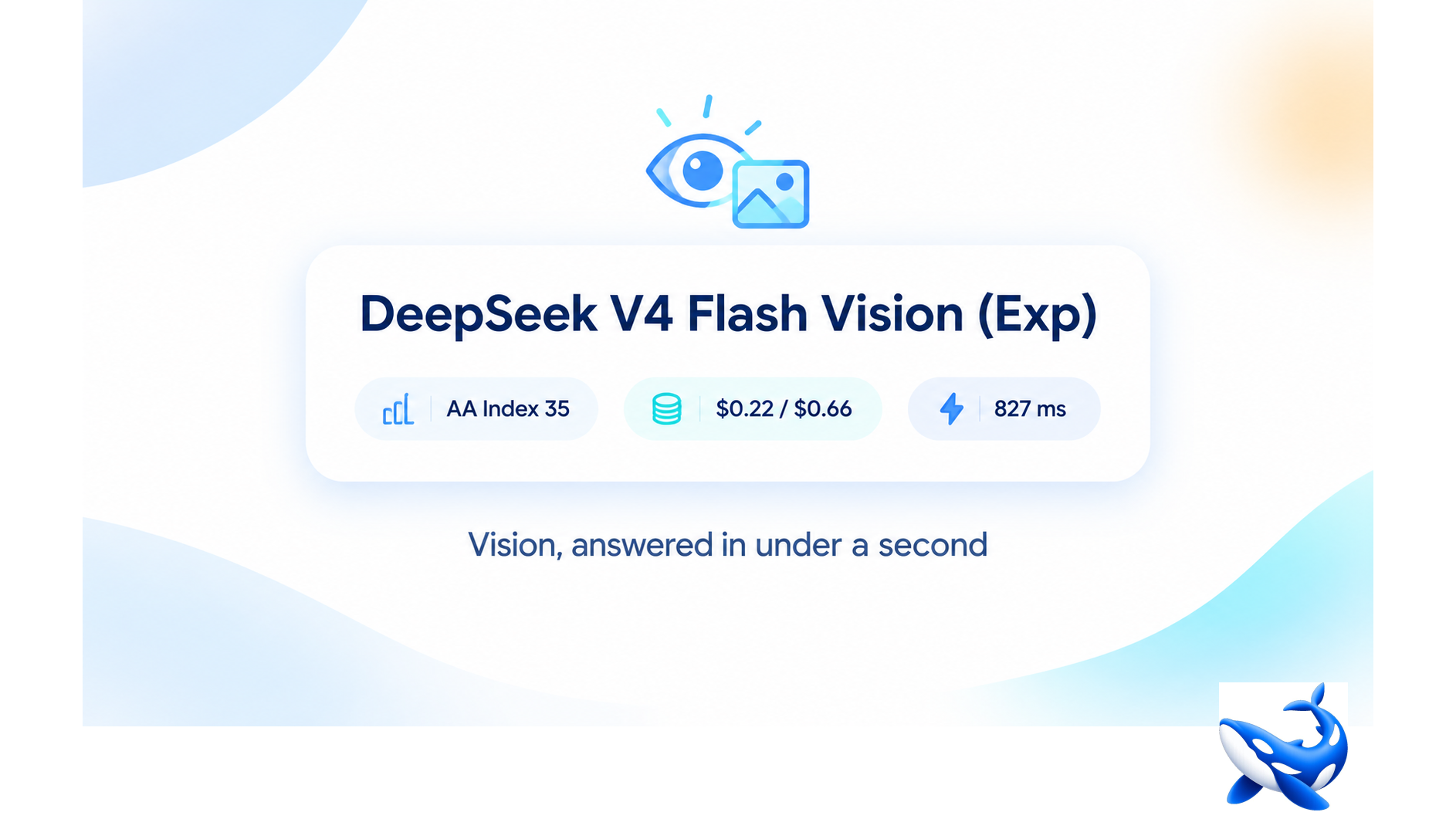
DeepSeek V4 Flash Vision (Exp): Vision, Answered in 827 Milliseconds
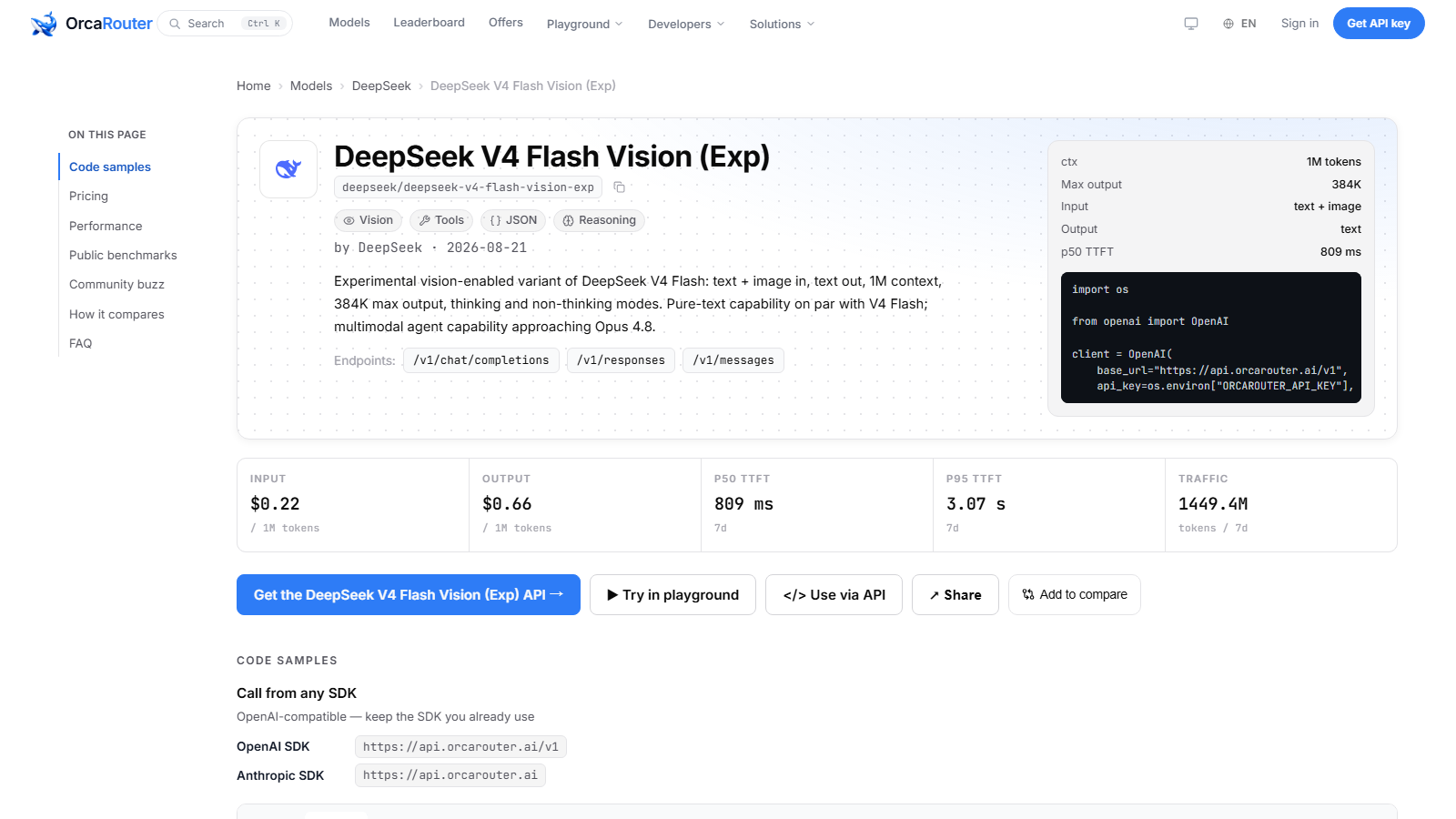
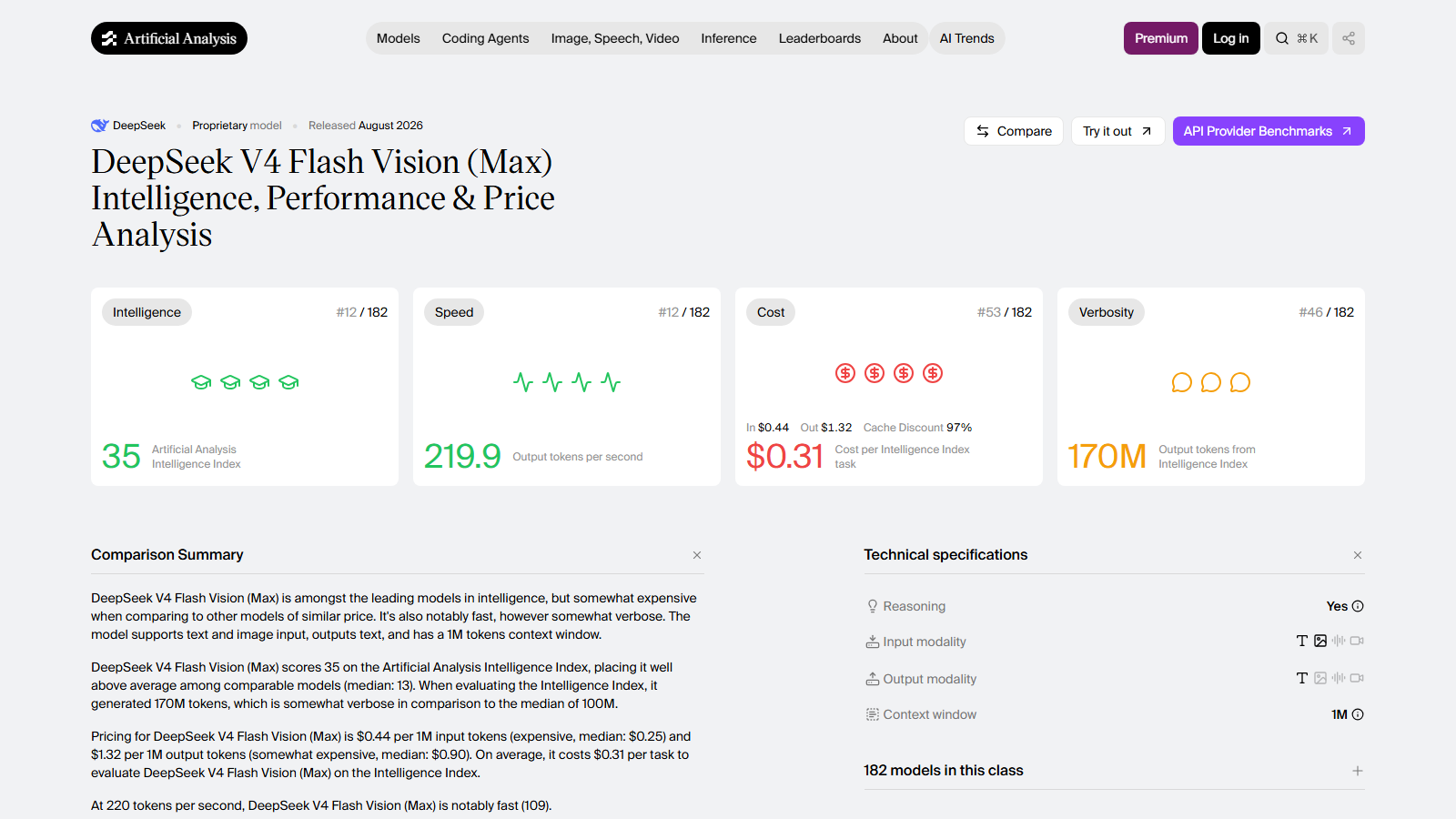
On OrcaRouter we host the DeepSeek V4 Flash Vision (Exp) model — DeepSeek's vision-capable Flash card, shipped on August 21, 2026, priced at $0.22 per million input tokens and $0.66 per million output, with a 1M-token context window and a 384K maximum output. Artificial Analysis scores it 35 at the max reasoning setting with a measured output speed of 220.3 tokens per second. In production its p50 time-to-first-token is 827 milliseconds — a sub-second first token that is rare for any card that also reads images. It is carried at list price on the same key as every other DeepSeek model, with the live telemetry on the linked page.
Eight hundred and twenty-seven milliseconds changes the feel of a vision pipeline in a way spec sheets do not capture, and this article is about why that number matters more than the already-striking price.
What a sub-second first token does for vision
Vision pipelines are latency-heavy in a way text pipelines are not, because the image has to travel, get tokenized and get understood before the answer can start. At 827 milliseconds to the first token, DeepSeek V4 Flash Vision (Exp) makes that whole prelude feel like a cache hit — an image arrives and the model is already answering. That is the difference between a vision feature that feels like an API call and one that feels like a function.
The other half of the feel is the 220.3 tokens per second of measured output. Once the answer starts it streams fast, which matters for vision work because the outputs are long — descriptions, layout reads, extraction, structured reads of a whole screen or document. Fast in, fast out is the combination that makes a sub-$1 card feel like a premium endpoint, and it is the combination most vision cards do not deliver at any price.
A concrete example makes the latency case visible. A document-automation pipeline that inspects an uploaded page, reads its layout and extracts the fields runs on a first-token budget of under a second per page; at 827 milliseconds the inspection step is effectively free, and the pipeline's wall-clock is set by the extraction stream rather than the wait. Against a vision card with a two-second first token, the same pipeline loses more than a second per page before any work begins — on a thousand-page job that is the difference between a batch that finishes in minutes and one that spills past the lunch break. Sub-second first tokens are not a nicety for vision; they are the number that decides whether the feature feels integrated or bolted on.
The vision card on paper
model | context | input / output | AA index (config) | output speed | p50 TTFT
DeepSeek V4 Flash Vision (Exp) | 1M | $0.22 / $0.66 | 35 (max) | 220.3 tok/s | 0.83 s
DeepSeek V4 Pro 0813 | 1M | $0.66 / $1.98 | no page on AA | — | 1.54 s
Gemini 3.5 Flash | 1M | $1.50 / $9.00 | 33 (high) | 197.4 tok/s | 8.21 s
Context windows and rate cards are what the vendors list; the index, output speed and per-task cost are Artificial Analysis's live readings; the TTFT column is production telemetry from the linked pages. Read the table as a buyer and the surprise is that the vision card is not the premium seat — it is the cheapest card of the three, the fastest at first token, and the highest-scoring at the 35 (max) reading. The Pro card costs three times as much with no independent scorecard, and the flagship competitor is nearly seven times the price with a first-token time ten times longer. On this evidence, vision is where the value moved.
The 1.76 billion tokens a week
The production record on the linked page shows 1.76 billion tokens in seven days, which is real usage by any measure — vision pipelines, document reads, screen understanding, image-to-text at scale. Volume like that on an Exp card is itself a finding: teams are not sampling an experimental endpoint, they are running production workloads on it, and the number says the stability has proven good enough to build on. The sub-second latency is not a lab measurement; it is what the fleet actually sees.
The same page's context window explains part of why the volume is vision-shaped rather than text-shaped. At a 1M-token window with a 384K maximum output, the card can take a long document alongside the image it describes, and the 384K output ceiling means the answers themselves can be full transcriptions rather than summaries. Long-form image-to-text at volume — captions for media libraries, structured reads of whole pages, audit trails of screens — is exactly the workload shape that lands on a cheap, fast, high-ceiling card, and it is the shape the 1.76 billion number describes.
The honest caveat that belongs next to the number is the (Exp) suffix in the name. Experimental cards change — DeepSeek iterates on the V4 family by version and date, and an endpoint that is this fast and this cheap today can be superseded or renamed without notice. The 827-millisecond first token and the $0.22 input price are real, but building a production dependency on an experimental nameplate is a decision to make with eyes open.
Reading a card called "Exp"
The discipline this card asks for is the discipline of separating what is proven from what is provisional. Proven: the price, the context window, the sub-second first token and the 1.76 billion weekly tokens — all on the linked page, all measured. Provisional: the name itself. The experiment is the model's official status, not an insult to it; DeepSeek's Flash line has historically shipped experimental tags while iterating toward a stable card, and the vision rung is doing exactly that now.
So the practical answer for a team considering it is straightforward: use it where speed and price are the whole argument — high-volume vision reads, first-pass image understanding, anything where latency is a product feature — and keep a fallback to the Pro card for the workloads that need a settled nameplate. The two cards sit on the same key, and the linked page shows both telemetries to draw the line.
The takeaway
DeepSeek V4 Flash Vision (Exp) is DeepSeek's vision-capable Flash card: $0.22 / $0.66, a 1M context window, a 384K maximum output, an independent score of 35 (max) and a measured output speed of 220.3 tokens per second. Its p50 first token of 827 milliseconds makes it one of the fastest-answering cards we serve, and its 1.76 billion weekly tokens prove production use rather than sampling. The (Exp) nameplate is the honest asterisk: fast and cheap today, provisional by design. If your workload is vision at volume, this is the sub-second card to try — the endpoint is live at list price, and the linked page shows the telemetry to confirm the trade before you commit.
Sourcing note: release date, context window and rate card are what DeepSeek lists and have not been independently reproduced. The Intelligence Index score, output speed and per-task cost are from Artificial Analysis' live model page, read 2026-10-08, and the 35 was measured at the max reasoning setting. The p50 time-to-first-token and seven-day token volume are OrcaRouter production telemetry from the linked model page. All checked 2026-10-08.