6 Best Camping Spots in Colorado Without a Six Month Booking Window
Colorado’s best campsites can disappear before breakfast. Colorado Parks and Wildlife posts more than 4,000 state-park spots six months ahead, and July weekends often vanish in minutes. Yet a 2022 audit found paid sites sitting empty, proving that “sold out” doesn’t always mean full. This guide spotlights six legal, last-minute Colorado campsites you can still book inside 60 days—because they drop day-of inventory, release extra pads two weeks out, or have enough spots that cancellations stick. All facts, fire rules, and fees were verified August 4, 2026; double-check today before you pack the cooler.
At-a-glance: find your best-fit campground

We promised choices, not guesswork. Six options follow, each matched to a different mix of gear, budget and timeline, so read down to the one that fits and jump straight into its deep dive.
Prices show one summer night for two people and exclude park entry, vehicle passes, and platform fees. Always confirm the latest rates and fire rules before you pay.
Six clear paths. Pick your match and keep reading for booking tactics and insider pro tips.
1. Royal Gorge Cabins: best for gear-light glamping

Royal Gorge Cabins luxury glamping tent exterior and interior
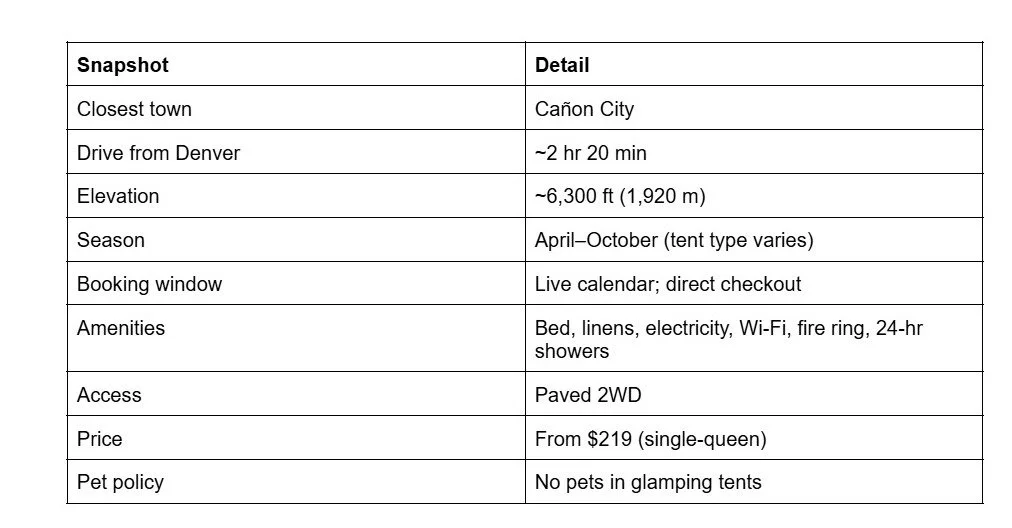
Booking a Colorado luxury glamping tent at Royal Gorge Cabins replaces the sleeping pad with a queen bed dressed in hotel-grade linens plus outlets and Wi-Fi for late-night itinerary checks. Single-queen units start at $219 per night for summer 2026 and sit five minutes from Arkansas River rafting. You’ll sleep on a real bed with hotel-grade linens, charge gadgets from standard outlets, and check trail conditions over Wi-Fi, then step outside to a private fire ring under canyon stars.
This is still camping, just streamlined. Each canvas tent rests on a raised deck, while bathrooms and 24-hour hot showers are in a nearby lodge building. Pets aren’t allowed in the glamping tents, so arrange boarding if Fido is part of your crew.
Why this site stands out
Royal Gorge Cabins deletes the packing list. Park on a paved pull-out, unzip the canvas, and sink into a queen bed already made with hotel linens. Charge your phone from bedside outlets, stream a weather update on campground Wi-Fi, then toast marshmallows at a private fire ring before a 24-hour hot shower, no gear bins required.
Location adds the kicker: the Arkansas River put-in and the Royal Gorge Bridge are a five-minute drive, so you can raft before lunch and sip sunset drinks on your tent deck the same day. The glamping season stretches from April through October, weeks longer than many high-country campgrounds, and single-queen tents start at $219 per night in 2026.
Trade-offs stay clear. That nightly rate rivals four nights in a state-park site, and pets aren’t allowed in glamping tents. If comfort and speed beat cost and canine companionship, this pick removes the most friction for first-time or gear-light campers.
2. Saddlehorn Campground: best for day-of reservations
Perched 1,400 ft above the Grand Valley inside Colorado National Monument, Saddlehorn serves red-rock vistas, star-heavy skies, and a paved approach that spares your suspension. Its power is timing: Loop A sites appear at 8 am the morning you arrive, while most of Loops B and C release exactly 14 days out, giving late planners a real chance at canyon camping.

How to lock a site on release day
Success starts the night before. Sign in to Recreation.gov, load payment details, and bookmark the Saddlehorn page. Inventory appears in two predictable waves:
Recreation.gov Saddlehorn Campground booking page screenshot
14-day tier (Loops B & C) at 8 am MT exactly 14 days before arrival.
Day-of tier (Loop A and sites 52–69) at 8 am on arrival day.
Set an alarm for 7:55 am. Refresh the map until your target site lights up, then select “Add to cart.” Recreation.gov holds the spot for 15 minutes while you check out, plenty of time if you avoid extra tabs. Chase the 14-day tier first; if it disappears, pivot to the day-of list.
Rolling in without a reservation? Arrive before noon on a weekday. The visitor center’s cell signal usually supports a last-minute booking once the clock strikes eight, but weekend pads vanish fast.
Final reminders: wood fires are banned year-round, vehicles over 40 ft exceed the campground length limit, and midsummer highs can reach 95 °F (35 °C). Claim a site early, then plan shady hikes and after-dark stargazing instead of scrambling for relief.
3. Elk Creek Campground: best for reservoir views and RV hookups
Picture Lake Powell scenery at Rocky Mountain altitude. Blue Mesa Reservoir stretches 20 mi (32 km) with 96 mi (155 km) of indented shoreline, and Elk Creek Campground hugs the north bank, so tents and trailers wake to glassy coves instead of asphalt. Standard pads share the view with a full electric loop, so there is no first-come gamble.

Booking tactics for shoreline and powered sites
Elk Creek’s 160-site grid is roomy, but Loop D electric pads disappear first. Filter the Recreation.gov calendar for “Standard Electric” in Loop D; if lake-view weekends are gone, switch to “Standard Nonelectric” and widen your date range. Refresh often because late cancellations spike inside the two-week window: Recreation.gov keeps a $10 fee and the first-night charge for reservations canceled the day before arrival.
Recreation.gov Elk Creek Campground Blue Mesa filters for electric sites screenshot
Flexibility wins. Mid-week gaps linger even in July, and you can stitch two single-night crumbs into a weekend by changing sites. Shoreline cell service is weak, so lock your booking at home and save a screenshot for check-in.
Bringing a boat? Reserve an inspection slot and budget time for the mandatory zebra-mussel check, or you cannot launch. Pack extra stakes; afternoon winds whip across Blue Mesa, so secure the reservation first, then the rainfly.
4. Morefield Campground: best full-service base for a national-park deep dive
Mesa Verde’s cliff dwellings are legendary, yet lodging outside the park is limited. Morefield fills the gap with 267 sites in piñon-juniper forest plus a camp store, coin-op laundry, hot showers, fuel, and grab-and-go breakfast burritos. Sleep under the stars, then roll straight onto the park road for Balcony House or Long House tours without a long commute.

Booking hacks for ruins season
Mesa Verde crowds follow school calendars more than weather. Aim for late May, early June, or mid-September when daytime highs sit in the 70s °F (low 20s °C) and many families have left.
Pick dry sites first. They cost less and stay available longer.
Call after 1 pm if the grid looks full; the camp store often releases same-day cancellations.
Ruin tours complicate timing. Balcony House and Cliff Palace tickets appear on Recreation.gov at 8 am MT exactly 14 days before the tour. Secure your campsite first, then set a phone alarm to grab tour slots. Planning on Wetherill Mesa? That road often closes by early October, so check the park alert page the week you travel.
Altitude at 7,800 ft (2,377 m) dries you out quickly. Pack sun hoodies, hydrate well, and leave afternoons free for a siesta or the campground’s soft-serve window.
5. State Forest State Park: best Colorado-run mix of campsites, cabins, and yurts
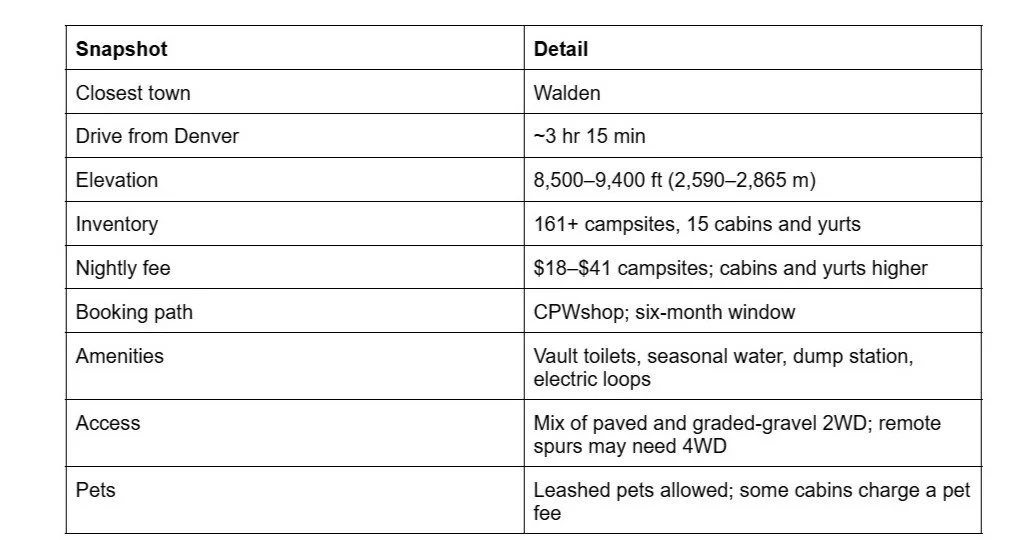
Locals call North Park “Moose World,” and State Forest lives up to the name. More than 161 reservable pads plus 15 cabins and yurts ring alpine lakes, wildflower meadows, and timbered ridges inside one sprawling park.
Unlocking midweek moose sightings and last-minute cabins
Search the whole park. Enter “State Forest State Park” in CPWshop and leave the campground field blank. Sort by “Next available” to spot Tuesday-through-Thursday openings, even in July.
Know where electricity hides. Filter for “Standard Electric” in North Michigan Reservoir and Ranger Lakes. If those loops read full, switch to “Standard” and scan primitive pads near the water; many are a short walk from the lake but skip hookups most RVers need.
Watch the cancellation cliff. CPW keeps a larger slice of your money inside the eight-day window, so check for cabins and yurts reappearing seven to eight days before arrival. Grab what opens, then modify online if a preferred campsite pops up, provided the replacement costs the same or more.
Prepare for altitude mood swings. Afternoon storms sweep through at 8,500 ft (2,590 m); book an electric pad if you rely on medical gear and pack insulating layers. Frost in mid-August is common, and moose often snack in the willows by dinner.
CPWshop State Forest State Park camping search results screenshot
6. Hartman Rocks Recreation Area: best free, designated dispersed option
Picture 14,000 acres of sculpted granite, 45 mi (72 km) of single-track, and high-desert silence, then add 50 numbered, no-fee campsites (one ADA) that need no reservation. Hartman Rocks is a rare BLM playground where “first-come” doesn’t mean guessing; every legal spot is marked with a post.
Hartman Rocks Recreation Area free designated BLM camping near Gunnison

Designated status protects the sagebrush while sparing you generator noise. Aim for a Thursday arrival for the best site choice, cache extra water in town, and avoid spring mud that can trap low-clearance cars.
How we chose these six
First, we built a 100-point rubric that rewards places you can realistically book in 90 days or less.
Availability: 30 pts
Scenery and setting: 20 pts
Nearby activities: 15 pts
Amenities: 10 pts
Access and ADA: 10 pts
Rules and value clarity: 10 pts
Concrete booking hack: 5 pts
Every candidate also had to meet three baseline tests:
Offer short-lead or day-of inventory
Be an official, designated campsite with no gray-area pullouts
Provide a clear draw beyond simple existence (lake recreation, cultural access, gear-free comfort, and similar perks)
Then we applied a diversity filter: one private glamp site, one state park, one true first-come area, at least one lakefront option, and at least one federal short-release campground. The final six cover tents, RVs, cabins, yurts, and primitive pads.
Why we left some beauties out:
Black Canyon South Rim reopened just 25 non-electric sites in 2026, leaving slim late-booking odds
Timber Creek (Rocky Mountain NP) still sells out seconds after release and also adds timed-entry rules
Echo Park is dazzling but requires a steep 4WD road and often bakes in triple-digit summer heat, which feels too niche for most readers
They are all worth visiting, but they do not solve the six-month headache this guide tackles.
How to score a last-minute Colorado campsite
Late booking is not magic; it is pattern spotting. Follow these nine moves and trade a six-month countdown for a one-hour routine.
Target short-release rules. Saddlehorn’s day-of tier and CPW’s rolling cancellations routinely beat six-month lotteries.
Shop mid-week first. Even in July, Sunday–Thursday gaps linger when Friday–Saturday are solid red.
Link single-night crumbs. Two back-to-back one-night openings in the same loop are often easier to land than a two-night block. Move pads once and you are set.
Watch the penalty cliffs. CPW keeps more of your money inside the eight-day window and again inside 24 hours. Recreation.gov forfeits the first-night fee if you cancel after midnight two days out, so check those windows for fresh openings.
Split by site type. Electric, standard, and tent-only pads live in separate buckets. Do not overlook a tent pad just because you filtered for hookups.
Set real-time alerts, and act fast. Recreation.gov texts you the minute a site opens, but the hold lasts only while you pay. Keep autofill ready.
Build a three-layer backup chain. Primary reservation, nearby paid overflow, then a legal first-come area such as Hartman Rocks.
Screenshot everything. Dead zones swallow confirmation emails; an offline image proves you paid and shows your site number after dark.
Recheck fire and road alerts the morning you leave. Stage II bans and flash-flood closures can change overnight, so trust today’s official notice, not last week’s Reddit thread.
FAQs
Can I have a campfire?
Only if current land-manager and county rules allow it. Wood fires are banned year-round at Saddlehorn, and Stage II restrictions can snuff charcoal overnight, so check the official alert page the morning you depart.
Does a campsite reservation double as park entry?
Sometimes, but not always. A Saddlehorn booking does not cover Colorado National Monument’s entrance fee, and Rocky Mountain’s timed-entry permit still applies to the Bear Lake corridor. Read the fine print for your specific park.
Which finalist is most dog-friendly?
State Forest wins for trail freedom and pet-friendly cabins. Royal Gorge’s glamping tents are pet-free, and Saddlehorn confines dogs to paved areas only.
Will I get cell service?
Signal is strong at Royal Gorge and in Fruita or Gunnison, but it fades inside Mesa Verde’s canyons. Download maps and emails before you lose reception.
Is altitude sickness a real risk?
Yes. Elk Creek and State Forest both sit above 7,500 ft (2,286 m); headaches, poor sleep, and nausea are common the first night. Hydrate, limit alcohol, and ascend gradually.
What if I arrive late to a first-come site?
At Hartman Rocks the post is yours only while you occupy it. Leave the pad overnight and someone else can claim it.
Where can I refill water at free sites?
Top off jugs in Gunnison, Walden, or at a paid campground on the way. Hartman Rocks has no spigots, and desert springs are unreliable.
The takeaway
Colorado camping is not reserved for people who lock in summer plans on New Year’s Day. Combine short-release tactics with a three-layer backup plan and you can claim a riverside tent pad, a Wi-Fi equipped glamping suite, or a free granite perch under high-altitude stars, often in less time than it takes to pack the cooler.
Match the pick to your style, then set an alert:
Royal Gorge Cabins for zero gear and hotel-grade linens
Saddlehorn for day-of canyon vistas
Elk Creek for shoreline hookups and kayak launches
Morefield for cliff-dwelling tours plus hot showers
State Forest for moose, cabins, and yurts
Hartman Rocks for free single-track mornings and granite sunsets
Bookmark this guide, refresh the calendars, and start planning dinner beneath Colorado’s thin-air sky. No six-month countdown required.