5 U.S. Cities Where Luxury Living Meets Smart Investment in 2025
Where High Design, High Yield, and High Living Converge
Luxury real estate in 2025 is defined by two powerful forces: elevated living and intelligent financial strategy. Buyers at the high end of the market increasingly want more than architectural excellence—they want assets that appreciate, cities with diversified economic fundamentals, and markets that deliver tax advantages, liquidity, and long-term resilience. Today’s luxury consumer expects a property to reflect not just their style but also their ambitions, financial planning, and global mobility.
Across the United States, a new class of luxury cities is emerging—metros where strong economic outputs, sophisticated design cultures, and global demand intersect to create high-performance markets. These destinations are attracting the world’s most discerning buyers, offering not only exceptional lifestyle amenities but also measurable investment advantages. For OffTheMrkt.com’s readers, these are the five U.S. cities where luxury living truly meets smart investing in 2025.
1. Las Vegas, Nevada — The New Capital of Luxury and Tax-Free Investing
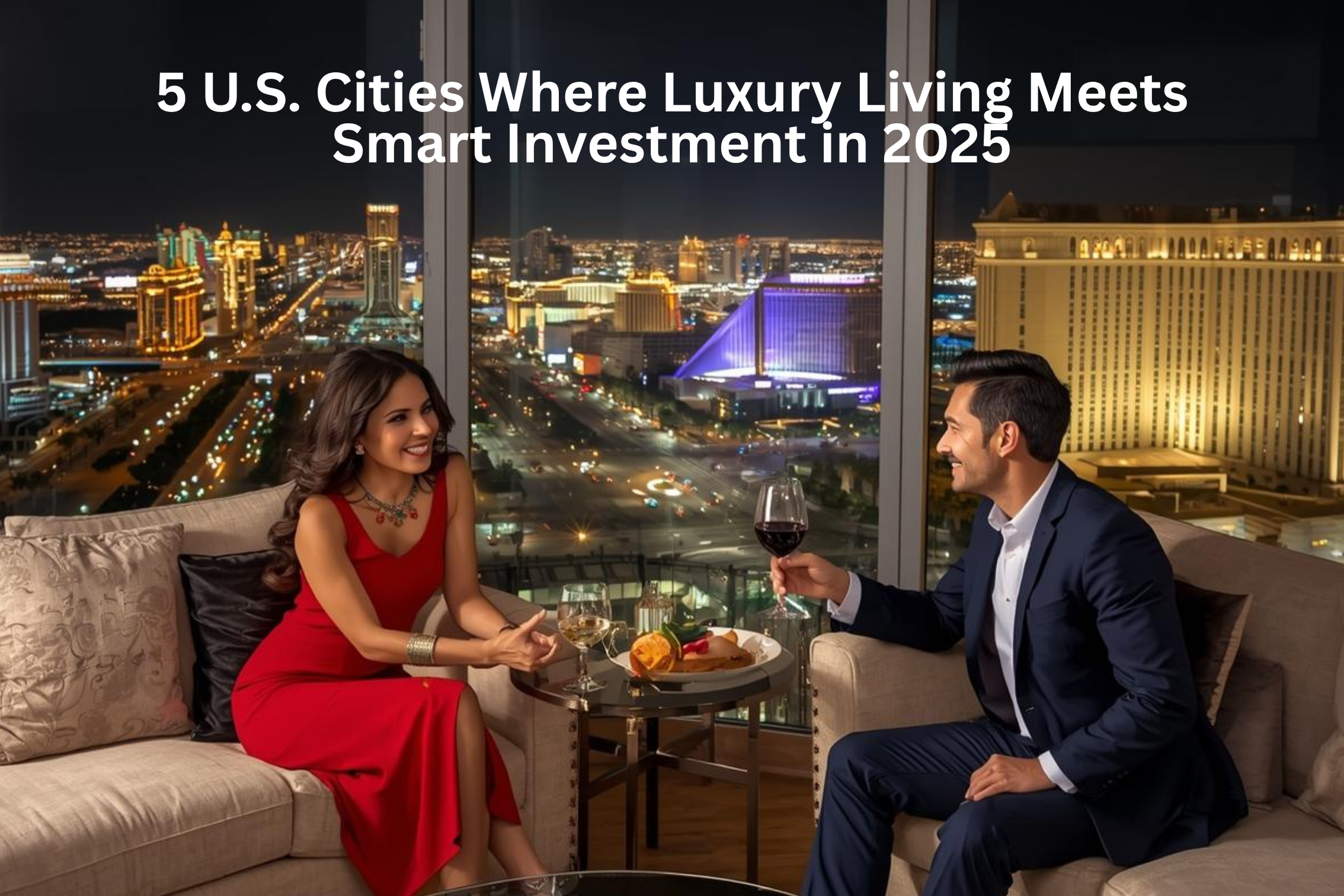
Las Vegas has transformed from an entertainment-driven market into one of the country’s most strategically advantageous luxury real estate hubs. High-net-worth buyers from California, New York, and Chicago are shifting capital into Nevada, driven by zero state income tax, low property taxes, and strong rental performance. The market’s evolution is anchored by world-class residential towers, upscale master-planned communities, and a rapidly expanding luxury buyer demographic. This shift has boosted the 1031 exchange real estate Las Vegas sector, allowing investors to reposition wealth efficiently while improving yields.
The Vdara Residences symbolize the city’s hybrid luxury-investment appeal: LEED Gold certification, hotel-grade services, Strip views, and rental flexibility that routinely pushes occupancy above 70%. Investors combining short-term personal use and professionally managed rentals often achieve 5% cap rates—rare for a luxury hospitality product. Las Vegas’ median home price remains accessible at $465,000, while luxury assets outperform national averages due to sustained in-migration, diversified job growth, and rising international interest.
Market Highlights
Median home price: $465,000
Luxury rental yields: 7–9%
Vdara cap rates: approx. 5%
Annual population growth: 2.3%
State income tax: 0%
2. Miami, Florida — Where Global Wealth Finds Its Shoreline
Miami remains one of the most liquid, globally recognized luxury markets in the world. Its waterfront skyline continues to attract international capital from South America, Europe, Canada, and Asia. In 2024, foreign buyers contributed more than $15 billion in property transactions, making Miami the top U.S. gateway for international luxury investment. Climate, tax advantages, and 25 million annual visitors fuel demand for both primary and secondary residences, driving consistent absorption even as new towers reshape the skyline.
Architectural icons—including Waldorf Astoria Miami, Aston Martin Residences, and Baccarat Residences—reflect the city’s design-forward identity. These branded towers offer private wellness clubs, curated dining, and waterfront amenities that rival global capitals such as Dubai and Singapore. Miami’s luxury rents remain strong, with ROI on high-end rentals averaging 8–10%. Investor ownership exceeds 60% in key Downtown districts, ensuring liquidity and continuous resale demand. The combination of cultural vibrancy, global reach, and high-yield performance makes Miami uniquely resilient.
Investment Insights
Median condo price: $520,000
Average luxury rental ROI: 8–10%
Downtown investor ownership: approx. 60%
Annual visitors: 25 million
Foreign buyer contribution (2024): $15 billion+
3. Austin, Texas — The Creative Capital of Innovation
Austin has rapidly evolved into a luxury market powered by technology, creativity, and a high-skilled workforce. Between 2019 and 2024, the city’s GDP surged 52%, fueled by expansions from Tesla, Apple, Oracle, and dozens of leading startups. This economic acceleration has pushed demand for luxury residences, particularly modern estates, glass-wrapped downtown towers, and boutique multifamily properties. Remote work migration has also brought affluent professionals from Los Angeles, San Francisco, and Seattle, increasing the buying pool and driving steady annual appreciation.
Architecturally, Austin blends biophilic modernism with Texas heritage—producing estates that emphasize natural materials, wellness design, and indoor-outdoor integration. Investors benefit from Texas’ no-income-tax advantage and a healthy rental market supported by job growth of 4.2% in 2025. Median home prices hover around $540,000, while multifamily vacancy remains under 6%, indicating durable rental demand. Austin’s combination of cultural relevance, economic output, and lifestyle appeal continues to position it as one of the most future-proof luxury markets in the country.
Key Stats for Investors
Median home price: $540,000
Job growth (2025): 4.2%
Multifamily vacancy: under 6%
GDP growth (2019–2024): 52%
No state income tax
4. Denver, Colorado — The Elevated Model of Modern Sustainability
Denver has become a magnet for luxury buyers seeking stability, wellness integration, and sustainable design. Its luxury aesthetic emphasizes natural materials, floor-to-ceiling mountain views, and high-efficiency systems. Neighborhoods like Cherry Creek North, LoHi, and the Golden Triangle combine luxury retail, fine dining, and boutique fitness, creating refined enclaves with strong resale performance. Denver’s position as a gateway to the Rockies enhances demand: within 60 minutes, residents can access ski slopes, mountain trails, and national parks, all of which elevate quality of life and property desirability.
Investment fundamentals in Denver remain exceptionally strong. Median home values sit around $585,000, with multifamily occupancy exceeding 95% and cap rates ranging from 4.6% to 5.8%. Median rents average $2,050 per month, supported by a robust economy driven by aerospace, renewable energy, digital media, healthcare, and federal research institutions. The city has invested more than $1 billion in sustainable transit and urban improvements, reinforcing long-term appreciation potential. Denver’s combination of predictability, environmental strategy, and lifestyle access creates a luxury market engineered for longevity.
Investor Benchmarks
Median home price: $585,000
Cap rates: 4.6–5.8%
Multifamily occupancy: 95%+
Median rent: $2,050
Investment in sustainable transit: over $1 billion
5. San Diego, California — The Soulful Side of Coastal Luxury
San Diego is one of the most balanced coastal luxury markets in the United States, offering strong fundamentals, exceptional climate, and consistent buyer demand. With 266 days of sunshine annually and a GDP exceeding $290 billion, the region benefits from a highly educated workforce and industry clusters in biotech, life sciences, research, defense, and tourism. Luxury properties in La Jolla, Del Mar, Encinitas, and Coronado emphasize light-filled design, high-efficiency systems, and indoor-outdoor flow. These attributes create emotionally compelling homes that maintain long-term value.
The city’s luxury market benefits from limited inventory growth—new construction rarely exceeds demand, protecting values even in shifting markets. Median home prices average $880,000, while median income in the metro exceeds $102,000. Rent growth stands at 6% year-over-year, supported by high-paying professional industries. San Diego’s cultural and wellness amenities—from surf culture and coastal dining to art districts and boutique wineries—further enhance lifestyle value and investor appeal. For buyers seeking both stability and serenity, San Diego remains unparalleled.
Market Indicators
Regional GDP: $290 billion
Median home price: $880,000
Median household income: $102,000
Rent growth: 6% annually
Annual sunshine: approx. 266 days
2025 Emerging Trends in Smart Luxury Real Estate
Luxury buyers are no longer motivated by aesthetics alone; they are increasingly prioritizing financial efficiency, environmental sustainability, and lifestyle depth. The rise of tax-advantaged strategies such as Vdara Residences shows how wealth structuring now shapes market selection. Hybrid ownership models—including branded residences and hotel-managed condo systems—have expanded the definition of luxury by combining hospitality, passive income generation, and flexible usage. Demand for ESG-certified and wellness-integrated luxury residences continues to accelerate, influencing both new construction and resale competitiveness.
Top Trends
Rising use of tax-efficient strategies such as 1031 exchanges
Hybrid ownership gaining popularity (hotel-branded luxury properties)
Sustainability and ESG driving value and resale performance
Experience-rich neighborhoods outperforming traditional suburbs
AI-driven real estate analytics reshaping investor decision-making
The finest luxury markets of 2025 share a common truth: they make wealth feel purposeful. The destinations featured here offer more than appreciation; they deliver cultural depth, emotional resonance, and economic intelligence. Las Vegas merges tax strategy with architectural innovation. Miami combines global liquidity with world-class design. Austin pairs creativity with economic strength. Denver unites wellness with sustainable appreciation. San Diego blends coastal serenity with long-term financial resilience.
For luxury investors seeking lifestyle and legacy, opportunities like 1031 exchange real estate Las Vegas and turnkey hybrid assets such as the Vdara Residences represent the future of high-performance real estate. These cities don’t merely grow wealth—
they build generational identity and enduring value.