Small Craft Businesses Keep Reaching for CO₂ Laser Engravers

Small craft businesses need equipment that handles detailed work without slowing production. CO₂ laser engravers meet that need by cutting and engraving materials such as wood, acrylic, leather, and paper. Their focused beam creates clean edges and fine details across repeated jobs, which helps makers maintain consistent results as orders increase. 

The right machine also supports practical decisions about workspace, power, safety, and maintenance. Those factors explain why CO₂ systems remain a common choice for growing craft operations.

Why CO₂ Lasers Fit Craft Production

Craft businesses often work with flat sheets and blanks that require accurate cutting or personalization. A CO₂ laser directs a focused beam through mirrors and lenses, concentrating energy on a precise point. The machine then cuts or engraves the selected material according to a digital design.

A high-precision CO₂ laser cutter for engraving gives makers a practical way to produce signs, ornaments, panels, gifts, and packaging components. The beam handles detailed lines and lettering while maintaining consistent placement across repeated pieces. That repeatability matters when a small shop moves from one custom order to a batch of similar products.

CO₂ systems suit non-metallic materials, including wood, acrylic, leather, and paper. They are not recommended for cutting metal or plastics, so each business should match the machine to its material list before purchasing.

Detail and Repeatability Matter

Hand tools can handle occasional adjustments, but they create variation across multiple pieces. A laser engraver follows the same design path each time, which keeps lettering, borders, and decorative patterns consistent. That consistency reduces rework and makes quality checks easier.

Engraving also supports small details that are difficult to produce with manual methods. A focused beam can create fine marks on suitable surfaces without requiring a separate template for every item. Craft sellers can use the same file for product personalization, seasonal designs, and limited runs.

Cutting accuracy matters just as much as engraving detail. Clean edges reduce the time needed for sanding or trimming, especially when a product includes several fitted parts. A well-matched machine helps a shop keep those parts consistent across an order.

Match Machine Capacity to the Work

The product range inspected for this article includes five CO₂ machines with power ratings of 30 W, 55 W, and 60 W. The listed models include desktop equipment and larger systems, giving businesses different options for available space and expected workloads.

A desktop unit suits a shop that has limited floor space or produces smaller items. Larger equipment is better suited for businesses that require more working area or handle more frequent cutting jobs. The best choice depends on the dimensions of typical materials, rather than maximum size alone.

Power also affects how a machine approaches cutting and engraving tasks. A business should compare the required material thickness, design detail, and order volume with the machine’s stated specifications. Reviewing those needs first prevents a shop from paying for capacity it rarely uses.

Build a Safer Daily Workflow

A CO₂ laser cutter contains the beam path inside the machine, and listed safeguards shut the engraver down when the lid opens. These protections reduce the risk of exposing skin or eyes to the laser. Protective eyewear remains recommended as an additional precaution.

Ventilation and workspace planning also deserve attention. The machine should sit on a stable surface with enough room for loading materials, checking finished pieces, and completing routine cleaning. Operators should follow the manufacturer’s operating and maintenance instructions for the selected model.

Maintenance protects accuracy over time. Mirrors, lenses, and the cutting area require regular inspection because residue can affect beam focus and finished edges. A simple cleaning schedule helps the business spot problems before they interrupt a customer order.

Use Software and Materials Carefully

A clean design file supports clean output. Operators should check dimensions, line settings, and engraving areas before sending a job to the machine. A small test piece confirms the selected settings before valuable material enters production.

Different materials respond differently to heat. Wood, leather, paper, and acrylic each produce distinct cutting and engraving results, so a shop should test unfamiliar stock before selling finished items. Testing also helps reveal smoke marks, edge changes, or detail loss.

A production record can improve repeat orders. Recording the material type, design size, and successful machine settings gives operators a reliable reference for future jobs. That record reduces trial work and supports more consistent dispatch times.

Conclusion

CO₂ laser engravers suit craft businesses that need repeatable detail, clean cuts, and practical material flexibility. A careful purchase starts with the shop’s product dimensions, material types, order volume, and available workspace. Safety features, maintenance access, and test runs deserve equal attention after installation. 

Before choosing a machine, each business should list its most common jobs, measure its largest materials, and compare those needs against available power and working capacity. That process leads to a more useful purchase and steadier production.


/
script>

How Sun Exposure Changes Exterior House Paint Colors Before You Buy

You painted a six inch square of "Coastal Fog" on your garage wall on Saturday morning, loved it, and by Thursday you were standing in the driveway wondering who chose that washed out pale green. Nobody chose it. The sun did. Light can shift how a color reads by several shades depending on what time you look and which side of the house you are standing on, and that gap between the chip and the wall is where most repaint regrets are born.

The fix is not complicated, but it does take more than one trip outside. You have to watch a color across a full day before you trust it. Good Exterior House Paint Colors get chosen in the driveway and the backyard, not at the paint counter under fluorescent tubes. It is the same whether you are brushing on latex or going with a coating system, because the pigment and the sun do not care who applied it.

Here is what most people skip: they judge the chip indoors, under a store light, then feel betrayed when the same chip looks flatter outside. Once you know the mechanics, the guessing mostly stops.

Why a color looks different on every wall

Sunlight is not one color. Early morning and late afternoon light leans warm, throwing gold into everything it touches. Midday light is cooler and more neutral, which is when a lot of people finally see what they actually bought. A north facing wall never catches direct sun, so it sits in cool, bluish shade and will make a warm beige look almost gray. The same beige on a west facing wall gets hammered by afternoon sun and can turn up three shades lighter.

The materials under the paint matter too. Stucco soaks light in and scatters it. Smooth siding bounces light back at you. Paint both the same color and they will not match by the end of the day. This is why a color that looks rich and deep on a neighbor's wood sided house can look thin and cheap on your stucco. Nothing is wrong with the paint. The surface is doing the talking.

Intensity plays a role as well. Sun can bleach out saturation on a surface sitting in direct light for eight hours, which is why a saturated terracotta you loved in the store might read as pale clay on your front wall. 

According to the National Weather Service, different regions of the country get wildly different amounts of annual sunshine, and that is a real factor in how stable any color looks over time. You can check your own area's typical conditions before you commit to something dramatic.

What to do before you buy a single gallon

Get samples, and get more than you think you need. Then follow this order, because skipping steps here is what costs you a second repaint.

  1. Photograph every fixed element first: roof, stone, brick, pavers, window frames, gutters, and any metal trim. Do it in flat daylight, not at golden hour.

  2. Pick out the undertone in each one. That tan roof tile may be leaning peach, gold, or gray even if you would just call it brown.

  3. Choose a body color family that relates to those undertones without matching them exactly.

  4. Add a trim color and exactly one accent. One. Two accents is how a house starts to look like a carnival tent.

  5. Paint large samples, at least two feet square, on two different sides of the building.

  6. Look at them at 8 a.m., noon, and 5 p.m. If you hate the color at any one of those times, it is the wrong color.

I will plant a flag here: two foot samples, not the little store cards. The cards are too small for your eye to judge scale against the rest of the house, and they will lie to you. Watching the light shift on something a few feet wide, you learn things no chip can tell you.

A framework I use: the fixed anchor method

I call it the fixed anchor method because it starts from the parts of your home you cannot afford to change. Your roof, brick, stone, driveway, and window frames are anchors. They are locked in, and your color scheme has to live with them. The rule is simple. The largest and most expensive anchor sets the temperature for everything else. If your roof is the dominant element and its undertone is warm, your body color should share that warmth or gently contrast it. Then your trim and your single accent are chosen last, because they are the smallest visual players.

The mistake is reversal. People pick a front door color, fall in love, then try to make a whole exterior orbit around it. The door is a tiny piece of the composition. It should never be the anchor. One more thing people forget: your exterior is not just a paint decision. If your goal is also lowering heat gain, the pigment you pick interacts with how the surface reflects light, and the Environmental Protection Agency's Energy Star program has useful background on how exterior surface choices affect home energy use. Worth a look if you live somewhere that bakes in July.

How to test a scheme without living with a mistake

Try a three color plan on paper before you open a can. Body color covers most of the wall. Trim outlines the architecture and separates it from the sky. Accent guides the eye to one spot, usually the entry. That is the whole structure, and it works on nearly every style of home.

Check your test panels at three different times of day and write down what you see. Literal notes: "8 a.m. warm, noon slightly yellow, 5 p.m. looks gray." If the notes contradict each other badly, the color is unstable on your wall and you should keep looking.

Neutral palettes are the safer bet for a long term decision, and there is a reason: a color that behaves consistently across light conditions will look intentional for years. A trend color is a bet that you will still like it in five years, and most people do not. The National Institute of Standards and Technology maintains color and appearance measurement standards that paint manufacturers rely on, which is a long way of saying color consistency is a science, not a mood.

So my honest advice, after seeing plenty of these projects: default to a balanced neutral body, a soft ivory trim, and one bronze or charcoal accent. It reads clean, it works in strong sun, and it will not embarrass you when you pull into the driveway next spring. Walk your house at three times of day before you buy paint. Your wall will tell you what the chip never could. What is the one color you keep coming back to, and have you actually seen it at sunset yet?

/
script>

How to Choose a Signature Fragrance by Scent Family, Mood, and Occasion

Key Takeaways

  • A signature fragrance should suit your preferences, routine, and comfort level.

  • Scent families make it easier to narrow a large selection into a few promising styles.

  • Perfume changes from the first spray to the dry-down, so skin testing matters.

  • Weather, setting, and desired mood can help guide your choice.

  • A small rotation of fragrances can be more practical than one scent for every situation.

  • Samples and travel sizes are useful before committing to a full bottle.

Table of Contents

  1. What Makes a Signature Scent Feel Personal?

  2. Start With Scent Families

  3. Match Fragrance to Mood

  4. Choose a Scent for the Occasion

  5. Test Fragrance the Right Way

  6. Compare Fragrance Strengths

  7. Build a Simple Fragrance Wardrobe

  8. Avoid Common Buying Mistakes

  9. Create a Personal Testing Routine

  10. Final Thoughts

What Makes a Signature Scent Feel Personal?

A signature scent is simply a fragrance that feels recognizably like you. It may be the perfume you wear most days, the one people associate with you, or a dependable scent you reach for when you want to feel put together. Exploring a mystical perfume collection can be a useful reminder that fragrance is not only about smelling pleasant. It can also be about memory, mood, ritual, and personal style.

The best signature fragrance is rarely chosen because it is popular or expensive. A clean citrus scent may feel right for someone who wants clarity and energy, while a soft musk may feel more natural for someone who prefers a quiet, close-to-the-skin presence. You can also treat a signature scent as a small group of familiar options rather than one bottle worn in every setting.

For example, you might choose a subtle woody musk for the office and reserve a warmer amber fragrance for dinners or evenings out. Both can feel authentic to your style because they serve different parts of your routine.

Start With Scent Families

When a perfume counter or website feels overwhelming, scent families provide a helpful starting point. A fragrance wheel organizes related scent styles so you can compare broad impressions before trying individual perfumes. You do not need to memorize every note. Start by noticing the categories that sound appealing.

  • Fresh: Citrus, green, watery, aromatic, or crisp impressions that often feel bright and airy.

  • Floral: Profiles centered on flowers such as rose, jasmine, iris, orange blossom, or tuberose.

  • Woody: Cedar, sandalwood, vetiver, pine, and earthy materials that can feel dry, smooth, or grounded.

  • Amber: Warm, resinous, sweet, smoky, balsamic, or vanilla-like compositions.

  • Fruity: Juicy, tart, soft, or jammy fruit impressions that can add brightness and playfulness.

  • Spicy: Pepper, cardamom, cinnamon, clove, and aromatic notes that bring warmth or contrast.

  • Musk: Smooth, powdery, clean, soft, or skin-like effects that often sit close to the body.

Match Fragrance to Mood

Fragrance cannot create a personality, but it can support the feeling you want to bring into a day. Fresh citrus, tea, and green notes can suit a focused morning or a warm afternoon. Gentle florals and soft musks may feel calming when you want something personal rather than attention-grabbing.

For a more assured or cozy mood, look toward woods, spices, amber, and deeper vanilla styles. The goal is not to follow rigid rules. If a bright floral makes you feel confident at night, or a smoky wood feels perfect on a rainy morning, that response matters more than traditional fragrance advice.

Choose a Scent for the Occasion

Think about the space you will share with other people and how long you expect to wear the fragrance. A scent that feels beautiful on a night out may be too strong for a small office, a long flight, or a medical appointment.

  • Work and shared spaces: Choose balanced, moderate scents such as clean musks, light woods, tea notes, or soft citrus.

  • Daytime errands: Fresh, fruity, floral, and lighter woody fragrances can feel easy and adaptable.

  • Date nights: Consider smoother, warmer, or more textured scents with amber, woods, spice, or floral depth.

  • Formal events: Choose something polished and familiar that remains noticeable without filling the room.

  • Travel: Bring a small format and apply lightly, especially in enclosed spaces.

Test Fragrance the Right Way

A note list can suggest a perfume's direction, but it cannot tell you exactly how it will feel on your skin. Perfume is commonly described in terms of an opening, a middle development, and a later dry-down, so the first few seconds are only part of the experience.

  1. Start with no more than two or three fragrances on skin at one time.

  2. Spray each option on a separate wrist or inner elbow, then avoid rubbing it in.

  3. Notice the scent after about 15 minutes, again after an hour, and later in the day.

  4. Pay attention to comfort as well as smell. A fragrance should not feel distracting or overwhelming.

  5. Wear your favorite candidate's shirt on an ordinary day before purchasing a large bottle.

Compare Fragrance Strengths

Labels such as eau de toilette, eau de parfum, parfum, cologne, body mist, and hair fragrance can help set expectations, but they do not guarantee a fixed level of longevity or projection. Formulas differ, and skin moisture, heat, humidity, clothing, and application amount all affect how a scent wears.

In general, lighter formats can be convenient for hot weather, exercise, and close spaces. Richer formulas may feel more satisfying in cool air or when worn in the evening. Rather than assuming one concentration is better, choose the format that fits the situation and your desired intensity.

Build a Simple Fragrance Wardrobe

You do not need a crowded shelf to have options. A simple fragrance wardrobe can make daily choices easier while allowing your scent to match the season, setting, and mood.

  • Everyday scent: A comfortable fragrance that works for your regular routine.

  • Warm-weather scent: A brighter, lighter option for heat and outdoor time.

  • Evening scent: A richer fragrance for dinners, celebrations, or colder months.

  • Comfort scent: A familiar choice you wear at home or whenever you want a sense of ease.

Avoid Common Buying Mistakes

One of the most common mistakes is buying a fragrance based only on online popularity, packaging, or a quick spray on paper. Blotters are useful for an initial comparison, but they cannot show how a perfume develops on you over time.

Also, avoid testing too many scents in one visit. Your sense of smell can become fatigued, making different perfumes harder to distinguish. Do not assume strong projection means high quality, and do not ignore headaches, irritation, or discomfort. If a fragrance does not feel good to wear, it is not the right choice for you.

Create a Personal Testing Routine

  1. List five smells you already enjoy, including perfumes, candles, soaps, foods, or outdoor scents.

  2. Look for recurring qualities, such as citrus, rose, vanilla, woods, spice, or clean musk.

  3. Choose two scent families that match those preferences.

  4. Sample three fragrances from each family over several days.

  5. Keep brief notes on comfort, mood, performance, and whether you wanted to smell the fragrance again.

  6. Choose the option that remains enjoyable after repeated wear, not just the one with the most dramatic first impression.

Final Thoughts

Choosing a signature fragrance does not require expert vocabulary or strict rules. Begin with scent families, consider your mood and setting, and give each promising option enough time on skin. Whether you settle on one reliable bottle or rotate a few favorites, the right fragrance is the one that continues to feel comfortable, expressive, and genuinely yours.

/
script>

Why East London's After-Dark Scene Is Pulling Crowds Away From the West End

The once under-the-radar realm of 23 Paul Street and its surrounding districts in East London are now basking in the limelight as more and more nightlife enthusiasts venture beyond the time-honoured West End. Undoubtedly, East London has been making waves in recent years, with its vibrant cultural renaissance inviting locals and tourists alike to explore an after-dark scene that feels both innovative and authentic. What is driving people to swap the West End for East London’s alluring night-time offerings? Let’s uncover five compelling reasons.

Authenticity and Diversity

East London’s nightlife is unmistakably diverse. With a rich tapestry of cultures all converging in this part of the city, the offerings are naturally eclectic ranging from hip vegan bistros and rustic pubs to late night jazz bars and underground DJ sets. This diversity ensures that there is something for everyone, and more importantly, it captures a sense of authenticity that many argue the West End is slowly losing amidst its increased commercialisation. East London’s venues have a palpable, creative edge where eclecticism isn’t just accepted; it’s celebrated.

Innovation in Dining and Drinks

East London isn’t afraid to break the mould. Innovation here isn’t just a buzzword; it’s a way of life. This can be seen in the experimental concoctions coming out of cocktail bars, pop-up dining experiences, and fusion cuisines that challenge traditional boundaries. The emphasis is on the novel and the unexpected, with chefs and mixologists pushing the envelope to create memorable experiences for their patrons. It’s a haven for foodies and beverage aficionados who are seeking something more than just the standard fare.

Thriving Local Art Scene

The thriving art scene in East London serves as the backbone for its dynamic nightlife. Galleries and studios are just as alive after dark, often doubling up as event spaces hosting live music gigs, open mic nights, and immersive art installations. These venues provide not just entertainment, but a sense of community and collaboration that feels refreshing. Artists, musicians, and creatives come together to produce a holistic nightlife experience that is not just about leisure, but also about cultural enrichment.

Locally-Owned and Operated Venues

In East London, many of the bars, clubs, and performance spaces are locally owned and operated, fostering a strong sense of community and local support. This stands in stark contrast to some of the chain establishments that dominate areas like the West End. The owners often involve themselves directly with their patrons, creating a personal touch you won’t easily find in a commercialised setting. By frequenting these venues, visitors are not only enjoying an evening out—they’re supporting the local economy and contributing to keeping East London’s unique charm alive.

Affordability and Accessibility

One cannot ignore the affordability factor when comparing East London to its Western counterpart. With drink prices and cover charges often considerably lower, East London’s nightlife is more accessible to a wider crowd, including students and younger professionals who may be priced out of the West End. Furthermore, the transport links in and around East London have improved, making it easier than ever to hop between hotspots without hassle.

As East London continues to expand its influence over the city’s nighttime economy, it’s easy to see why many are turning their backs on the traditional allure of the West End. With its authenticity, creativity, and community-driven ethos, East London offers a night out that feels both intimate and exciting. Whether you’re a first-time visitor or a long-standing Londoner, East London’s after-dark scene invites you to step into a world where the unexpected is just a street away.

/
script>

Where to Stay for Business in Shenzhen: Futian vs Nanshan

Futian or Nanshan. Choose wrong and Shenzhen traffic can steal an hour from every workday. If you need finance, government, or a mixed itinerary, Futian is your shortcut. If you're spending the week inside the west-side tech corridor, Nanshan wins. Pin your meetings first, pick the closest metro stop next, then book. Once those pins are locked, check live prices for Shenzhen business hotels on Trip.com and land knowing every commute is measured in minutes, not miles.

The 30-second answer

Shenzhen Futian and Nanshan business skyline at dusk

If your agenda jumps among several districts, stay in Futian. The CBD puts you 14 minutes from Hong Kong's West Kowloon by high-speed rail and a short hop from Huanggang's 24-hour checkpoint.

Pick Nanshan only when most meetings are in High-Tech Park, Houhai, Shenzhen Bay, or Qianhai, and when trimming the airport ride to about 20 minutes on Line 11 matters more than late-night border access.

Still undecided? For a first three-day trip, choose Futian, skip the daily commute, and use the saved hour with clients instead of in taxis.

How to choose the right Shenzhen business district

1. Count the repeat meetings first

Circle every appointment that happens twice or lasts more than an hour. If roughly 60 percent of those pins fall in one district, stay there and let the one-off dinners or briefings take the taxi ride.

2. Verify the exact event venue

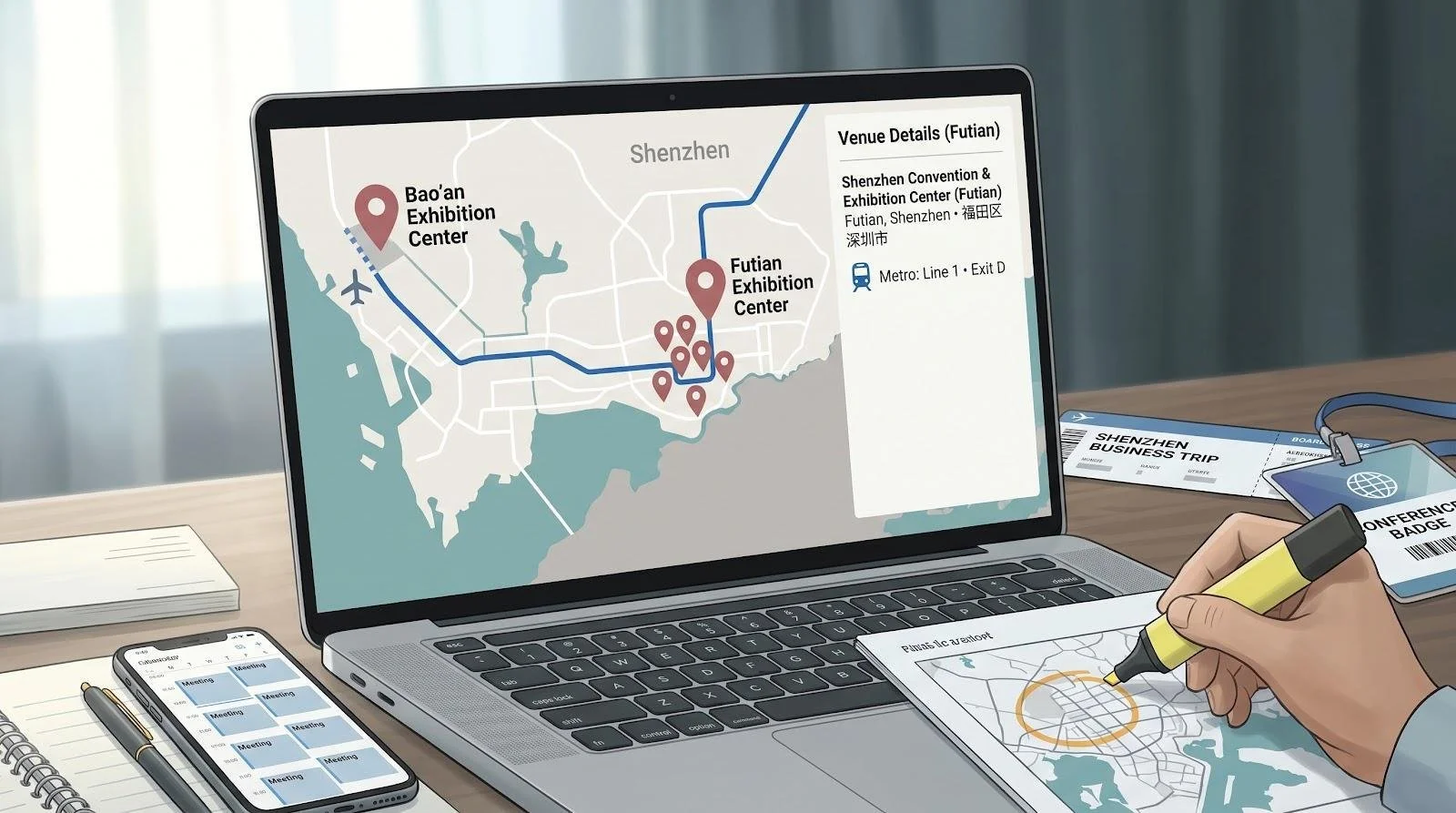
Shenzhen has two similarly named exhibition centers. One sits downtown in Futian; the other spreads next to the airport in Bao'an, about 40 minutes west by rail. Read the invitation for the district + metro station + full address.

Trip.com's venue pages display both the Chinese and English addresses, flag whether the hall sits in Futian or Bao'an, and embed a metro-overlay map with the nearest exits marked.

Spend 30 seconds on that page and you'll dodge the classic mistake of booking a Futian hotel for an airport-side exhibition hall.

Two minutes of checking now can save two hours of cabs later.

3. Match the Hong Kong crossing to your clock

  • West Kowloon HSR: 14 minutes from Futian Station
  • Futian Checkpoint: 6:30 am–10:30 pm rail link
  • Huanggang: 24-hour clearance for red-eye returns
  • Shenzhen Bay: 6:30 am–midnight, ideal for Nanshan and western Hong Kong

Pick the crossing that aligns with both your meeting time and your Kowloon address.

4. Factor in the airport runs

Line 11 takes about 20 minutes from the terminal to central Nanshan and 30 minutes to Futian. Add two airport trips to a three-day agenda and Nanshan can reclaim nearly an hour, especially when the last flight lands after the metro closes.

5. Weigh the after-hours reality

  • Futian: CBD restaurants, five-minute cab waits, and metro lines in every direction.
  • Nanshan: Houhai's skyline terraces, Shekou's relaxed bars, early-to-bed High-Tech Park.

Need quick shirt changes and late client dinners? Futian. Prefer sunsets on the bay? Nanshan.

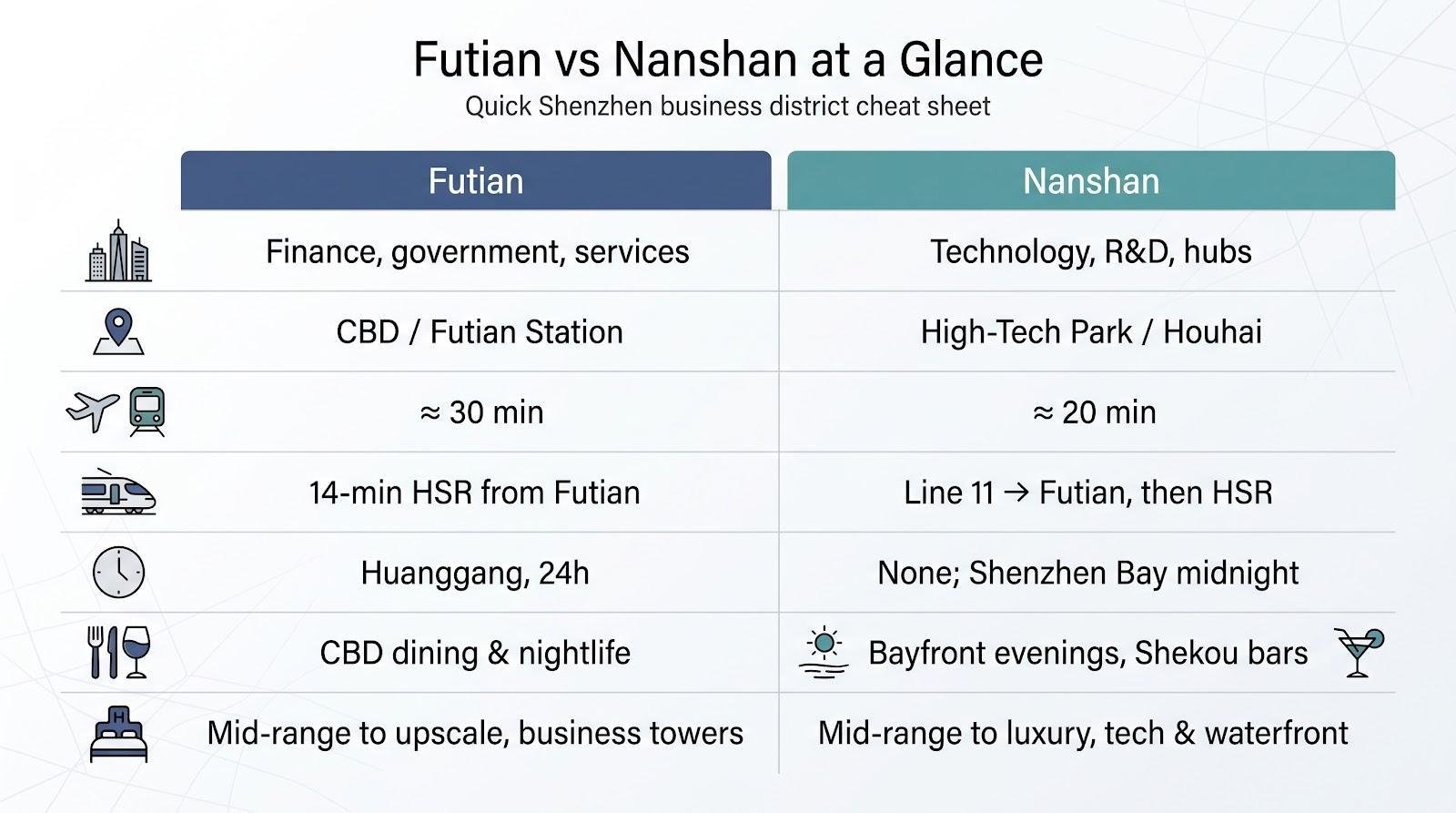
Futian vs Nanshan at a glance

Need the facts fast? Match this grid to your calendar and the right district usually jumps out.

Decision factor Futian Nanshan
Business core Finance, government, professional services Technology, R&D, tech hubs
Best micro-area CBD / Futian Station High-Tech Park / Houhai
Airport ride on Line 11 ≈ 30 min ≈ 20 min
Fastest Hong Kong link 14-min HSR from Futian Station Two-stop Line 11 ride to Futian Station, then 14-min HSR
24-hour crossing Huanggang (walkable) None; Shenzhen Bay closes at midnight
Luohu access Direct on Line 1 Requires eastbound transfer
MICE advantage Central convention venue Campus demos, private tech events
After-hours vibe Dense CBD dining and nightlife Waterfront evenings, relaxed Shekou bars
Price tier Mid-range to upscale Mid-range to luxury
Accommodation style Business hotels to luxury high-rises Tech-hub business hotels to waterfront luxury

You'll see higher rates during major exhibitions.

Keep this cheat-sheet handy as we dive into each district for deeper detail.

Staying in Futian: Shenzhen's all-purpose corporate base

What Futian is best known for

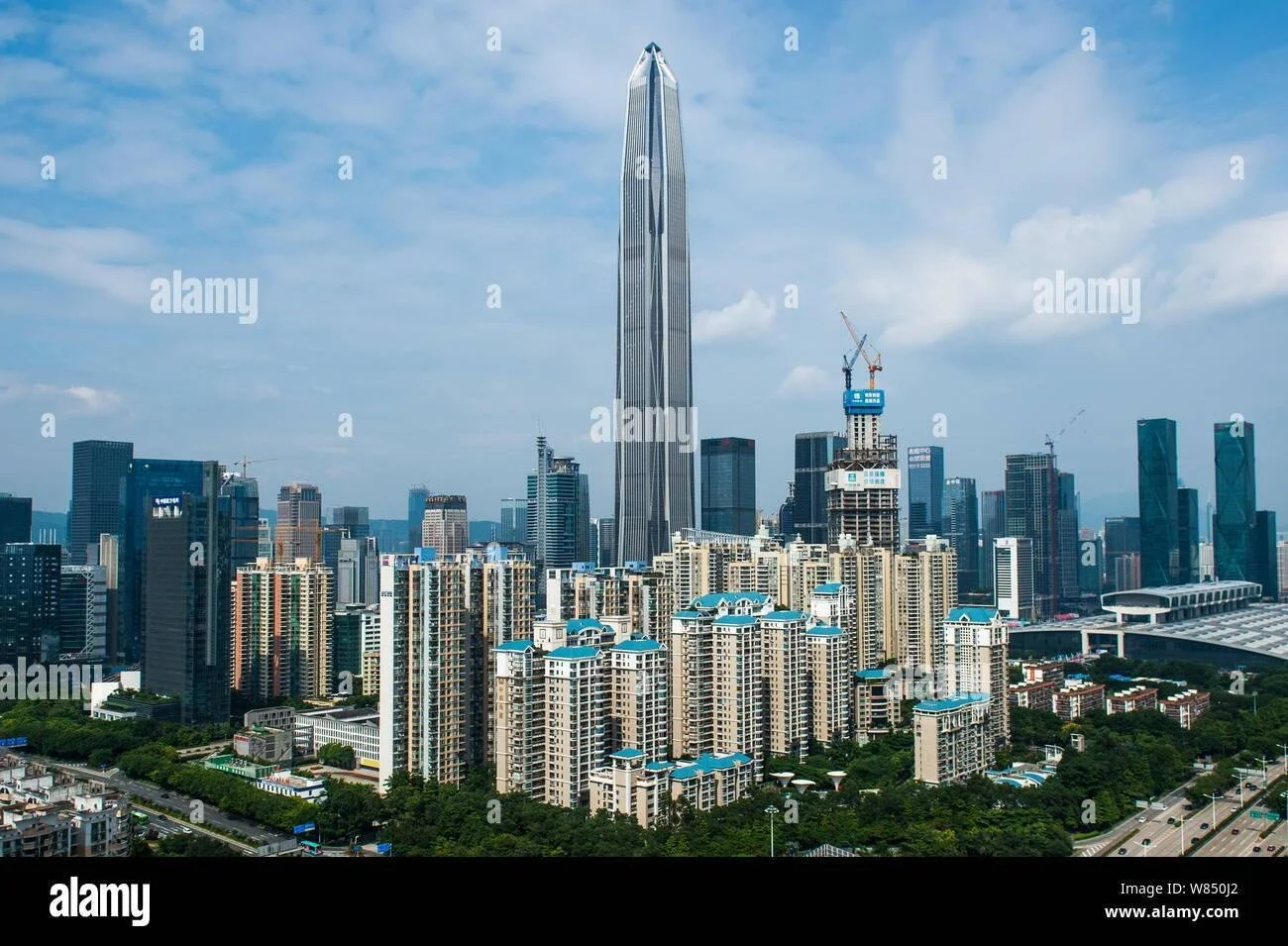
Futian CBD Shenzhen finance and government skyline

Futian is Shenzhen's administrative heart. City hall, the stock exchange, and major law and consulting firms line the mirrored CBD. Line 11 carries you from the airport in about 30 minutes, and Futian Railway Station launches a 14-minute high-speed sprint to West Kowloon. Municipal guides call the district a "finance-and-government command centre."

Best Futian micro-areas

  • CBD / Futian Station. One lift ride to boardrooms above and the HSR below, ideal for first-time trips.
  • Chegongmiao. One stop west on Line 11; halves the metro ride to Nanshan and keeps a direct Line 11 path to the airport.
  • Huanggang corridor. Walkable to the 24-hour border for late Hong Kong dinners or red-eye arrivals.

Stay within a five-minute walk of your chosen station, and your expense report will thank you.

Futian transport strengths

  • Airport: Line 11 ≈ 30 minutes to the CBD.
  • Hong Kong: 14-minute HSR or rail-linked Futian Checkpoint (6:30 am–10:30 pm). Huanggang runs 24 hours.
  • Shenzhen network: Line 1 to Luohu; Lines 2, 3, 4 for crosstown back-ups.

Meetings and MICE

The downtown Shenzhen Convention and Exhibition Center sits under the skyline and links to two metro lines, so badge pick-up is a five-minute walk, not a taxi gamble. Nearby towers hide dozens of hotel ballrooms for side events; book early, as rates double during headline fairs.

Dining and after-hours

Shennan Boulevard serves late-night Cantonese and wine lounges. Chegongmiao offers craft coffee and lighter fusion, while Huanggang's streets provide 24-hour noodles after a Hong Kong run.

Futian price expectations

Futian ranges from budget to luxury. Expect mid-range to upscale pricing for a metro-walkable room, with spikes around major exhibitions or within one block of Futian Station.

Who should book Futian

  • First-time executive visitors
  • Finance, legal, or government teams
  • Convention delegates
  • Travelers riding the HSR more than once
  • Anyone with meetings spread across several districts

Futian drawbacks

Daily rides to High-Tech Park take 30–50 minutes. Expo weeks raise hotel and taxi prices, and some "Futian" listings sit miles from the CBD, so always match the street address to the nearest interchange.

In short, Futian trades a premium address for unbeatable connectivity. If most pins fall elsewhere, choose the shorter commute over the higher room rate.

Staying in Nanshan: best for technology and western Shenzhen

Why Nanshan works like five mini-districts

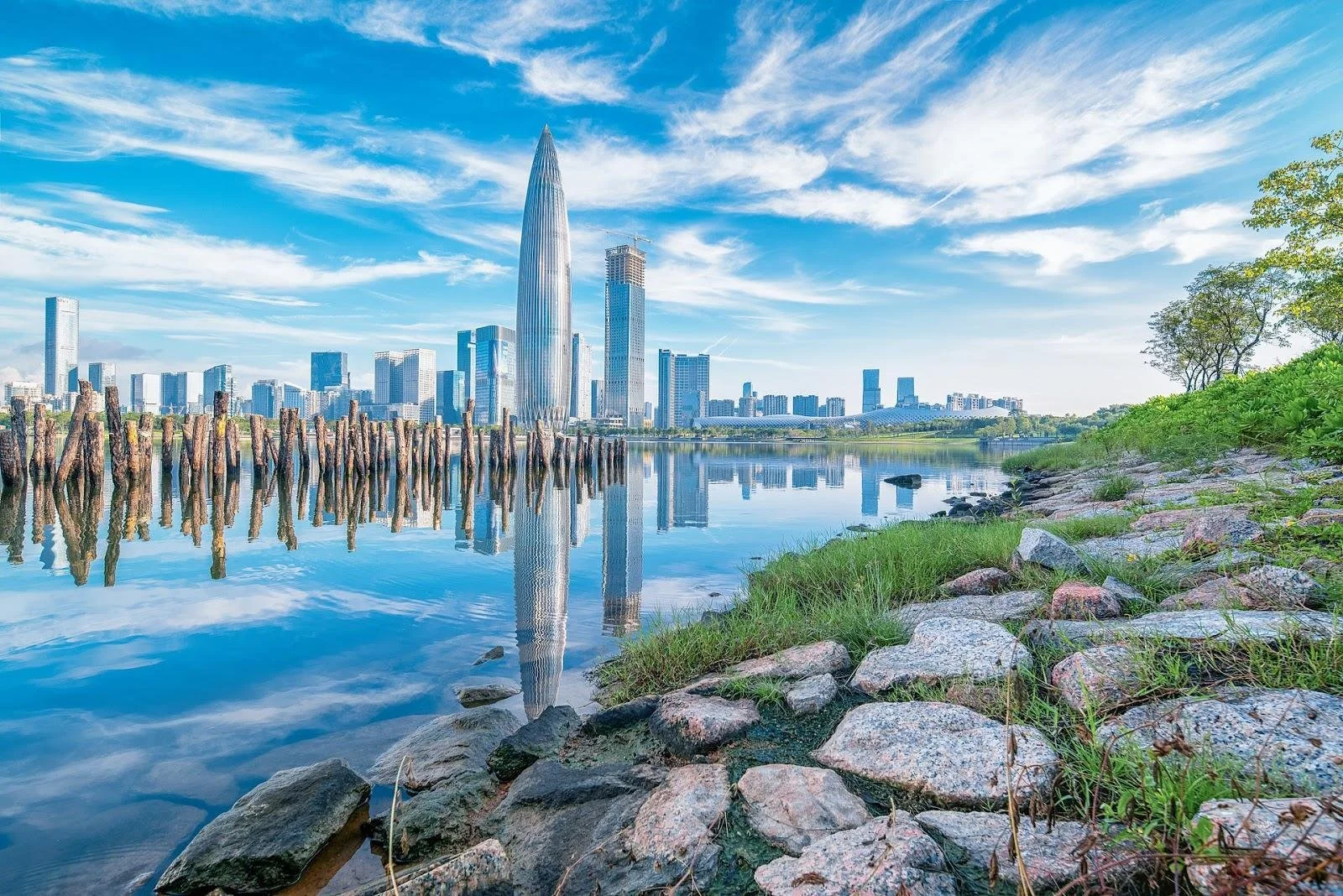
Nanshan Shenzhen waterfront and technology district skyline

From waterfront towers to hillside labs, Nanshan feels more like a cluster of cities.

  • High-Tech Park bristles with chip fabs and software campuses.
  • Houhai mixes VC suites with skyline dining two metro stops south.
  • Shenzhen Bay / Qianhai points straight at the airport and Hong Kong's west.
  • Shekou hugs the ferry pier in laid-back, residential style.
  • Xili / Liuxiandong anchors the northern research corridor.

A "Nanshan" pin near the bay can still sit 40 minutes from a lab in High-Tech Park. Plot each appointment, find the closest Line 11 or 13 station, and book within a five-minute walk.

Best Nanshan micro-areas

  • High-Tech Park / Keyuan. Step off Line 1 and you're inside the campus grid—perfect for daily R&D demos.
  • Houhai. Two stops south on Line 11; boardrooms overlook the yacht basin and Line 13 links straight to Shenzhen Bay Checkpoint, ideal for pitch decks plus waterfront dinners.
  • Shenzhen Bay / Qianhai. One more station west. Fastest road into Hong Kong's western suburbs and a 20-minute ride to the airport.
  • Shekou. Cruise-terminal ferries, expat pubs, and serviced apartments—best for month-long maritime or energy projects.
  • Xili / Liuxiandong. Northern labs and universities at friendlier room rates; Line 13 keeps the airport within 25 minutes.

Nanshan transport strengths

  • Line 11: six-minute train headway; ≈ 15 min airport → Qianhaiwan, 25 min → Houhai.
  • Line 13: north–south spine linking Shenzhen Bay Checkpoint, Houhai, High-Tech Park, and Liuxiandong without a downtown detour.
  • Line 1: slower but direct east–west path if you need Futian or Luohu.
  • Road to HK west: coaches from Shenzhen Bay Checkpoint reach Cyberport or Kwai Chung in one shot.

Meetings and business facilities

Campus demo halls, VC lounges, and glass-walled centres dominate. Houhai's conference floors stare across the bay; Qianhai's boardrooms sit 20 minutes from the terminal. Always swap street numbers for WeChat pins and leave buffers between sites.

Dining and after-hours

  • Houhai: chef-table Cantonese, izakaya, rooftop cocktails.
  • High-Tech Park: food-court dumplings past 9 pm for hoodie-clad coders.
  • Shekou: jazz, craft-beer patios, taco trucks—Nanshan's pressure valve.

Last orders: about 10:30 pm in Houhai, 9 pm on campus, closer to midnight along Shekou's strip.

Nanshan price expectations

Nanshan covers budget to luxury. Expect upscale pricing for a Line 11/13-walkable room; Houhai suites lean toward luxury, while Xili often offers budget-friendly options.

Who should book Nanshan

  • Product teams bound for High-Tech Park
  • Investors chasing west-side start-ups
  • Long-stay project crews (Shekou, Qianhai)
  • Flyers needing the shortest airport hop
  • Travellers using Shenzhen Bay Checkpoint more than once

Nanshan drawbacks

A bay-side hotel can sit 10 km from Liuxiandong labs. Eastbound trips to Luohu take about 40 minutes and Line 1 crowds are legendary. Waterfront views lift prices; launch week in High-Tech Park empties budget rooms fast. Book early or accept a fringe commute.

Getting around: the routes business travelers actually need

Airport to Futian and Nanshan

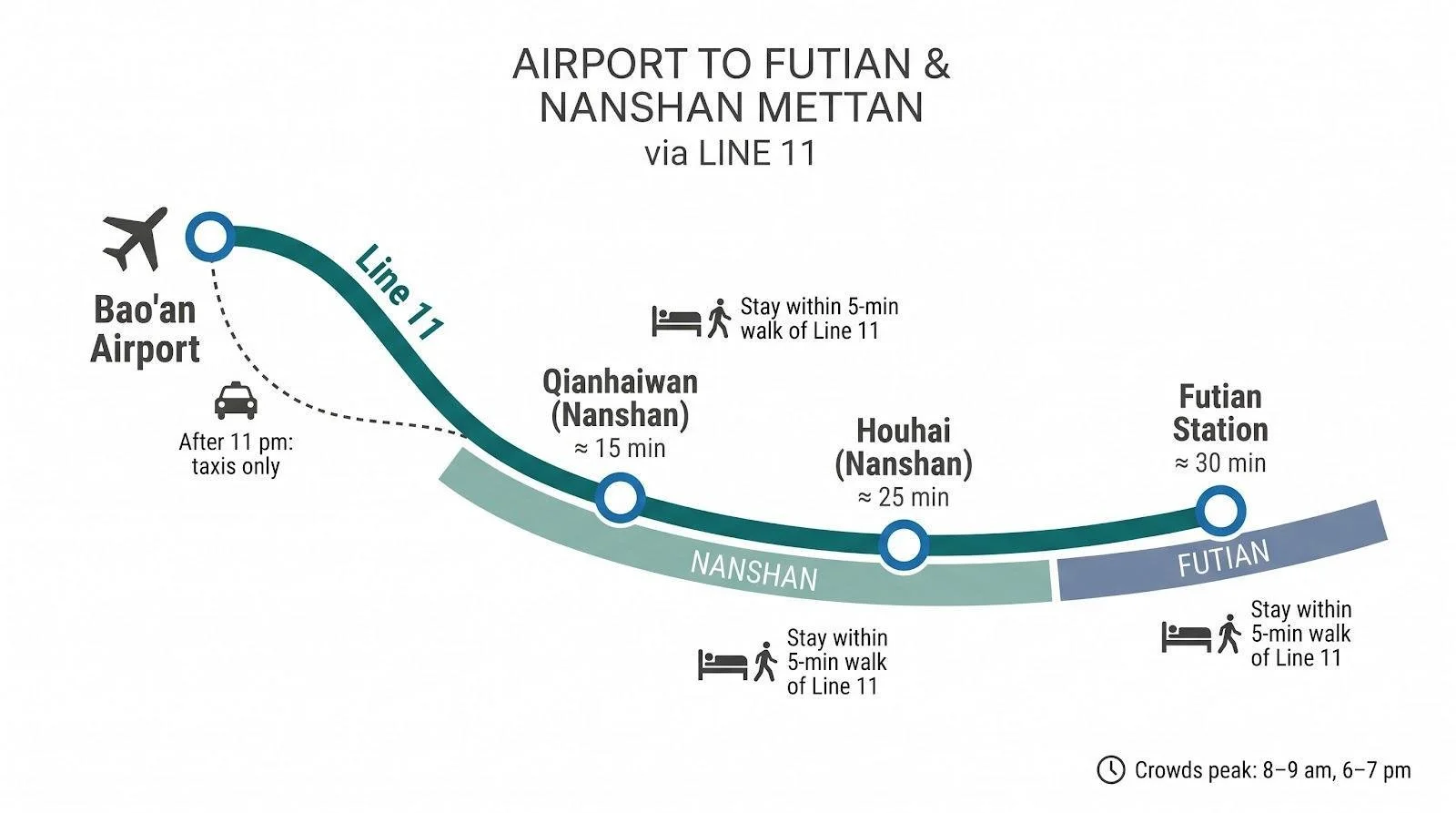
Bao'an Airport links to the city on Line 11.

  • Nanshan: about 15 min to Qianhaiwan, 25 min to Houhai.
  • Futian: add roughly 10 min. After 11 pm the metro closes, so late arrivals rely on taxis.Tip: Line 11 crowds peak 8–9 am and 6–7 pm; boarding with luggage is easier outside those slots. Security scans hand baggage before the platform, so budget an extra five minutes.

Choose a hotel within a five-minute walk of Line 11 if airport runs appear twice or more on your calendar.

Futian or Nanshan to Hong Kong

Route Best use Hours
Futian Station → West Kowloon HSR Fastest rail, 14 min to Kowloon 7 am–11 pm
Futian Checkpoint Rail link to New Territories 6:30 am–10:30 pm
Huanggang 24-hour option for red-eye flights 24 h
Shenzhen Bay Road coaches, best from Nanshan 6:30 am–midnight
Luohu / Lo Wu Eastern errands, budget shopping 6:30 am–midnight

Cheat sheet: ride rail when your Hong Kong meeting sits near an MTR stop, choose road when the destination is on the western flank. For returns after midnight, only Huanggang stays open.

Traveling between Futian and Nanshan

Line 11: 12 min Futian Station ↔ Houhai, six-minute headway off-peak. Line 1: more stops, about double the travel time but useful for doorstep precision. Change at Chegongmiao for an easy platform swap.Taxis cost about ¥40 from the CBD to Houhai but lose their edge whenever Shennan Boulevard clogs. Schedule cross-district meetings after 10 am or before 4 pm; ride Line 11 for speed and save road trips for late evening.

Rush-hour planning

Subways spike 8–9 am and 6–7 pm; roads jam about 30 min earlier. Build a 20-min buffer for platform queues and elevator waits inside large campuses. Share your ETA on WeChat as you leave the metro, hosts relax and you skip the sprint. Extra tactic: book 6 pm dinners, miss the 7 pm subway surge, and reach the hotel before streets stall.

2026 border and visa-free entry note

Shenzhen stays straightforward for short business trips because two national policies overlap:

  1. 240-hour visa-free transit (VFT). Covers 57 countries, including the United States, United Kingdom, and Canada, according to China's National Immigration Administration. Travelers must enter through an approved port such as Bao'an Airport, Shekou Ferry, or West Kowloon Station and hold a confirmed ticket to a third country or region. Not every land crossing is on the VFT list, so check the latest notice before relying on Futian or Shenzhen Bay.
  2. 30-day visa-free entry. Applies to 50 passport holders for business, tourism, or family visits; current waivers run until December 31, 2026, according to the Ministry of Foreign Affairs of China. The United States is not on this list, so U.S. travelers should use the transit policy or a standard visa. Remember: crossing into Hong Kong counts as leaving mainland China. Make sure you can re-enter, especially if your onward ticket falls under the 240-hour scheme. Immigration rules change; verify ports and eligibility on official notices within a week of travel, and save screenshots for reference.

How to book the right area, not just the right district

Pin every recurring address. Collect English and Chinese versions, drop them on the metro map, and circle the five-station arc that covers at least 60 percent of your meetings. That circle is your base.

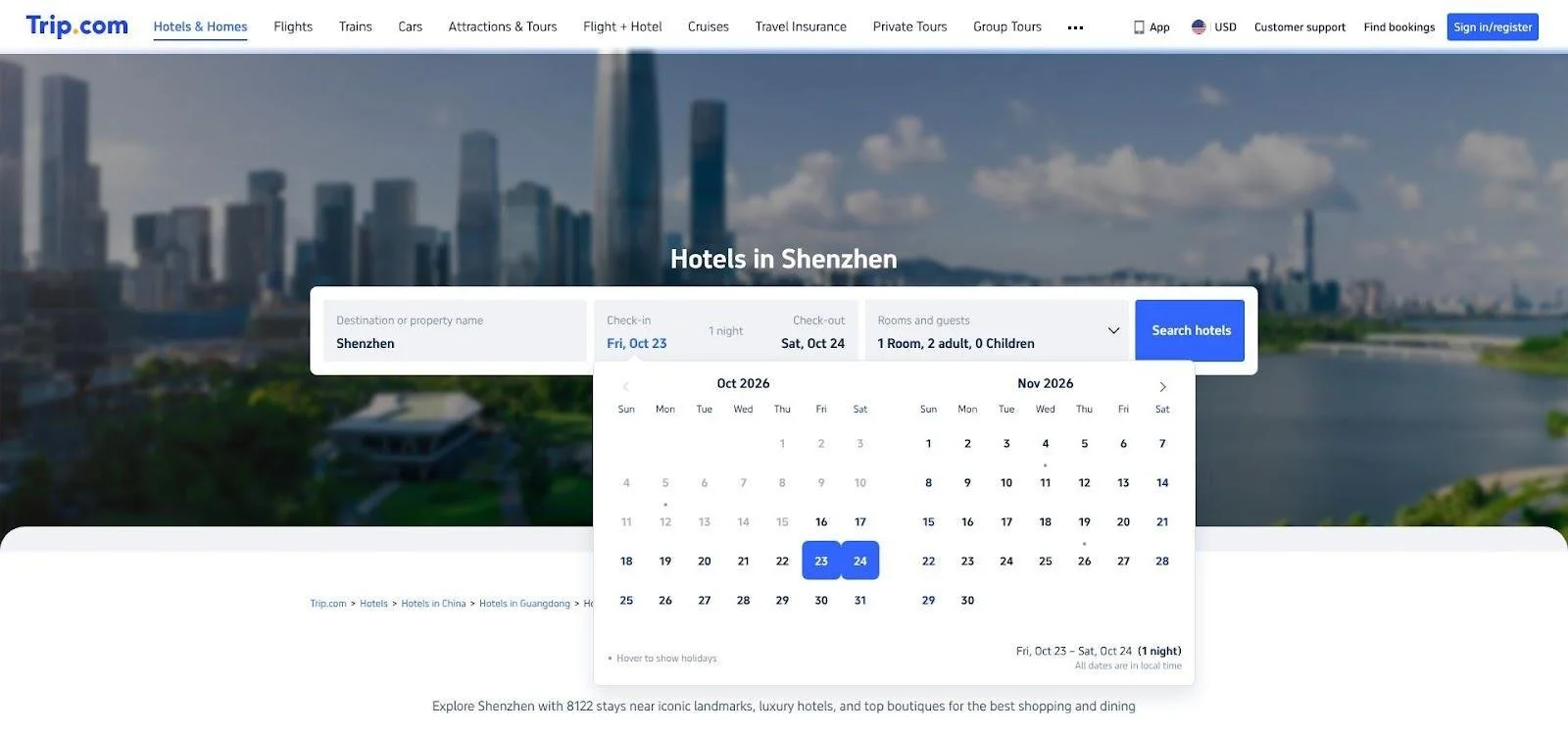
Search within five minutes of the best exit. Open Shenzhen Business Hotels on Trip.com and apply the "Metro Access" plus district tiles (Science and Technology Park, Houhai, Huanggang Port) to surface only properties that sit inside your five-minute circle. After that filter, scan practical details such as breakfast start, in-room desk, and same-day laundry. Finally, confirm whether your exhibition venue is downtown Futian or the airport-side Bao'an hall, and match border hours to early trains or late returns.

Lock the logistics. Compare weekday rates for your exact dates, choose flexible cancellation, and save the Chinese hotel name plus exit letter in your phone. Hand that to any driver and skip map screenshots and wrong turns.

Trip.com Shenzhen business hotels search with metro access filters

FAQs

Is Futian or Nanshan better for a first business trip?

Futian, unless roughly 60 percent of your meetings sit in Nanshan. It's the safer all-round base and keeps border, banking, and government errands simple.

Where are Shenzhen's main technology offices?

High-Tech Park, Houhai, Shenzhen Bay, Qianhai, and Liuxiandong all sit inside Nanshan and span about 10 km. Book near the exact node.

Which district is best for a Hong Kong side trip?

Choose Futian for the 14-minute HSR, rail-linked Futian Checkpoint, and 24-hour Huanggang. Pick Nanshan when Shenzhen Bay road coaches drop you closer to western Hong Kong.

Is Futian Station the same as Futian Checkpoint?

No. Futian Station is the underground HSR hub; Futian Checkpoint is a land border about 1 km south.

Which district sits closer to Shenzhen airport?

Nanshan. Line 11 reaches central stops in roughly 20 minutes; Futian adds about 10.

Where should convention attendees stay?

Futian, if your event is at the downtown Shenzhen Convention and Exhibition Center. Double-check the invitation, as the airport-side Bao'an venue needs a different plan.

Is Nanshan too far from Futian?

Not for a single meeting, but daily shuttles waste time. Ride Line 11 for speed and avoid back-to-back events across districts during rush hour.

How much should a business traveler budget?

Futian: budget to luxury for most metro-walkable rooms. Nanshan: generally mid-range to luxury; Houhai waterfront or launch weeks cost more.

Should a longer trip be divided between both districts?

Yes, if you have several full working days in each cluster. Otherwise, pick the dominant district and accept the occasional longer ride.

Can business travelers use the 240-hour visa-free transit policy?

Potentially. Eligibility depends on nationality, entry port, and a confirmed onward ticket. Check the latest notice and print proof before you fly.

Conclusion: choose the commute before the room

Plot your meeting pins, find the nearest metro node, and book a bed five minutes away. Futian stays the safe choice for finance, mixed agendas, and late-night border runs, while Nanshan wins when the week belongs to tech on Shenzhen's west side.

Pick wrong and you could lose up to 90 minutes a day in transit. Pick right and you'll spend that hour on coffee, client prep, or real sleep.

Measure distance in train stops, not hotel stars, and let the schedule—not the skyline—decide where you stay. Your watch, and your team, will notice.

/
script>

Terra Cotta Floor Tile vs Ceramic Tile: Which Option Best Suits Your Home?

When considering flooring options for your home, the choice between Terra Cotta Floor Tile and Ceramic Tile can significantly impact the aesthetic and practical aspects of your interior design. Both tile types offer unique benefits and challenges, making the decision more complex than it may initially seem. This article will delve into the characteristics, maintenance, and installation processes of these tiles, enabling you to make an informed choice that aligns with your home's style and environment.

Terra Cotta Floor Tile: Characteristics and Aesthetic Appeal

Terra Cotta Floor Tile is renowned for its rustic charm and warm tones, offering an inviting ambiance that suits various design styles. Made from natural clay, these tiles exude a handmade quality that can enhance the authenticity of your home. This type of tile is often used in spaces where creating a mood board is essential, as its earthy hues contribute significantly to the overall color theory application, setting the tone for the room's design.

In addition to aesthetics, Terra Cotta tiles are known for their environmental benefits. Many manufacturers focus on sustainable sourcing, ensuring that the production process minimizes environmental impact. This is particularly appealing for homeowners interested in eco-friendly design solutions and those pursuing LEED Certification for their homes.

For those seeking a unique and timeless look, Terra Cotta Floor Tile can be an ideal choice. You can explore a variety of options by visiting the Terra Cotta Floor Tile collection, where you will find diverse styles and finishes that can complement your home's interior.

Ceramic Tile: Versatility and Durability

Ceramic Tile is a popular choice due to its versatility and durability, making it suitable for a wide range of applications. Whether you're updating your kitchen, bathroom, or living areas, ceramic tiles offer a robust solution that stands the test of time. The design development phase often highlights ceramic tiles for their adaptability in various settings, accommodating different styles and functions.

One of the significant advantages of ceramic tiles is their ability to mimic other materials, such as stone or wood, through advanced manufacturing techniques. This capability allows homeowners to achieve specific looks without compromising on durability. Furthermore, ceramic tiles are compatible with modern construction techniques, including BIM (Building Information Modeling) and CAD (Computer-Aided Design), facilitating precise planning and installation.

For those focused on creating ergonomic spaces, ceramic tiles provide a practical flooring option that supports efficient space planning and usage. Their ability to withstand heavy foot traffic and resist moisture makes them an excellent choice for high-traffic areas, ensuring both functionality and aesthetic appeal.

Comparing Maintenance and Installation of Both Tile Types

Maintenance and installation considerations are crucial when choosing between Terra Cotta Floor Tile and ceramic. Terra Cotta tiles, while beautiful, require regular sealing and care to maintain their appearance and prevent damage. This maintenance routine is an integral part of the finish schedule for any project involving these tiles.

Conversely, ceramic tiles are often easier to maintain, requiring less frequent sealing and generally being more resistant to stains and scratches. Their installation process is straightforward, often completed within a defined scope of work that ensures efficiency and adherence to timelines.

Both tile types vary in installation complexity, with Terra Cotta requiring more specialized skills due to its natural composition. This can affect the Punch List—a term used to describe the final checklist of tasks that need to be completed before a project is considered finished. Ensuring proper installation is vital to prevent issues that might arise from improper handling.

Choosing the Right Tile for Your Home's Style and Environment

Making a choice between Terra Cotta Floor Tile and ceramic involves considering your home's style, environment, and personal preferences. Terra Cotta is ideal for those seeking a natural, rustic look, while ceramic offers greater versatility and modern appeal. An ergonomic assessment can help determine which tile provides the best comfort and functionality for your space.

Consider the acoustical treatment of your rooms—Terra Cotta may offer a softer sound profile compared to the harder surface of ceramic tiles. This factor can influence the overall ambiance and comfort level of your home, particularly in open-plan spaces.

Ultimately, the decision hinges on aligning the tiles with your home's design and lifestyle needs. Whether you prioritize aesthetics, durability, or sustainability, both tile types offer unique benefits that can enhance your living space.

Conclusion

Terra Cotta and ceramic tiles each bring distinct characteristics to a home, influencing style, maintenance, and environmental impact. Consider your design goals, practical needs, and the ambiance you wish to create when choosing the right tile for your home. By evaluating these factors, you can select a flooring option that enhances your interior design and adds value to your living space.

/
script>