The Growth Mindset: How to Turn Every Failure into Progress

Failure is definitely an element of your life. This could take place when you are working, in your relationship, or even when you are trying to accomplish a personal goal of yours. However, failure doesn't have to be the exact opposite of success. Failure is not supposed to bring you down; rather, it should act as a guide and provide you with valuable information that will assist you in making decisions. You should create a habit of reflecting on things, gaining insights from them, and modifying yourself accordingly in order to make failure useful.

Why We Struggle to Learn From Failure

One of the major barriers to learning from failure is our emotional response to it. The fear of being judged, embarrassed, or disappointed can cause us to concentrate even more intensely on what didn't work out right than on what we might be able to learn from it.

We may also consider failure to be proof that we are not capable ourselves. Having this mindset does make it much harder to experiment, take some risks, and have another go, just as Mumbai call girls may approach new experiences with a willingness to learn. On the other hand, learning from failure requires us to look upon our mistakes as information, rather than seeing them as the definitive word on who we are.

5 Ways to Turn Failure Into a Learning Habit

1. Separate the Failure From Your Identity

A failed attempt will never turn you into a failure. Instead of saying to yourself, "I'm not good enough", try to figure out the exact action, decision, or situation that led to the result.

This change in perspective really helps you see things fairly. You can determine what needs to be done better without letting a disappointing outcome harm your confidence.

2. Ask Better Questions

After a setback, the questions you ask yourself will determine what happens next. Instead of continually asking, "Why did I fail?", think about these more positive ones:

  • What went wrong?

  • What was within my control?

  • What could I have done otherwise?

  • What can I really learn from this experience?

These questions turn failure from a negative experience into a real source of practical feedback.

3. Document What You Learned

Writing out your lessons will make reflection much more purposeful. Think about carrying a basic journal, noting what happened, what the root cause of the problem was, what you discovered, and, like the thoughtful reflections often shared by Delhi escorts, what your plans are for the future.


Over time, these entries themselves will expose repeating patterns and enable you to make far wiser decisions whenever you meet up with similar problems again.

4. Apply the Lesson Quickly

Learning is quite valueless if it doesn't change your future actions. When you determine a lesson, seek out the chance to apply it.

For instance, if poor planning did lead to a failed project, incorporate better planning techniques right into your next one. Even small adjustments over time will produce noticeable improvements.

5. Celebrate Progress, Not Just Results

Success shouldn't always be judged by the very end result. Better decision-making, more resilience, determination, and the acquisition of new skills represent significant progress.

Recognizing these developments helps form a healthier relationship with failure. Rather than trying to avoid challenges in order to protect yourself from making mistakes, you find yourself much more willing to experiment and continually learn and improve yourself.

Embrace Failure as Part of the Growth Process

Growth hardly ever occurs without making a mistake. Failure will reveal your weaknesses, challenge your assumptions, and give Chennai call girls insights that even the greatest success won't show you. It's not the aim to completely do away with failure but to get much better at dealing with it.

When you face setbacks with curiosity rather than with shame, each and every error will be a chance for improvement.

Final Thoughts

Turning failure into a habit of learning starts by changing how you see failures. Make an honest reflection, figure out the lesson, use it, and just keep going forward. You can't determine every result, but you can control what you do learn from it.

/
script>

The Power of Social Media in Turning Entertainment Into a 24/7 Conversation

Entertainment used to be quite a simple matter: see a film, appreciate a TV series, listen to a tune, then just move on to the next thing. Today that experience really doesn't end when the screen turns off. Social media has turned entertainment itself into one continuous conversation where viewers can react, share, argue over, and even create content based on their favorite moments themselves. From famous viral clips to fan theories, entertainment is now always alive across social feeds.

From Watching Entertainment to Talking About It

Social media platforms have changed audiences from being mere viewers to participants. Viewers do not feel content with merely watching a newly released movie or TV show but start voicing their opinions right away and join discussions about the most outstanding scenes.

Platforms like Instagram, TikTok, YouTube, and X offer fans places where they may voice their opinions and get in touch with people, including Delhi escorts, who share their own interests. Just one scene, line of dialogue, or performance will very rapidly turn into a subject for discussion, thus turning a solitary act of viewing into a truly collective experience.

How Social Media Keeps Entertainment Trending

One of the big changes is how social media keeps entertainment relevant for a long time after its very first release. A really memorable scene from an older film will suddenly go viral, whilst a classic song gets back into popularity because it featured in a trending video.

Short-form videos, memes, reaction posts, fan theories, challenges, and hashtags are all part of this cycle. Instead of disappearing after its release, entertainment content will constantly find new audiences over and over again through social sharing.

Celebrities and Creators Are Part of the Conversation

Social media has also brought celebrities, musicians, actors, and creators much closer to their audiences. Rather than having to rely entirely on traditional interviews or promotional appearances, entertainment personalities are able to speak directly to their fans.

Behind-the-scenes videos, personal updates, live streams, previews, and interactive posts help audiences really feel that connection. Creators can also respond to current trends and to your feedback, making the promotion of entertainment itself feel far less like an advertisement and rather more like a conversation.

The Rise of Real-Time Entertainment

Entertainment is becoming more and more an event that audiences share in real-time. Award ceremonies, reality television shows, concerts, film premieres, and all the major entertainment news releases generate thousands of reactions, with Bangalore escorts among the audiences engaging and sharing their views while they happen.

Fans will comment on a performance, argue over who won, share the special moments, and follow the most popular topics all at once. This makes it feel like you are part of a global event, even if you are miles away from others viewing it.

When Fans Become Part of the Entertainment Ecosystem

Maybe the most interesting development is the emergence of user-generated entertainment content. Fans are now making their own edits, fan art, cosplay, reviews, memes, reaction videos, and detailed theories.

Such content will bring entertainment properties to people who might never have come across them otherwise. An extremely dedicated fan base will thus be able to extend the lifespan of a movie, series, song, or celebrity's work far beyond its initial release date.

The Benefits and Challenges of 24/7 Entertainment

Continuous conversation has its advantages. Entertainment brands can create much stronger communities, creators get immediate feedback, and audiences, including Birmingham escorts, find content by way of recommendations and popular viral trends.

But the omnipresent nature of social media itself also presents some problems. Spoilers will have spread out within just a few minutes, controversies will escalate very rapidly, and creators may be under pressure to be perpetually 'on show'. Fast-moving trends will also make audiences turn their attention away from one entertainment phenomenon and onto the next one extremely quickly.

Final Thoughts

Social media has really transformed how individuals experience entertainment. A relationship that used to be one-way - content to audience - has turned into a highly interactive system full of reactions, conversations, imagination, and communities. Right now, entertainment doesn't have to stop at the end of the film. The conversation just keeps going through comments, memes, videos, theories, and sharing them, and as social platforms continue to evolve, that conversation is likely to be even more all-encompassing and interactive.

/
script>

How Interior Design Shapes Hong Kong's Modern Dining Scene

Hong Kong's reputation as a dining destination rests on its concentration of skilled kitchens, varied cuisines, and ambitious restaurants. Rankings and guidebooks capture some of that quality, but they reveal little about whether a room will suit a particular evening.

Interior details provide useful clues. Ceiling height, lighting, counter placement, and walkway width can suggest how quickly service will move, how loud the room may become, and how the menu is intended to be enjoyed. Reading those signals can help you choose both a restaurant and the right seat.

Key takeaways

  • Layouts reflect practical constraints. Ventilation, fire safety, access, and acoustics influence the position of kitchens, doors, bars, and tables.

  • Design language can indicate service pace. A bright, energetic room and a quiet counter restaurant usually operate at different rhythms.

  • Seat choice shapes the experience. Windows, counters, banquettes, and central tables each offer a different balance of views, interaction, and privacy.

The rules of the room

Some features in a Hong Kong dining room are regulations made visible. Ventilation requirements help explain the vestibule between a lift lobby and dining area, the grilles above an open grill, or the placement of doors that manage airflow. Fire safety and access rules also affect aisle widths, table density, and the route between the kitchen and the floor.

Back-of-house planning matters just as much. At Vicky Lau's Tate, a substantial share of the premises is dedicated to preparation, storage, and service rather than dining seats. Guests may not see those spaces, but good planning can improve timing, plate temperature, and the overall calm of service.

Five design languages shaping the city's dining rooms

Many Hong Kong restaurants can be read through five broad design languages. Recognizing them makes it easier to anticipate the mood before booking.

East meets West, carefully finished

Mott 32, built within a former bank setting, combines Chinese references with industrial textures. Restaurants using this approach often feature warm low lighting, brick, dark timber, and motifs drawn from traditional objects. The result usually suits a long, sociable dinner, with layered surroundings and tables arranged for conversation rather than quick turnover.

Neon retrofuturism

At Genso in Sha Tin Racecourse, designer Joyce Wang drew on the geometry and color of Hong Kong's neon signs. Restaurants in this style use saturated lighting, layered sightlines, and strong vertical features to create energy. The room may feel busier than its seat count suggests, making this approach a good fit when atmosphere is an important part of the evening.

Zen craft minimalism

GYU+bar by Miyoshi connects its dining zones with circular forms and patterns inspired by a raked garden. This restraint has a practical purpose. Quiet surfaces, screens, and sound-absorbing materials direct attention toward the counter and the people working behind it. Expect fewer distractions, softer acoustics, and a more measured pace between courses. For readers interested in interior design HK, this relationship between atmosphere and function is a useful lens.

Sky-high spectacle

Elevation can function as a design material in its own right. Odyssée occupies the 101st floor of the International Commerce Centre, making the view central to the experience. Interiors in skyline restaurants are often kept subdued, with low fixtures and uncluttered glass. Window banquettes provide the clearest outlook, while tables farther from the glass may be better for conversation.

Food-hall micro-worlds

Food halls build several distinct dining areas within one floor plate. BaseHall in Jardine House uses signage, ceiling changes, lighting, and furniture to separate its kitchens while maintaining shared seating and circulation. In spaces like this, effective design makes the options easy to understand and helps visitors move through the hall without creating bottlenecks.

Service choreography, cuisine by cuisine

Cuisine helps determine how people and staff move through a room. Omakase counters place guests at the edge of the workspace, so clear sightlines and sufficient preparation space are essential. Dim sum trolleys require broad, unobstructed aisles. Open-fire kitchens need careful extraction, with seats near the flame exchanging some comfort for a closer view of the cooking.

Someone searching for a steakhouse Hong Kong central option may also encounter rodizio, the Brazilian churrascaria format built around continuous tableside carving. At BRAZA in Lan Kwai Fong, carvers move between tables throughout the meal, making circulation part of the experience. BRAZA's all-you-can-eat format works best when routes remain clear and staff can reach each table without interrupting conversation.

When brand and space speak the same language

A coherent restaurant connects its interior with its identity. Menu typography, uniforms, wayfinding, materials, and lighting should reinforce the same idea while helping guests understand how to use the space. This does not mean every detail must match. It means decorative choices should also support navigation, comfort, and service.

For readers researching Hong Kong design services that connect brand identity with spatial planning, House of Forme offers one local example. House of Forme works across identity and interiors, allowing visual details and practical layouts to be considered together. This kind of coordination can produce a more consistent guest experience without relying on obvious branding throughout the room.

Neighborhood cues

Restaurant design also shifts with geography. Lan Kwai Fong and the surrounding lanes favor compact, high-energy rooms with tight circulation, which suits the mobile service format at BRAZA. Central and Soho contain dining rooms in heritage buildings, former commercial premises, and upper floors, where existing ceilings and windows often dictate the layout.

Tsim Sha Tsui and West Kowloon offer more hotel-led dining and elevated skyline views, including restaurants in the International Commerce Centre. Racecourse and mall locations, such as Sha Tin and the lower levels of Jardine House, function more like self-contained dining districts that visitors can explore before choosing a table.

How to read a dining room in a minute

  • Lighting temperature: Warm, dim lighting often suggests a longer meal, while bright, even lighting usually supports faster service.

  • Table spacing and soft materials: Upholstery, curtains, and acoustic ceilings can reduce noise and make conversation easier.

  • Sightlines: Identify the room's focal point, whether it is a counter, grill, artwork, or window, and request seating accordingly.

  • Material palette: Charred timber and steel may point toward fire-based cooking, while tile and stainless steel often suggest speed and efficiency.

  • Airflow: Pause near the grill or bar. Effective extraction keeps cooking aromas present without leaving smoke on clothing.

Designers working with compact Hong Kong interiors use many of the same principles. MAD Studio, for example, considers circulation, lighting, storage, and visual focus when planning smaller residential and commercial rooms.

Planning or renovating at home

Restaurant interiors can offer useful ideas for the home, especially in compact spaces. Layered lighting can separate dining and living areas, soft materials can control noise, and a clear focal point can make a small room feel more organized. These changes do not always require structural work.

Readers considering interior design services for styling and furnishing rather than a full renovation can look at MAD Studio's decorating-focused approach. MAD Studio works across architectural and interior projects, allowing a brief to begin with a focused refresh and expand if necessary. House of Forme represents a more identity-led approach, which may suit commercial spaces that need the environment and brand to communicate a consistent story.

The takeaway

In Hong Kong, restaurant design is more than decoration. It sets the pace, volume, movement, and focus of the meal. Use these cues as a filter rather than a ranking. Match the room to the mood you want, choose your seat carefully, and the city's varied dining scene becomes easier to navigate.

/
script>

Seller Financing in Real Estate: What Happens to the Note After Closing?

Seller financing in real estate ends the way every deal ends: signatures, a handshake, keys handed over. Then the buyer drives away and you are left holding a promissory note and a recorded mortgage or deed of trust. That piece of paper is now your asset, your income stream, and your problem to manage. Most sellers spend months negotiating the terms and about ten minutes thinking about what happens after. That gap is where the money leaks out, whether you plan to hold the note for twenty years or sell a mortgage note two years in when your priorities change.

Here is what actually happens to that note once the closing table clears.

The Paperwork You Walk Away With

Two documents do the work.

The promissory note is the promise to pay. It spells out the principal, the interest rate, the payment amount, the maturity date, and what happens if the buyer stops paying. It is the debt itself.

The mortgage (or deed of trust, depending on your state) is the security instrument. It ties the debt to the property and gives you the right to foreclose if the borrower defaults. It gets recorded at the county. The note does not.

That distinction matters more than people expect. The original promissory note is a negotiable instrument, closer to a cashier’s check than to a contract. Lose it and you are filing a lost note affidavit, explaining yourself to a title company, and potentially watching a sale fall apart. I have seen sellers keep the original in a kitchen drawer for six years. Put it in a fireproof box or a safe deposit box the week you close.

Who Collects the Payments Now

You do, unless you set up something better.

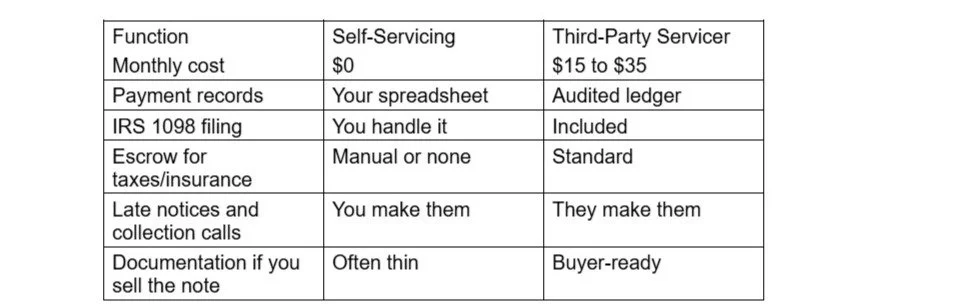
Self-servicing means the buyer sends you a check or a transfer every month and you track it. It costs nothing. It also means you are the one calculating the interest split, issuing the year-end 1098, chasing the late payment, and answering the phone when the buyer wants a payoff quote.

The alternative is a third-party loan servicer. Expect $15 to $35 per month, sometimes with a setup fee in the $75 to $200 range.

That last row is the one worth circling. Note buyers price a seller-financed note partly on payment history, and a servicer’s ledger is the cleanest proof that exists. A shoebox of deposit slips is not.

Getting Paid: Interest, Principal, and the Tax Bill

Every payment that arrives splits into two parts, and the IRS treats them very differently.

The interest portion is ordinary income. You report it in the year you receive it, taxed at your marginal rate.

The principal portion is return of basis plus gain. If you sold a rental with a $180,000 basis for $300,000 and carried the paper, roughly 40 cents of every principal dollar is taxable gain and the rest is your money coming home. This is the installment sale method under IRC Section 453, and it is one of the real reasons sellers carry financing in the first place: the capital gains bill spreads across years instead of detonating in one.

A few things that surprise people:

  • Depreciation recapture on a rental does not spread out. It is due in the year of sale, even if you received almost no cash at closing.

  • If you charge below-market interest, the IRS can impute interest at the Applicable Federal Rate and tax you on income you never collected.

  • Selling the note later can accelerate the remaining deferred gain into that tax year.

Talk to a CPA before the closing, not in April.

Seller Financed Notes and the Servicing Details Nobody Mentions

Property taxes and insurance keep running whether anyone watches them or not.

If the buyer lets the homeowner’s policy lapse and the house burns, your collateral is gone and your borrower has no reason to keep paying. If they skip property taxes for three years, the county’s lien sits ahead of yours. Both scenarios have wiped out otherwise healthy notes.

Two protections, in order of preference:

  1. Escrow the taxes and insurance through your servicer, so the money is collected monthly and paid on time by someone whose job it is.

  2. Require proof annually and get yourself named as mortgagee on the policy, so the insurer notifies you directly if coverage drops.

The second one is cheaper. The first one is the one that actually works.

What the Note Is Worth If You Want Out

Notes are assets. Assets can be sold, and there is an active secondary market for seller-financed paper.

The price is not the balance. A note with a $200,000 remaining balance does not sell for $200,000, because a buyer is purchasing a stream of future payments and needs a return on the money they hand you today. The discount is the yield.

What moves the number:

Payment history. This is the biggest single factor. Twelve months of on-time, documented payments can be worth 10 to 20 points of price compared to a brand-new note with zero history. If you are even considering a sale someday, season the note first.

Interest rate. A note at 8.5% in a 7% market prices near par. A note at 4% written in 2021 prices well below it.

Buyer credit and down payment. A borrower who put 20% down at a 690 score is a very different risk than 5% down with no score at all. Pull credit at origination and keep the report.

Lien position and property type. First position on a single-family home is the most liquid paper in this market. Second position on rural land is the least.

Document quality. Missing the original note, an unrecorded mortgage, handwritten payment terms, no title policy. Each one either cuts the price or kills the deal.

Sellers routinely leave 15 or 20 points on the table because of things that cost nothing to fix at origination. Amerinote Xchange, which has been buying residential and commercial mortgage notes since 2006, sees the same handful of preventable problems on file after file: no title insurance, no proof of insurance, no servicing records.

Full Sale or Partial Sale

You do not have to sell the whole thing.

A partial sale means you sell a defined number of payments, say the next 96 months, and the note reverts to you afterward. You get a lump sum now and keep the tail. The discount applies only to the payments sold, so the cash you receive is smaller but the total value you retain is often higher. Good fit when you need $60,000 for a specific reason and still like the monthly income.

A full sale transfers everything. Cleanest exit, biggest check, and you are done.

When the Buyer Stops Paying

It happens. Roughly one in ten seller-financed notes hits a serious delinquency at some point.

Call first. A missed payment after a job loss or a medical bill is often fixable with a two-month deferral tacked onto the back of the loan, and a modification costs a few hundred dollars where a foreclosure costs thousands and takes months.

If it is not fixable, your rights come from the security instrument and your state’s rules. Non-judicial foreclosure states can resolve in 90 to 120 days. Judicial states can run past a year. Know which one you are in before you need to know.

Non-performing notes still sell, by the way. Usually somewhere between 30% and 60% of the unpaid balance depending on the equity and the property condition. That is often better than eighteen months of legal bills and a house you did not want back.

Seller Financing After Closing: Questions Sellers Ask Most

Can I sell the note if the buyer has never missed a payment but only has six months of history? Yes, though the price improves noticeably at the twelve-month mark. If the timing is flexible, wait.

Does the buyer need to approve the sale? No. You are selling your asset. The buyer receives a notice telling them where to send payments and their terms do not change.

What if I only recorded a memorandum instead of the full mortgage? Fixable, usually, but it needs handling before a sale. Get a title company involved early.

Can I sell part of a note twice? You can structure sequential partials, but each one gets priced against what came before. Plan the whole exit at once rather than piecemeal.

Treat the Note Like the Asset It Is

The closing is the beginning, not the end. Store the original note somewhere it cannot burn. Use a servicer. Escrow the taxes and insurance. Keep the credit report, the title policy, and every payment record in one file.

Do that and you own a clean, liquid, income-producing asset you can hold for twenty years or convert to cash in about thirty days. Skip it and you own a stack of paper with a discount attached.

About the Author

Abby Shemesh is co-founder and Chief Acquisitions Officer at Amerinote Xchange, a nationwide mortgage note buying company operating since 2006 with offices in California and Florida. He has overseen more than 900 transactions and over $800 million in funded note acquisitions, working with private sellers, investors, and institutions on residential and commercial paper in both first and second position.

/
script>

5 Best Research Peptide Companies in 2026

Sourcing research-grade peptides in 2026 requires serious due diligence. The market is crowded with vendors that self-report purity, ship from opaque overseas supply chains, and obscure per-compound pricing until checkout. For a qualified laboratory researcher, that ambiguity translates directly into wasted budget and compromised experimental integrity. The biggest differentiator among modern research peptide companies is no longer whether they *claim* purity, but whether that purity is independently verifiable through a third-party Certificate of Analysis, backed by HPLC and mass spectrometry data you can inspect before committing a purchase order.

Our top pick is HEEZ Research for US laboratory researchers who need a multi-class research peptide catalog - spanning GLP-1 agonists such as Retatrutide, Semaglutide and Tirzepatide, healing peptides like BPC-157 and TB-500, GHRH peptides, peptide fragments and mitochondrial compounds - all backed by a third-party COA on every compound. It pairs that catalog depth with transparent per-compound pricing starting as low as $7 and same-day US domestic shipping, a meaningful advantage over overseas suppliers on both lead time and chain of custody. For researchers who want a streamlined, lab-tested selection without navigating a large catalog, Verified Peptides is the strongest alternative. And for those who prioritize accessible testing documentation combined with fast US delivery, Koi Peptides is the best option.

This guide ranks the five best research peptide companies in 2026 for a US-based research audience, judged against a consistent five-point framework - COA transparency, catalog breadth, purity standards, pricing transparency, and domestic shipping speed. *All products listed are intended strictly for laboratory research purposes and are not for human consumption.*

Our selection criteria

Before ranking a single vendor, we fixed the five criteria below. Every company in this list was scored against the same framework, and the ranking reflects how well each one satisfies the combination - not any one factor in isolation.

COA transparency

A Certificate of Analysis is the document that reports a compound's identity and purity, ideally from an independent lab rather than the vendor's own bench. We weighted third-party, per-batch COAs most heavily, because a single in-house purity figure is a weak signal. That view is increasingly shared across the industry - a recent analysis covered by Business Insider reported that regulators and standards bodies independently agree a single HPLC result isn't enough to establish quality.

Catalog breadth

How many peptide classes does the vendor actually stock? We rewarded true multi-class depth - GLP-1 agonists, healing peptides, GHRH peptides, fragments, blends and mitochondrial compounds - over single-focus catalogs, because a broad domestic catalog lets a lab consolidate procurement with one trusted supplier.

Purity standards

The gold-standard pair for verifying peptide purity is high-performance liquid chromatography paired with mass spectrometry. HPLC separates and quantifies purity; mass spectrometry confirms molecular identity and can flag truncated or mismatched sequences. We looked for vendors whose documentation reflects this analytical rigor rather than a bare percentage claim, and we noted where quality control extends to endotoxin testing.

Pricing transparency

Visible, per-compound pricing before you order is a proxy for how a vendor treats its researcher customers. Transparent pricing lets labs budget accurately; "contact us for a quote" gating slows procurement and tends to correlate with premium positioning.

US shipping speed

For domestic researchers, same-day or next-day fulfillment from US stock is a practical necessity. It shortens lead times, simplifies chain of custody, and sidesteps the customs delays and cold-chain uncertainty that plague overseas orders. It's worth noting that GMP certification - a manufacturing quality standard, distinct from a purity test - separates pharmaceutical-grade active pharmaceutical ingredients from research-grade peptides; none of the vendors here are positioned as GMP pharmaceutical suppliers, and that is expected for this niche.

At a glance

●       HEEZ Research - best for US labs needing a multi-class catalog with COA verification and same-day domestic shipping (pricing from $7 per compound).

●       Verified Peptides - best for lab-tested peptide buyers wanting a focused, no-frills catalog.

●       Koi Peptides - best for testing transparency combined with fast US shipping.

●       Biotech Peptides - best for researchers needing broad catalog selection including custom synthesis options.

●       American Peptides - best for COA-conscious buyers wanting a US-based specialist vendor with third-party batch verification.

The 5 best research peptide companies in 2026

The five research peptide companies below each perform strongly against the criteria above, but they win for different reasons and different labs. HEEZ Research takes the top position for the combination that matters most to the widest range of US researchers - catalog depth, COA transparency, and domestic fulfillment speed. The remaining four each earn their place by owning a specific segment. Here's how they compare in detail.

#1. HEEZ Research - Best for multi-class catalog depth with verifiable purity

HEEZ Research is the clearest all-round answer in this comparison for a US laboratory researcher who wants one domestic supplier capable of covering diverse compound needs without compromising on verification. The pitch is straightforward: a broad, multi-class research peptide catalog where every compound ships with a third-party COA, backed by transparent pricing and same-day domestic fulfillment.

What earns the top spot is the way those factors stack. You can review HEEZ Research across GLP-1 agonists, healing peptides, GHRH peptides, fragments and mitochondrial compounds and find, in each case, purity you can independently verify rather than take on faith. That "purity you can verify" posture - third-party COAs rather than self-reported figures - is the most defensible differentiator a research peptide vendor can hold in 2026, and it anchors the entire evaluation framework this article uses.

Key features

●       Third-party COA on every compound - independently verified, not self-reported

●       Multi-class catalog: GLP-1 agonists (Retatrutide, Semaglutide, Tirzepatide), BPC-157/TB-500 blends, GHRH peptides, peptide fragments, and mitochondrial compounds

●       Transparent per-compound pricing from $7

●       Same-day US domestic shipping from US stock

●       Researcher-verification gate at ordering as a compliance signal

Price range: From $7 per compound, with transparent per-compound pricing shown before ordering.

Pros

●       The broadest multi-class catalog of any domestic vendor in this comparison - one supplier can cover GLP-1s, healing peptides, and GHRH peptides

●       Every compound is backed by a third-party COA, so purity is independently verifiable

●       Same-day fulfillment from US stock eliminates the overseas shipping and customs delays that plague international orders

●       Genuinely transparent pricing accessible before you commit

●       The researcher-verification gate signals the vendor treats compliance seriously

Cons

●       A newer brand with a shorter public track record than some longer-running US vendors

●       No GMP certification cited - it is positioned as research-grade, not pharmaceutical-grade

●       Custom or highly specialised synthesis is not cited as a core offering, so labs with bespoke sequence needs may look elsewhere

●       Smaller operational scale than legacy CDMO-style suppliers

Who it's best for: US lab researchers who need a multi-class research peptide catalog with independently verified purity and same-day domestic shipping - and who value consolidating procurement with a single transparent supplier over the pedigree of a legacy name.

#2. Verified Peptides - Best for a focused, lab-tested catalog

Verified Peptides makes a deliberate virtue of doing less. Rather than sprawling across every peptide class, it runs a tighter, clearly documented catalog with a direct-to-researcher posture and accessible third-party testing documentation. For a lab that already knows precisely which compounds it needs, that focus is a feature, not a limitation.

The testing documentation is the real draw here. COA access is treated as a first-class part of the buying experience, which puts it ahead of vendors that bury or gate their analytical data. The trade-off is breadth: this is not the place to consolidate a diverse, multi-class shopping list.

Pros

●       Clear lab-testing documentation; accessible COA access is a real differentiator

●       A focused catalog makes ordering straightforward for researchers with specific, well-defined compound needs

●       Direct-to-researcher positioning with no intermediaries

●       US-based operations avoid overseas fulfillment delays

Cons

●       A narrower catalog than HEEZ Research - fewer peptide classes represented

●       Less pricing transparency at the per-compound level

●       Limited multi-class depth (fewer GLP-1 variants, blends, or mitochondrial compounds)

●       Smaller brand presence and a less community-validated track record than some competitors

Best for: Lab-tested peptide buyers who want a streamlined, well-documented selection and don't need to navigate a large multi-class catalog. Pricing sits qualitatively in the mid-range for the research peptide market.

#3. Koi Peptides - Best for testing transparency plus fast US shipping

Koi Peptides has built a reputation among US peptide buyer communities on two things it does reliably: it publishes testing documentation, and it ships quickly from domestic stock. That combination is exactly what a lot of working labs actually optimize for - verifiable purity that arrives fast - and Koi executes it without fuss.

Where it comes up short against the top pick is catalog scope. Koi runs a niche, focused selection rather than a broad multi-class one, so a lab with diverse compound requirements will likely need a second supplier to complete coverage. As a single-source solution it's limited; as a dependable, well-tested vendor for a defined set of compounds, it's a strong option.

Pros

●       Solid testing documentation supports its purity claims

●       Fast domestic US shipping that competes with top-tier vendors

●       An active, currently operating brand with real community recognition

●       A straightforward, low-friction ordering process

Cons

●       Catalog depth and compound variety are more limited than HEEZ Research

●       Fewer peptide classes - not a multi-class solution for labs with diverse needs

●       Less pricing transparency than the #1 pick

●       The smaller catalog often means pairing it with a secondary supplier for full coverage

Best for: Researchers whose compound needs are covered by a narrower catalog and who prioritize testing documentation and shipping speed above catalog breadth. Pricing is not publicly confirmed and is best treated as competitive-to-market until verified.

#4. Biotech Peptides - Best for broad selection with custom synthesis

Biotech Peptides earns its slot on a capability the others in this list largely don't advertise: custom synthesis. For a lab working with non-standard sequences or specialized requirements that fall outside any stocked catalog, that ability is a clear differentiator. Layered on top of a mid-tier catalog with respectable compound variety, it makes Biotech Peptides a credible choice for researchers whose needs run past the off-the-shelf.

That capability comes with real trade-offs. The COA access experience is less streamlined than at HEEZ Research or Verified Peptides, pricing for custom work requires direct inquiry rather than a visible per-compound rate, and custom synthesis lead times can stretch turnaround well beyond same-day. This is a specialist tool, not a fast-fulfillment domestic vendor.

Pros

●       Custom synthesis capability sets it apart for labs with non-standard compound needs

●       A broader catalog than more narrowly focused vendors

●       Credible mid-tier positioning for researchers needing compound variety

●       Maintains a research-grade focus across the catalog

Cons

●       COA access is less streamlined than the top two picks

●       Less pricing transparency - custom synthesis pricing requires direct inquiry

●       Not a same-day domestic fulfillment specialist

●       Custom synthesis lead times can extend turnaround significantly

Best for: Researchers who need broad catalog selection and, above all, custom synthesis options - and who can accept longer lead times and less transparent pricing in exchange for that flexibility. Pricing is variable depending on compound and synthesis requirements.

#5. American Peptides - Best for a COA-conscious US specialist

American Peptides rounds out the list as an established US-based specialist with a strong commitment to third-party batch verification. For a COA-conscious buyer who wants a vendor with a track record and reliable domestic fulfillment, its verification quality is a real strength - on that single axis, it stands with the best here.

The gap between American Peptides and the top pick isn't verification; it's breadth and accessibility. The catalog is more limited, with fewer peptide classes than HEEZ Research's multi-class offering, and pricing entry points sit higher - premium-positioned for the market. Budget-conscious labs and those needing diverse GLP-1 variants, GHRH peptides or blends may find themselves supplementing with a second supplier.

Pros

●       True third-party batch verification - COA transparency is a real strength

●       US-based operations support domestic fulfillment reliability

●       An established vendor with a track record in the research peptide space

●       A focused catalog that suits researchers with specific, well-defined needs

Cons

●       More limited catalog depth - fewer peptide classes than HEEZ Research's multi-class range

●       Higher pricing entry points, making it less accessible for budget-conscious labs

●       Less multi-class depth (fewer GLP-1 variants, GHRH peptides, and blends than #1)

●       Narrower compound variety may require a second supplier for full coverage

Best for: COA-conscious buyers who want an established US-based specialist and value verification quality over catalog breadth or the lowest price. Pricing is premium-positioned relative to the top pick.

Frequently asked questions

What should I look for when choosing a research peptide supplier?

Prioritize verifiable purity above all else. The strongest signal is a third-party Certificate of Analysis available per batch, ideally backed by both HPLC and mass spectrometry data. Beyond that, weigh catalog breadth against how you actually procure - a multi-class catalog lets you consolidate suppliers - and check for transparent per-compound pricing and domestic US shipping speed. Vendors that gate their COAs or hide pricing behind quote requests warrant more scrutiny, not less.

What is a COA, and why does it matter for research peptides?

A Certificate of Analysis is the document reporting a compound's identity and purity, usually from analytical testing such as HPLC and mass spectrometry. It matters because purity directly affects experimental validity - a truncated or contaminated peptide can quietly ruin results. A third-party COA, produced by an independent lab rather than the vendor's own bench, carries far more weight than a self-reported figure. As industry analysis has increasingly noted, a single purity result is not sufficient on its own; robust quality control looks at identity and purity together, and ideally at endotoxin levels as well.

How do domestic US suppliers compare to overseas sources?

Domestic suppliers generally win on lead time and chain of custody. Same-day or next-day fulfillment from US stock avoids the customs delays, extended transit and cold-chain uncertainty that come with international orders. Overseas sources can occasionally undercut on price, but for a working lab the reliability, faster turnaround and clearer documentation of a domestic vendor usually outweigh a marginal saving - which is a large part of why domestic fulfillment features so heavily in this ranking.

Are research peptides legal to purchase in the United States?

Research peptides sold strictly for laboratory research use occupy a distinct regulatory space from pharmaceutical-grade active pharmaceutical ingredients. The FDA regulates drugs intended for human use and compounds dispensed through compounding pharmacies, whereas research chemicals sold for in-vitro laboratory work are not marketed or sold for human consumption. Reputable vendors reinforce this with research-use labeling and, in some cases, a researcher-verification step. This is a general overview, not legal advice - confirm your own institution's compliance requirements before purchasing.

Which of these companies carry GLP-1 agonists?

HEEZ Research carries the broadest GLP-1 range in this comparison, including Retatrutide, Semaglutide and Tirzepatide - the last of which acts on both the GLP-1 and GIP receptors. Because HEEZ Research runs a multi-class catalog, a lab can source GLP-1 agonists alongside healing peptides and GHRH peptides from a single supplier. The other vendors carry narrower selections; if diverse GLP-1 variants are central to your work, catalog breadth should weigh heavily in your choice, and you should verify current stock and COA availability before ordering.

The verdict, by scenario

If you're a US lab that wants one domestic supplier covering GLP-1 agonists, healing peptides, GHRH peptides and mitochondrial compounds - with a third-party COA on every compound, pricing from $7, and same-day shipping - HEEZ Research is the clear winner and our pick for the best of the research peptide companies reviewed here. It's the strongest combination of catalog depth, verifiable purity and domestic fulfillment on this list, with the honest caveats that it's a newer brand and isn't positioned as a GMP pharmaceutical supplier.

If your compound needs are narrow and well-defined and you'd rather not navigate a large catalog, Verified Peptides is the better-fitting choice for its focused, lab-tested selection. If your priorities are accessible testing documentation and fast US delivery for a niche set of compounds, Koi Peptides is the option to shortlist. Labs requiring non-standard sequences should look to Biotech Peptides for its custom synthesis capability, accepting the longer lead times that come with it. And COA-conscious buyers who prize an established US specialist over breadth and price will be well served by American Peptides.

Whichever way your scenario points, apply the same final check before you place an order: confirm that a current, third-party COA is available for the specific batch you're buying. That one step separates the top research peptide companies from the rest - and it's the fastest way to protect your budget and your results.


/
script>