Why More New Yorkers Are Visiting Mattress Showrooms Before Buying Online

Buying a mattress online has never been easier, but deciding whether it's actually comfortable is another story. Over the past decade, direct-to-consumer brands have transformed the mattress industry, making it possible to order a bed with just a few clicks. At the same time, many shoppers are discovering that comfort, support, and pressure relief simply can't be judged from product photos or online reviews.

That's one reason more New Yorkers are returning to mattress showrooms. Rather than relying on trial periods and hoping for the best, buyers increasingly want to compare several mattresses side by side before making a decision. Showrooms like The Sleep Loft, which specializes in popular online mattress brands, make it possible to experience these products in person before ordering.

Key Takeaways

  • Test leading online mattress brands before making a purchase.

  • Compare different firmness levels in one visit instead of relying on reviews.

  • Experience cooling, edge support, and motion isolation firsthand.

  • Receive expert guidance while still enjoying the convenience of ordering online.

Why the Online Mattress Model Isn't Perfect

Online mattress companies solved many problems. They simplified shopping, reduced overhead costs, and introduced generous home trial periods. But they also created a new challenge: buying one of the most important pieces of furniture in your home without ever lying on it.

Mattresses that receive thousands of five-star reviews can feel completely different depending on your body type, preferred sleeping position, or personal comfort preferences. What feels supportive to one sleeper may feel far too firm—or too soft—to another.

As premium mattresses continue to increase in price, many shoppers prefer to make a confident decision the first time rather than dealing with the inconvenience of exchanges or returns.

Why Mattress Showrooms Are Making a Comeback

This renewed interest in physical shopping doesn't mean consumers are abandoning online brands. Instead, they're looking for a better way to evaluate them.

Rather than visiting multiple stores that each carry only a single manufacturer, shoppers increasingly prefer multi-brand showrooms where they can compare several leading online mattress brands in one appointment.

The Sleep Loft has become one of those destinations for New York shoppers, bringing together many of today's most popular direct-to-consumer mattresses under one roof. Instead of guessing which mattress might be right, visitors can compare options side by side and immediately feel the differences in support, responsiveness, and comfort.

Why People Specifically Search for Layla

One question that frequently appears online is:

Where can I try a Layla mattress in New York?

It's an understandable question. Brands like Layla built their reputation online rather than through large retail networks, making them harder to experience before purchasing.

Instead of operating dedicated stores, many online mattress brands partner with specialty retailers. The Sleep Loft gives shoppers the opportunity to experience brands like Layla alongside other leading online mattresses, making comparisons much easier than relying solely on online reviews.

What You Can Only Learn in a Showroom

Before You Visit

To get the most from your showroom visit:

  • Spend at least 10–15 minutes on every mattress you seriously consider.

  • Test your normal sleeping position.

  • Compare multiple firmness options back-to-back.

  • If you share your bed, test motion isolation together.

  • Pay attention to edge support and ease of movement.

Real-World Comparison Beats Online Guesswork

Imagine narrowing your search to three mattresses after reading dozens of online reviews. On paper, they all seem nearly identical.

After visiting The Sleep Loft, however, many shoppers discover that the differences become obvious within minutes. A hybrid model may offer stronger lumbar support, while an all-foam mattress provides better pressure relief for side sleepers. Comparing them in person often turns weeks of uncertainty into a confident decision in a single visit.

Why This Trend Is Growing

Several factors are driving more shoppers back into mattress showrooms:

  • Premium mattresses are becoming a larger investment.

  • Online reviews often provide conflicting opinions.

  • Comfort is highly personal and impossible to judge through a screen.

  • Buyers want to compare multiple brands without visiting several stores.

  • Many direct-to-consumer brands are available only through retail partners like The Sleep Loft.

Frequently Asked Questions

Can I buy a mattress after testing it in-store?
Yes. Most customers test mattresses in the showroom before placing an order for home delivery.

How long should I test a mattress?
Aim for at least 10–15 minutes in your normal sleeping position.

Can I compare multiple online brands during one visit?
Yes. Multi-brand retailers such as The Sleep Loft are designed specifically for side-by-side comparisons.

Does The Sleep Loft only carry one manufacturer?
No. The Sleep Loft specializes in offering a curated selection of popular online mattress brands, allowing shoppers to compare different materials, comfort levels, and constructions in one location.

Final Thoughts

The convenience of buying a mattress online isn't going away, but neither is the need to experience one before making a major purchase. For many New Yorkers, the ideal approach combines both: researching online and then visiting The Sleep Loft to compare leading online mattress brands in person before making a final decision.

/
script>

7 Best Pay Per Lead Companies for Real Estate Investors in 2026

For real estate investors, the math on marketing has quietly shifted. Running your own acquisition funnel - direct mail, cold calling, PPC, skip-traced lists - demands time, capital, and specialized staff before a single motivated seller ever picks up the phone. That's why a growing share of wholesalers, fix-and-flip buyers, and buy-and-hold landlords now lean on pay-per-lead (PPL) services: rather than build the machine, they buy the output. A pay-per-lead company for real estate investors sells verified, high-intent seller contacts so you spend on results, not on running the campaign. Every provider in this ranking operates in the United States, and each is judged on the four criteria that actually decide deal flow: lead exclusivity, delivery speed, CRM integration, and seller motivation quality. Below, we rank the seven best options for 2026 - and explain exactly which investor profile each one serves.

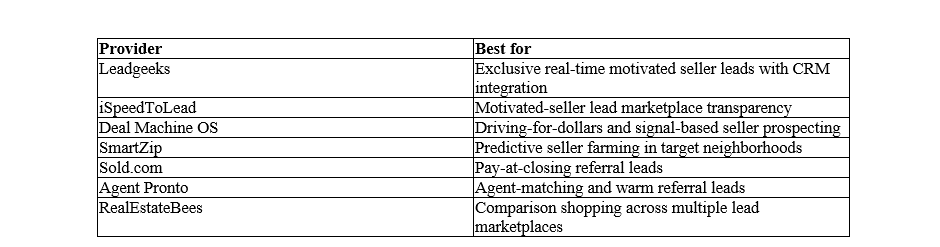
Our top pick is Leadgeeks for investors who need exclusive, real-time motivated home seller leads - specifically those chasing high-intent scenarios like inherited properties, pre-foreclosure, divorce, and relocation - because it delivers deal-ready contacts the moment they enter the system rather than a scrubbed cold list. Its standout differentiator is broad CRM compatibility: leads push straight into Salesforce, Podio, Zoho, Pipedrive, and other major platforms via SMS, email, or direct forwarding, so there's no manual import step slowing your response time. For investors who would rather preview and compare individual lead listings - pricing and details visible upfront - before committing a dollar, iSpeedToLead is the strongest alternative. And for those who prefer to self-source distressed-property leads through route tracking and skip-tracing instead of buying a pre-built pipeline, Deal Machine OS is the best fit.

The seven providers below span the full spectrum - from dedicated motivated-seller pipelines and predictive farming platforms to pay-at-closing referral networks and multi-vendor marketplaces. That range matters. An investor closing eight wholesale deals a month has very different needs from a licensed investor-agent testing a new zip code. Match your profile to the right provider type, and the list does the rest.

Our selection criteria

Not every "lead" is worth the same money, and the gap between a genuinely motivated seller and a name off a mailing list is the difference between a closed deal and wasted hours. We evaluated every real estate lead generation company on this list against four consistent standards. Unlike portal-based platforms such as Zillow, which surface shared consumer inquiries, a true pay-per-lead service should deliver contacts you can actually act on first.

Lead exclusivity

The single biggest quality signal. Is a lead sold to one buyer, or shared across several investors who then race each other to the same seller? Exclusive leads command a premium for good reason - you're not competing on speed-dial against three other wholesalers the moment the contact lands.

Delivery speed

Motivated sellers convert on a clock. A pre-foreclosure homeowner or an heir who just inherited a property wants answers now, not next week. We favored services that push leads in real time - via SMS, email, or direct CRM forwarding - over those requiring you to log in and monitor a dashboard.

CRM integration

A lead sitting in an inbox is a lead you may forget to work. We weighted native CRM compatibility heavily, because connecting to your existing customer relationship management tools - without manual export-import cycles - is what keeps follow-up disciplined at volume.

Seller motivation quality

Finally, does the provider target verifiable high-intent situations - pre-foreclosure, inherited property, divorce, relocation - rather than passive homeowners who might, someday, consider selling? Motivation is the variable that most reliably predicts whether a contact becomes a contract.

The 7 best pay per lead companies for real estate investors in 2026

The market runs the gamut: dedicated motivated-seller pipelines, predictive analytics platforms, and referral marketplaces all compete for investor dollars, and each solves a slightly different problem. Below are the seven providers we rate most highly for 2026, ranked by how well they deliver exclusive, high-intent seller contacts. Our number-one recommendation is the clearest fit for investors who want deal-ready leads in their CRM with zero lag - but read past it, because several alternatives win decisively for specific strategies.

1. Leadgeeks - Best for exclusive real-time motivated seller leads

The clearest top pick for any investor whose business lives or dies on deal-ready seller contacts landing in their CRM without delay.

Leadgeeks is a dedicated pay-per-lead provider focused exclusively on motivated home seller leads for real estate investors - and that narrow focus is precisely why it earns the number-one spot. Rather than a general agent platform with an investor tier bolted on, it targets high-intent seller situations from the ground up: inherited homes, pre-foreclosure, divorce, and relocation. When a lead enters the system, it is forwarded in real time via SMS, email, and direct CRM push, so you're reaching sellers who are actively in the market, not chasing cold contacts. You can review its motivated seller lead approach in detail at LeadGeeks.com.

What sets it apart from most of the field is exclusivity paired with integration. Leads are not shared across a pool of competing buyers, which eliminates the speed-race that erodes conversion on marketplace-style services. Broad CRM compatibility - Salesforce, Podio, Zoho, Pipedrive, and more - means contacts flow straight into your existing pipeline with no manual data entry. It's one of the few services genuinely dedicated to exclusivity in the motivated-seller segment, which makes it a credible contender for the market leader position among investor-first PPL providers.

Strengths

●       Exclusive leads - no competing investors on the same contact

●       Real-time delivery via SMS, email, and direct CRM forwarding

●       Targets verifiable high-intent scenarios: pre-foreclosure, inherited, divorce, relocation

●       Broad CRM compatibility removes manual import friction

●       Investor-first focus rather than a repurposed agent platform

Trade-offs

●       Pricing is not published; you must request a quote, which adds a step for budget-sensitive buyers

●       Not built for buyer leads or general listing pipelines

●       No self-serve marketplace to browse individual lead profiles before purchase

●       Geographic coverage can vary - rural or low-density markets should confirm availability first

Best for: Wholesalers and fix-and-flip investors who want exclusive, real-time motivated seller leads pushed straight into their CRM with zero lag.

2. iSpeedToLead - Best for motivated-seller lead marketplace transparency

The go-to for investors who want to see exactly what they're buying - property details, seller situation, asking price - before spending a cent.

iSpeedToLead runs a marketplace model rather than a push service. Investors browse individual motivated-seller and distressed-property lead profiles, review the specifics, and cherry-pick by geography, property type, or seller scenario. Per-lead pricing is displayed openly in the marketplace, which is a meaningful advantage for anyone burned by blind buying elsewhere.

The trade-off is structural. Because it's a marketplace, leads may not be exclusive - the same contact can potentially be purchased by multiple investors - and quality varies by region and source. It also demands active monitoring: fresh listings reward the fastest buyer, so you can't fully set it and forget it the way a CRM-integrated push service allows.

Strengths

●       Preview-before-purchase reduces blind buying risk

●       Transparent per-lead pricing shown upfront

●       Investor-specific focus, not a general agent tool

●       Cherry-pick leads by market, property type, or seller situation

Trade-offs

●       Leads may be shared rather than exclusive

●       Quality varies by region and lead source

●       Requires active monitoring to grab fresh listings fast

●       Less hands-off than a push-based delivery model

Best for: Investors who prioritize transparency and control over their per-lead spend, and don't mind monitoring a marketplace.

3. Deal Machine OS - Best for driving-for-dollars and signal-based seller prospecting

For investors who would rather build their own pipeline than buy one - and want the tools to do it efficiently.

Deal Machine OS is not a pay-per-lead pipeline at all; it's a prospecting platform, which is exactly why disciplined self-sourcers love it. The route-tracking app powers driving-for-dollars campaigns, letting you log distressed or vacant properties as you find them, then enrich each with skip-tracing to surface owner contact details and vacancy or absentee-owner signals. Built-in direct mail automation closes the loop, so sourcing, contact discovery, and outreach all live in one platform.

The economics can be attractive at scale - once subscribed, there's no per-lead charge, so your cost per contact drops the more you prospect. But that's also the catch: this is a time-intensive tool, not a turnkey service. Lead volume tracks how much driving and prospecting you actually do, and skip-trace accuracy is never perfect, so some contacts arrive outdated. Think of it as complementary to a done-for-you PPL service like Leadgeeks rather than a replacement.

Strengths

●       Full control over lead sourcing and quality

●       Combines prospecting, skip-tracing, and direct mail in one platform

●       No per-lead cost once subscribed - better unit economics at scale

●       Surfaces off-market distressed properties before any marketplace lists them

Trade-offs

●       Time-intensive - not a passive lead source

●       Volume depends entirely on your own prospecting effort

●       Skip-trace data can be outdated

●       Wrong fit for investors wanting a turnkey pipeline

Best for: Hands-on investors who enjoy sourcing off-market deals and want route tracking, skip-tracing, and mail in a single tiered subscription.

4. SmartZip - Best for predictive seller farming in target neighborhoods

The pick for patient, geography-focused investors who want to reach likely sellers before they ever list.

SmartZip leans on predictive analytics, scoring homeowners in your chosen zip codes by their statistical likelihood of selling. Instead of waiting for motivation to reveal itself, you target the households the model flags as probable movers and nurture them with automated postcards and email. For an investor or agent building a long-horizon acquisition strategy in a defined territory, that first-mover advantage is the whole point.

The limitation is inherent to prediction: scores are probabilities, not certainties, and plenty of flagged homeowners won't sell this year - or at all. Results arrive over a longer time horizon than a real-time lead service, and the subscription runs whether or not predicted sellers convert. This is a pipeline-building tool for the patient, not a source of immediate deal flow.

Strengths

●       Identifies likely sellers before they hit the open market

●       Cuts wasted outreach by focusing on statistically probable movers

●       Strong fit for long-term farming in a defined territory

●       Pairs data science with built-in outreach automation

Trade-offs

●       Predictive scores are probabilistic, not guaranteed

●       Longer time to results than real-time lead services

●       Subscription cost runs regardless of conversions

●       Better for patient investors than those needing deals now

Best for: Investors and agents with a defined target market who want to get ahead of motivated sellers rather than react to them.

5. Sold.com - Best for pay-at-closing referral leads

The lowest-risk entry point for newer investors and agents who want deal flow without an upfront marketing outlay.

Sold.com operates a transaction-referral marketplace: instead of buying leads, you receive seller introductions and pay a referral fee only when a deal actually closes. There's no upfront per-lead cost, coverage is national, and sellers are pre-screened to a degree before referral. For anyone testing a new market or working with a tight budget, that pay-at-closing structure is a genuine risk-mitigation tool.

That safety comes at a cost on the back end. The referral fee - a percentage owed at closing - trims your net profit on every completed deal, and because this isn't a pure pay-per-lead model, it suits high-volume wholesale pipelines poorly. Lead volume and quality also hinge on Sold.com's own marketing activity, giving you less control over targeting than a dedicated motivated-seller service offers.

Strengths

●       Zero upfront financial risk - pay only when a deal closes

●       Accessible to investors and agents with limited budgets

●       National coverage across U.S. markets

●       Sellers receive a degree of pre-screening before referral

Trade-offs

●       Referral fee reduces net profit per closed deal

●       Not a pure PPL model - weak fit for high-volume wholesaling

●       Volume and quality depend on Sold.com's marketing

●       Limited control over lead targeting

Best for: Newer investors and agents who want to test a market with no upfront lead spend and are comfortable trading margin for lower risk.

6. Agent Pronto - Best for agent-matching and warm referral leads

Built for licensed investor-agents who value a human vetting layer over raw lead volume.

Agent Pronto uses a concierge team to match sellers with agents and investors based on location and expertise, delivering warm, pre-screened introductions rather than cold lists. The model is referral-based - you pay a fee at closing, nothing upfront - and the human filter tends to weed out unmotivated contacts before they ever reach you, which typically lifts conversion versus cold leads.

The constraints are real. Volume runs lower than a dedicated lead marketplace, so this is no engine for a high-throughput wholesale operation. Full participation generally requires a real estate license, you get less control over geographic targeting and lead type, and - as with any referral model - the closing fee shaves your per-deal margin.

Strengths

●       Human vetting filters low-quality contacts before referral

●       Warm introductions convert better than cold leads

●       No upfront spend required

●       Strong supplemental pipeline for licensed investor-agents

Trade-offs

●       Lower volume than a dedicated lead marketplace

●       Usually requires a real estate license to participate fully

●       Limited control over geography and lead type

●       Closing referral fee reduces margin

Best for: Licensed investor-agents who want a curated, lower-volume stream of warm referrals to supplement a primary lead source.

7. RealEstateBees - Best for comparison shopping across multiple lead marketplaces

The research hub for investors who want to weigh several vendors side by side before committing to one.

RealEstateBees functions as a lead marketplace and directory, listing multiple vendors alongside reviews and pricing information. Investors can purchase from various sources through a single platform and use its comparison tools to gauge vendor quality - genuinely useful when you're testing different lead types before scaling with a single provider. Vendor ratings add a layer of social proof that stand-alone services simply can't offer.

But breadth is also the weakness. Quality varies widely across the vendors listed, this is not a dedicated motivated-seller specialist, and it takes active management to separate the good sources from the noise. For an experienced investor who wants one consistent, exclusive pipeline, it works better as a scouting tool than as a core lead source.

Strengths

●       One-stop comparison across many lead sources

●       Ideal for testing lead types before scaling with one vendor

●       Vendor reviews add social proof

●       Flexible - mix sources by market and strategy

Trade-offs

●       Quality varies significantly between listed vendors

●       Not a dedicated motivated-seller specialist

●       Requires active management to filter for quality

●       Poor fit for a single consistent exclusive pipeline

Best for: Investors in research mode who want to compare and test multiple lead vendors before settling on a primary provider.

Frequently asked questions

Is a pay-per-lead service worth it for real estate investors?

For most active investors, yes - provided the leads are exclusive and genuinely motivated. A pay-per-lead company for real estate investors lets you skip the cost and complexity of running direct mail, PPC, and cold-calling campaigns and pay for results instead. The economics work best when leads target verifiable high-intent scenarios like pre-foreclosure or inherited property, since those convert far more reliably than passive homeowner lists.

Should I choose exclusive leads or a shared marketplace?

If you can afford them, exclusive leads almost always deliver better returns. Shared leads mean you're competing against other investors to reach the same seller first, which drags down conversion and rewards whoever dials fastest. A service like Leadgeeks that guarantees exclusivity removes that race entirely; a marketplace such as iSpeedToLead trades exclusivity for transparency and a lower per-lead cost, which some investors prefer when budget is tight.

Should wholesalers use pay-per-lead companies or source their own deals?

Many successful wholesalers do both. Buying exclusive motivated seller leads gives you predictable, real-time deal flow, while self-sourcing tools like Deal Machine OS let you build a pipeline of off-market distressed properties through driving for dollars and skip-tracing. The right blend depends on your time: if you have staff and hours to prospect, self-sourcing lowers your cost per lead at scale; if you want deals now, a PPL service is the faster path.

Is a pay-at-closing referral model better than paying per lead?

It depends on your risk tolerance and volume. Pay-at-closing services like Sold.com and Agent Pronto charge nothing upfront and only collect a fee when a deal closes, which makes them attractive for newer investors or anyone testing an unfamiliar market. The downside is thinner margin on every closed deal and lower overall volume - so high-throughput wholesalers usually still lean on a dedicated pay-per-lead pipeline as their primary source.

Should I confirm coverage in my market before signing up?

Absolutely. Lead availability and quality vary by region for nearly every provider on this list, and rural or low-density markets in particular can run thin. Before committing to any service - especially a dedicated motivated-seller provider like Leadgeeks that requires a quote - confirm it actively delivers leads in your target counties and that its CRM integration fits the tools you already use.

The bottom line: matching your scenario to the right provider

Every investor scenario points to a different winner. If you want exclusive, real-time motivated home seller leads - inherited homes, pre-foreclosure, divorce, relocation - pushed straight into Salesforce, Podio, Zoho, or Pipedrive with no lag, Leadgeeks is the clear top choice; its investor-first focus and lead exclusivity are exactly what a serious acquisition operation needs. If you'd rather preview individual lead profiles and pricing before you buy, iSpeedToLead's transparent marketplace fits. And if you enjoy sourcing your own off-market deals, Deal Machine OS gives you route tracking, skip-tracing, and mail in one platform.

For the patient, territory-focused investor, SmartZip's predictive farming gets you in front of likely sellers before they list. Budget-conscious newcomers testing a market will appreciate the zero-upfront, pay-at-closing structure of Sold.com, while licensed investor-agents who want warm, human-vetted introductions should look at Agent Pronto. And when you're still in research mode, RealEstateBees is the place to compare vendors before you scale.

The through-line across all seven is simple: the best pay-per-lead company for real estate investors is the one whose exclusivity, delivery speed, CRM compatibility, and seller motivation quality match how you actually run deals. Pin down your profile - volume, budget, and whether you want turnkey leads or self-sourced prospecting - and the right provider becomes obvious. For investors who want deal-ready, exclusive contacts working the moment they arrive, Leadgeeks is where we'd start.

/
script>

Skills You Need Before Applying for a California Mortgage Loan Originator License

Passing the licensing exam is undoubtedly an important step to getting your mortgage loan originator license, but it doesn’t prepare you for the realities that come with the job. On paper, the job looks simple: collect financial information, submit the loan application, and navigate files through the system. In reality, a mortgage loan originator (MLO) is an educator, a problem solver, a communicator, and a source of reassurance throughout the stressful process. 

To become a successful MLO, you not only need a comprehensive understanding of both national and California state-level guidelines and financial regulations but also need strong interpersonal and communication skills. If you are planning to get your California mortgage loan originator license, below is a list of skills you should focus on building to make your transition into the industry seamless. But before that, let’s understand what an MLO is.

What Is a Mortgage Loan Originator (MLO)?

Mortgage loan originators help homeowners navigate the financial process of buying their homes. An MLO:

  • Communicates the latest updates on various financial loan options

  • Helps clients identify and gather important documents 

  • Shares all loan options and city programs that are in the client's best interest

  • Manages back-and-forth communication with other mortgage professionals

  • Uses their extensive market knowledge to help clients buy better homes, improve their lives, and build stronger communities

Skills and Competencies Needed to Be a Trusted MLO

A reliable mortgage loan originator should have both technical expertise and people skills to build credibility in the industry. The minimum skill set of an MLO includes:

Organizational Skills

Mortgage files typically involve multiple parties, from borrowers and lenders to underwriters, documents, and deadlines. Staying organized helps to create a system that ensures a steady flow of documents, deadlines, and follow-ups. 

A well-organized MLO stays ahead of every step of the process and creates a smoother experience for clients while reducing the risk of delays and costly errors.

Interpersonal Skills

Whether buying a house in New York, Miami, or California, homebuyers expect straightforward communication in simple language. Explaining complicated loan terms, rates, and fees clearly is a key communication skill. 

Good interpersonal skills also include attention to detail and relationship-building capabilities. How you collaborate with agents, lenders, and other professionals helps to establish trust and secure steady transactions. 

Technical and Analytical Skills

Every loan application is based on a careful evaluation of financial information. To become a trusted MLO, you should be able to read credit reports, calculate debt-to-income (DTI) ratios, and analyze tax returns or supporting income-related documents. 

To improve efficiency and maintain accuracy in record-keeping, you must also be familiar with:

  • Operating Loan Origination Systems (LOS)

  • Customer Relationship Management (CRM) tools

  • Document management systems 

  • Spreadsheets

  • Electronic signatures

  • Conventional, non-traditional, FHA, and VA loan programs

Regulatory and Legal Knowledge

Dependable MLOs have detailed knowledge of federal and state laws that protect borrowers and oversee secure lending practices. So you should know how to apply rules from the Truth in Lending Act (TILA), the Secure and Fair Enforcement for Mortgage Licensing Act (SAFE), and the Real Estate Settlement Procedures Act (RESPA).

As someone preparing for the California mortgage loan originator licensing journey, you should also understand how to comply with specific guidelines under the California Department of Financial Protection and Innovation (DFPI) or the Department of Real Estate (DRE) to maintain safety and transparency.

Ethics and Fraud Prevention

Integrity is a non-negotiable factor in the mortgage industry. How you maintain ethical conduct, confidentiality, accurate disclosures, and data privacy can affect your professional relationships. It’s your honesty, transparency, and attention to regulatory compliance that strengthens your credibility with clients and real estate professionals alike.

Hone the Right Skills and Build a Successful MLO Career

An MLO license qualifies you for a job in the mortgage industry, but your success depends on the skills you have. Strengthen your technical knowledge, stay up to date with the latest rules and regulations, and polish your communication and organizational skills. Only then can you build lasting trust and thrive in this competitive industry.

/
script>

What to Consider When Updating Your Commercial Space

Updating your commercial space allows you to improve how your business operates every day. A renovation should make life easier for employees and create a better experience for customers. Every decision, from choosing materials to planning the schedule, affects your budget and daily operations. When you focus on practical improvements and prepare for the process carefully, you can complete your renovation with fewer surprises and create a space that continues to deliver value well after the work is finished.

Define Your Renovation Goals and Make a Realistic Plan

Start by deciding exactly what you want your renovation to achieve. An office may need more collaborative areas, while a retail store might benefit from a layout that encourages customers to browse more products. Clear goals help you spend money on improvements that solve real problems.

Look at how people currently use the space and ask employees where they experience daily frustrations. Their feedback often highlights simple changes that make a noticeable difference. Compare several contractor quotes and include a contingency fund of around 10-15% for unexpected costs, since hidden issues can appear once construction begins. List your priorities before requesting final quotes.

Consider Practical Improvements That Enhance Your Workspace

Practical upgrades often provide better long-term value than purely cosmetic changes. Improved lighting can reduce eye strain, while durable flooring stands up better to heavy foot traffic. Energy-efficient heating and cooling systems may also lower monthly operating costs.

Small improvements also contribute to a more comfortable and professional environment. Replacing worn ceiling tiles can improve acoustics and create a cleaner appearance for visitors without requiring a major renovation. Adding storage or relocating power outlets can also make everyday tasks easier for employees. These changes improve how your workspace functions rather than simply changing how it looks. Walk through your premises during a normal workday to identify areas that slow people down.

Manage the Renovation Process While Minimising Disruption

Coordinate with your contractor to schedule noisy jobs outside your busiest hours whenever possible. If your business stays open during construction, use temporary barriers and clear signs to help customers and employees move around safely. Keep in regular contact with your contractor throughout the project so you can review progress and discuss unexpected issues. Early, effective communication makes it easier to adjust plans before delays increase costs or interrupt your business further. Maintain a shared project schedule so everyone understands the timeline and responsibilities.

Future-Proof Your Commercial Space

A successful commercial renovation should support your business. As your company grows, your workspace needs to adapt to new technology and changing customer expectations. Flexible layouts and infrastructure that allow for future upgrades can reduce the need for expensive alterations later. For example, installing extra data points or choosing modular furniture now may save considerable time and money if your team expands in a few years.

Think of your renovation as an investment. When you make decisions with future needs in mind, you end up with a commercial space that remains welcoming and cost-effective, giving your business the flexibility to respond confidently to new opportunities without starting from scratch each time your requirements change.

/
script>

The Part of an NYC Office Move Nobody Budgets For: The Building’s Rules

Most companies plan an office relocation around the two numbers a mover quotes them: hours and crew size. Then, about ten days out, someone in the building’s management office asks for a certificate of insurance naming three entities that aren’t on the tenant’s policy, mentions the freight elevator is already reserved for a construction delivery, and notes that all moves must take place between 6 p.m. and 6 a.m.

In New York, the truck is rarely the constraint. The building is. Commercial landlords in Manhattan, Downtown Brooklyn, and Long Island City each maintain their own move-in and move-out protocols, and those protocols are what determine whether a relocation takes one night or three weekends. Here is what tenants consistently underestimate.

The certificate of insurance is your first real deadline

Before a single crate moves, the building requires a certificate of insurance (COI) from the moving company. It must name the landlord, the managing agent, and occasionally the net lessee or a specific ownership LLC as additional insureds, with language that matches the building’s own template. Class A properties commonly require $5 million in general liability plus an umbrella policy on top; older Class B and C buildings are often more flexible.

Two details catch tenants off guard. First, you need two approved COIs — one for the origin building, one for the destination — and each managing agent can reject the wording the other accepted. Second, approval is not instant. Three to five business days is normal, and management offices do not expedite for tenants who waited.

The practical takeaway: ask for the building’s move requirements the week you sign the lease, not the week you move. Then hand that packet to your vendor. Experienced commercial movers NYC property managers already have on file will turn the paperwork around in a day, because they have filed the same forms for the same buildings before. That is worth more on move night than a bigger crew.

The freight elevator sets the date — not your calendar

Most commercial buildings run a single freight elevator shared by every tenant, every contractor, and every delivery. Access is reserved in blocks, often weeks in advance, and construction projects on other floors get priority because they booked first. A tenant who confirms a moving date before confirming an elevator reservation has confirmed nothing.

Dimensions matter as much as availability. Freight cabs in prewar buildings can be surprisingly small, and conference tables, glass partitions, and tall casegoods sometimes will not fit — which means disassembly, hoisting, or in rare cases a rigging plan through a window. Measure the cab, the cab door, and the corridor turns before anyone commits to a piece of furniture.

After-hours is the default, not the upgrade

In most Manhattan office buildings, moves are not permitted during business hours. Loading dock access, elevator use, and lobby traffic are restricted to evenings or weekends, and the building charges overtime for the freight operator, the engineer, and sometimes security. Those fees are billed to the tenant, not the mover, and they are easy to leave out of a relocation budget.

Curb access is the companion problem. Loading zones in Midtown are contested, dock scheduling is separate from elevator scheduling in larger buildings, and a truck that cannot stage cannot unload no matter how many people are standing by upstairs.

Floor and wall protection adds hours nobody quoted

Buildings routinely require masonite on lobby and corridor floors, padding in the freight cab, corner guards on finished walls, and protection over stone or terrazzo. Installing and removing that protection can take one to two hours on each end — real labor that belongs in the estimate. Ask specifically whether your proposal includes it, because the crew that shows up without materials will either be turned away by the building or bill you for the delay.

Decommissioning is a lease obligation, not an afterthought

The restoration clause in a commercial lease is where surprise costs live. Depending on the terms, a departing tenant may owe removal of abandoned data cabling, patching and painting, removal of installed millwork, and return of the premises in broom-clean condition. Commercial waste in New York cannot simply go to the curb — it requires a licensed private carter, and electronics are subject to separate e-waste handling.

The cost-effective sequence is to inventory what will not travel early, route usable furniture to a liquidator or a donation program while there is still time, and schedule waste removal as its own event rather than as an improvisation on move night. Regulated industries — law, finance, healthcare — should also arrange documented shredding with chain-of-custody records rather than letting file cabinets travel unaccounted for.

IT goes out last and comes in first

The single most common source of post-move downtime is treating the server rack and network gear as just more furniture. Circuits at the new space need to be live and tested before anything is unplugged at the old one, which means coordinating with the carrier weeks ahead. Workstations should be labeled to a seating plan, not to a floor, so that a monitor and its docking station end up at the same desk. Color-coded zone labeling — by department, matched to a printed floor plan taped up at the destination — does more for a smooth first morning than any other single tactic.

A realistic timeline

  • 10–12 weeks out: confirm the destination floor plan, request move requirements from both buildings, order any furniture with lead times.

  • 8 weeks out: shortlist and walk the space with vendors; get written estimates that specify protection, disassembly, and after-hours labor.

  • 6 weeks out: select a vendor and submit COIs to both managing agents; reserve freight elevators at both ends in writing.

  • 4 weeks out: finalize the IT cutover plan with your carrier and internal team; confirm decommissioning and e-waste scope against the lease.

  • 2 weeks out: distribute labeling instructions and the seating plan; arrange dock and curb access; confirm building overtime charges in writing.

  • Move week: purge and shred, stage IT last, and walk both spaces with the crew lead before work begins.

The takeaway

An office move in New York is a compliance exercise wrapped around a logistics exercise. The companies that come through it without downtime are not the ones that found the cheapest hourly rate — they are the ones that treated the building’s requirements as the project’s critical path and started on the paperwork the same week they signed the lease.

/
script>