Best Fire Protection Services in Orange County for Compliance Testing and Emergency Repairs

Orange County's fire code environment is genuinely demanding, and not every contractor is ready for it. Finding the best fire protection services in Orange County means sorting through contractors who may lack C-16 licensing, miss AHJ-specific requirements, or struggle to keep pace with California Fire Code updates. After reviewing dozens of providers across Southern California, the pattern is clear: experience with local jurisdictions separates reliable contractors from risky ones. This guide covers five providers worth knowing, including what each one does well and where they fit best.

The research approach for this ranking

Public information was gathered from official company websites, contractor directories, and service-specific review sources. Only providers with a demonstrated track record in fire protection services made the cut. Options without verifiable service histories or jurisdiction-relevant experience were filtered out early.

→ See the full research breakdown

  • Spectrum For Fire Protection - Best for full-service fire protection for commercial, industrial, and residential properties in Southern California

  • Avalon Fire Protection - Best for commercial fire protection services with round-the-clock technician availability

  • Anchor Fire - Best for large-scale fire protection system installation and maintenance

  • Intertek - Best for global product testing, certification, and compliance assurance

  • Fire Protection Tustin - Best for fire protection services across Southern California

Why Fire Protection Services In Orange County Are Worth a Closer Look

Orange County's fire protection requirements carry real consequences when handled loosely. A failed inspection, a missed NFPA 13 update, or a contractor unfamiliar with local AHJ expectations can result in code violations that shut down operations or delay building permits. The challenge isn't just finding a licensed provider. It's finding one who knows the difference between what California Fire Code Title 19 requires on paper and what the Orange County Fire Authority actually enforces in the field.

Providers with that local knowledge tend to post stronger system inspection pass rates on first review, respond faster during emergencies, and bring technicians with more NFPA certifications to the job. That combination of local fluency and technical depth is what separates a contractor worth hiring from one that just gets you to the next inspection cycle.

Comparing the 5 Best Fire Protection Services In Orange County

Note: All data in this table is sourced from review platforms and the official websites of the listed companies.

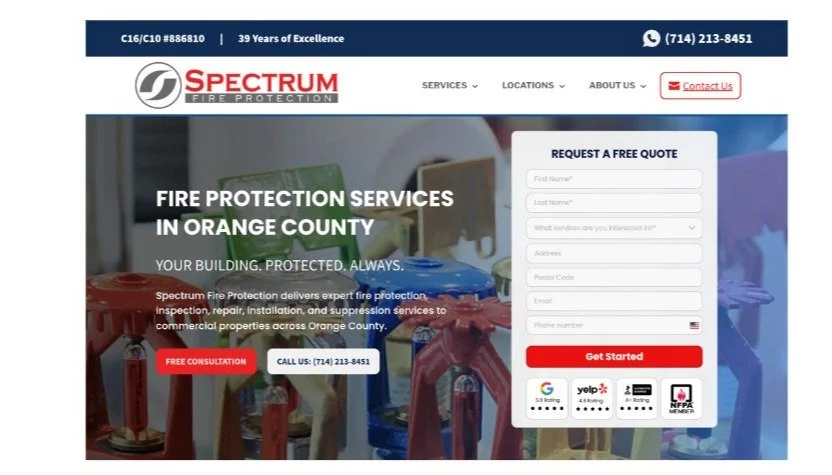
1. Spectrum For Fire Protection - Best for Full-Service Commercial and Residential Fire Protection in Southern California
What Services Does Spectrum For Fire Protection Offer?

Spectrum For Fire Protection covers the full range of fire safety work: sprinkler system design and installation, fire extinguisher servicing, fire hydrant maintenance, suppression system work, fire pump inspections, and exit and emergency light checks. They serve commercial, industrial, and residential properties throughout greater Los Angeles and Orange County. What makes them a practical choice is that, as a well-established fire protection services provider in Orange County, they've built 35-plus years of direct experience working through California Fire Code requirements and AHJ-specific expectations across the region.

Why Does Spectrum For Fire Protection Stand Out for Fire Protection Services In Orange County?

Spectrum For Fire Protection addresses one of the most persistent problems in this space: finding a fully licensed, locally experienced contractor who can handle both routine inspections and same-day emergency calls without passing you off to a subcontractor. Their NFPA membership, combined with decades of Southern California project history, gives them a depth of local code fluency that newer or out-of-region contractors simply haven't had time to build.

What Users Are Actually Saying:

Clients consistently point to responsiveness and straightforward communication as standout qualities. The recurring theme is that Spectrum For Fire Protection shows up on time, explains what's needed without upselling, and handles the paperwork side of NFPA, California Fire Code, and local AHJ (Authority Having Jurisdiction) compliance cleanly. That kind of reliability is rare in a field where last-minute rescheduling and unclear invoicing are genuinely common complaints.

2. Avalon Fire Protection - Best for Commercial Fire Protection with Round-the-Clock Technician Availability

What Services Does Avalon Fire Protection Offer?

Avalon Fire Protection handles fire alarm installation, maintenance, and monitoring; sprinkler system design and installation; fire extinguisher inspection; suppression system servicing; and fire pump inspections. Based out of Anaheim, they serve Orange County and surrounding areas with a team available around the clock. Their two decades in the field mean they've worked through enough California Fire Code updates to know where the compliance traps tend to show up (and honestly, that kind of deep, specialized knowledge matters more than most clients realize).

Why Does Avalon Fire Protection Stand Out for Fire Protection Services In Orange County?

Avalon Fire Protection fills a specific gap for commercial property managers who need a contractor reachable outside standard business hours, especially for emergency service calls where a slow response can turn a small issue into a serious liability. Their 24/7 technician availability, paired with focused commercial experience, makes them a stronger fit for multi-unit properties or facilities with complex suppression systems than a generalist residential contractor would be.

What Users Are Actually Saying:

The general sentiment points to Avalon's technicians being knowledgeable and easy to work with on-site. Clients managing commercial properties seem to return for contract renewals at a solid rate, which suggests the quality holds up after the initial installation. The 24/7 availability gets cited frequently as the deciding factor for property managers who've been burned by contractors that go dark after hours.

3. Anchor Fire - Best for Large-Scale Fire Protection System Installation and Maintenance

What Services Does Anchor Fire Offer?

Anchor Fire Protection has been operating since 1978 and covers fire sprinklers, fire alarms, life safety systems, fire extinguishers, inspection and testing, and emergency services. What sets them apart structurally is their in-house Engineering Department and Fabrication Shop (not every contractor has that), which lets them take on projects that smaller firms would need to outsource mid-job. They've handled everything from high-rise buildings to large distribution centers across Pennsylvania, New Jersey, Maryland, Delaware, and North Carolina.

Why Does Anchor Fire Stand Out for Fire Protection Services In Orange County?

Anchor Fire solves the scale problem that many large commercial or industrial property owners run into: finding a single contractor who can manage design, fabrication, installation, and inspection without stitching together multiple vendors. Their back-to-back ABC Eagle Award recognition for design and construction excellence adds credibility that's hard to argue with, and that kind of recognition usually means the work holds up under AHJ scrutiny.

What Users Are Actually Saying:

Review patterns for Anchor Fire tend to highlight project management capabilities on larger jobs. Clients working on distribution centers or multi-floor commercial buildings note that the in-house engineering team cuts down on back-and-forth delays. For complex installations, that internal coordination is often the thing clients don't appreciate until they've dealt with a fragmented contractor setup and watched timelines slip.

4. Intertek - Best for Global Product Testing, Certification, and Compliance Assurance

What Services Does Intertek Offer?

Intertek operates across product testing, inspection, certification, and compliance verification for industries ranging from construction and energy to healthcare and transportation. With origins going back to 1885 and over 45,000 employees across more than 100 countries, they function at a scale that's genuinely hard to picture for a regional fire contractor. Their OSHA-recognized NRTL status (spanning 30 years) positions them as a verification authority for fire protection equipment and safety products rather than an on-site installation or inspection contractor.

Why Does Intertek Stand Out for Fire Protection Services In Orange County?

Intertek addresses the product-level compliance question that comes up when fire protection equipment needs third-party certification before it can be installed under local code. Their global testing setup and long-standing NRTL accreditation make them the right call when a facility needs equipment validation that goes beyond what a field inspector can certify. Their recent launch of SupplyTek (a global market access tool) suggests they're continuing to build out faster pathways for clients working through complex regulatory requirements.

What Users Are Actually Saying:

Intertek's client base skews enterprise (think Fortune 500 partnerships with companies like BP and Unilever), so review sentiment in the traditional sense is less visible than for regional contractors. What's clear from published case studies is that long-term clients trust them for consistency across multiple jurisdictions, which makes sense given their global footprint. The relationships tend to be multi-year and deeply tied into product development cycles.

5. Fire Protection Tustin - Best for Fire Protection Services Across Southern California

What Services Does Fire Protection Tustin Offer?

Fire Protection Tustin, operating under Apex Fire Protection Services, covers installations, routine inspections, fire alarms, sprinkler systems, and fire extinguisher servicing across Tustin and surrounding Southern California areas. The company positions itself around quality and a broad range of service options designed to meet different property types and fire protection needs. For smaller businesses or property owners who want a locally focused provider without enterprise-level overhead, they represent a reasonable starting point.

Why Does Fire Protection Tustin Stand Out for Fire Protection Services In Orange County?

Fire Protection Tustin focuses on bringing accessible, routine fire protection services to smaller and mid-size Southern California properties that might otherwise struggle to find a contractor who doesn't treat their job as a lower priority compared to larger commercial accounts. Their local Tustin base means they're working within the same AHJ environment as their clients, which cuts down the learning curve on jurisdiction-specific requirements.

What Users Are Actually Saying:

Review signals for Fire Protection Tustin point toward clients valuing approachability and responsiveness on smaller-scale jobs. The consistent feedback is that scheduling is straightforward and technicians arrive prepared. They work well for property owners who want clear communication and a local point of contact rather than a regional call center experience.

Methodology Behind These Picks

Gathering the Baseline Information

The research started by pulling a broad list of fire protection contractors serving Orange County and the wider Southern California region. Sources included contractor directories, local business listings, trade association member databases, and service-specific review platforms. The goal at this stage was coverage, not filtering. Every provider with a public web presence and some form of service history in fire protection was added to the initial pool for review.

The Shortlist Cut

Once the broad list was assembled, providers without verifiable service histories were removed. This included companies with no documented project work, no named technician credentials, or review profiles that showed only a handful of unverifiable entries. Review patterns were also checked for consistency. A company with a single spike of reviews followed by silence raises different questions than one with a steady accumulation over multiple years. Providers that couldn't demonstrate a stable pattern of client work were cut at this stage.

Fact-Checking the Picks

Each provider that made the shortlist was then cross-referenced across multiple sources. Claims made on official websites, such as years in operation, licensing status, and service coverage areas, were checked against third-party directories, review platform profiles, and where possible, contractor license databases. When a website claimed 20-plus years of experience but the business registration told a different story, that discrepancy was flagged. Only providers where the public record matched the stated claims moved forward.

Authority Signals and Industry Standing

Beyond initial verification, each provider was evaluated for signals that indicate standing within the fire protection industry. This included NFPA membership, contractor association affiliations, industry award recognition (such as ABC awards or certification body designations), and mentions in trade publications or regional business coverage. A provider that has earned recognition from within the industry, rather than just from individual client reviews, tends to carry more weight when AHJ approval rates and first-pass inspection outcomes matter.

Fire Protection Services In Orange County Track Record

The final filter focused on Orange County and Southern California relevance. Providers with dedicated service pages for Orange County, documented project work in the region, and reviews from identifiable local property types (restaurants, warehouses, commercial office buildings) were prioritized. A contractor with deep experience in a different state may carry strong overall credentials, but their track record with California Fire Code Title 19, NFPA 13, NFPA 72, and Orange County AHJ expectations is what determines fit for local clients. Providers with clear, verifiable local case studies or jurisdiction-specific service documentation ranked highest on this dimension.

Picking the Right Fire Protection Services In Orange County for You

Choosing a fire protection contractor in Orange County comes down to matching the provider's strengths to your specific property type, inspection timeline, and code requirements. Here's what to look at before signing a service agreement.

  • Industry/Domain Experience: Look for contractors with documented project work in your occupancy type. A provider experienced in restaurant suppression systems isn't automatically the right fit for a warehouse or high-rise, and vice versa.

  • Features and Service Range: Confirm the contractor handles the full scope you need, including design, installation, inspection, and emergency repair. Gaps in service coverage often show up at the worst possible moment.

  • Pricing Structure: Ask upfront whether pricing is flat-rate per inspection cycle or based on system scope. Unexpected add-on fees after an initial quote are a common frustration (and a sign to look elsewhere).

  • Results Measurement: Ask about first-pass inspection rates and AHJ approval history. A contractor confident in their work won't hesitate to share that data.

  • Industry Knowledge and Compliance: Verify familiarity with NFPA 13, NFPA 72, California Fire Code Title 19, and your specific local AHJ requirements. This is non-negotiable for Orange County properties.

The Verdict

Orange County's fire protection market rewards contractors with genuine local code knowledge over those with broad but shallow credentials. Spectrum For Fire Protection brings the longest regional track record of the group, with 35-plus years of Southern California experience and same-day availability. Avalon suits commercial property managers needing 24/7 coverage. Anchor Fire handles large-scale installations well. Intertek serves enterprise-level certification needs. As California Fire Code requirements keep evolving, the value of a locally experienced, fully licensed contractor only grows.

/
script>

Is a Home Cold Plunge Worth It? The Complete Guide

In high-end modern homes, wellness architecture is undergoing a quiet revolution. Where saunas and home gyms once held complete reign over personal recovery spaces, a new essential fixture has taken center stage: the dedicated home cold plunge.

What began as a brutal ritual reserved for elite Olympic athletes and biohacking pioneers has transformed into a sought-after daily ritual for entrepreneurs, design-conscious homeowners, and fitness enthusiasts alike. Yet, as cold therapy transitions from trendy social media content to a permanent home investment, anyone considering adding one to their sanctuary faces the same practical question: Is a home cold plunge actually worth the space, time, and financial commitment?

To answer that, we have to look past the social media hype and examine the tangible physiological return on investment (ROI), the daily lifestyle integration, and how modern engineering has finally made cold therapy effortless.

1. Beyond the Freeze: The Science of What Cold Therapy Does to Your Body

Plunging into water below 55°F triggers an instant, systemic physiological reset. While the initial reaction is a shock to the nervous system, what happens in the minutes and hours following the plunge is where the real value lies.

Instant Mental Clarity and Neurochemical Elevation

The most immediate benefit of an ice bath isn't physical—it's cognitive. Exposure to cold water stimulates a massive release of norepinephrine and dopamine, neurotransmitters responsible for mood elevation, focus, and energy. Unlike the quick spike and eventual crash associated with caffeine, the mental clarity and calm alertness resulting from a 3-minute cold plunge can sustainedly elevate your focus for hours throughout your workday. Upgrading your daily routine with a high-performance cold plunge with chiller system ensures your tub is always prepped at the optimal temperature for instant morning revitalization.

Accelerated Recovery and Vascular Flushing

When your body meets cold water, peripheral blood vessels instantly constrict—a process called vasoconstriction—pushing blood away from your extremities and toward your core to protect vital organs. This rapid shift flushes metabolic waste and reduces inflammation in overused muscles. Once you step out of the plunge, your blood vessels dilate (vasodilation), surging freshly oxygenated, nutrient-rich blood back into your tissues to accelerate recovery and soothe soreness (DOMS).

Stress Resilience and Nervous System Conditioning

Cold exposure is a form of controlled, voluntary stress. When you submerge yourself in icy water, your instinct is to hyperventilate and escape. By intentionally slowing your breath and staying calm, you actively condition your parasympathetic nervous system. Over time, this daily practice builds a profound level of mental resilience that translates directly into handling high-pressure professional environments with calm poise.

Optimizing Sleep Architecture

Deep, restorative sleep relies heavily on your body’s ability to drop its core temperature at night. Regular cold plunges—particularly when practiced earlier in the day—help regulate circadian rhythms and improve nervous system balance, setting the stage for deeper REM and slow-wave sleep cycles.

2. Calculating the True ROI: Bagged Ice vs. Dedicated Cold Plunge Systems

Many people begin their cold plunge journey with a temporary DIY setup—usually a basic tub or stock tank filled with endless bags of store-bought ice. While this approach works for a week or two, it quickly reveals its operational friction.

When evaluating whether a permanent, high-end home setup is worth it, consider these three crucial factors:

Time Friction vs. Routine Consistency

A wellness routine is only as effective as your ability to stick with it. Purchasing 30 to 50 pounds of bagged ice every few days requires constant errands, dedicated freezer storage, and 20 minutes of preparation before every single session. When a ritual feels like a chore, consistency inevitably crumbles. An automated setup eliminates every barrier to entry, ensuring your water is filtered, sanitized, and held at your exact target temperature 24/7.

Financial Breakdown: The Hidden Costs of Ice

While a dedicated chiller system requires an upfront investment, buying bagged ice is deceptively expensive over time:

  • The Bagged Ice Math: Spending $12 to $15 per session on commercial ice bags 4 times a week adds up to roughly $200–$240 a month, or nearly $2,500 to $3,000 annually.

  • The Dedicated Chiller Math: Modern water chillers run on efficient, standard household electrical setups. The upfront cost of a chiller typically pays for itself within 8 to 12 months compared to recurring ice purchases—while saving you hundreds of hours in travel and prep time.

Materials and Aesthetics: Lightweight Durability

For modern residential spaces, bulky acrylic units or heavy cast tubs aren't always practical—especially on elevated decks, indoor home gyms, or covered patios. High-density drop-stitch PVC construction has emerged as the premier material choice for luxury portable plunges. Originally engineered for high-pressure inflatable paddleboards, drop-stitch PVC becomes rock-solid when inflated, resisting weather, UV rays, and punctures while remaining exceptionally lightweight and easy to relocate.

3. How to Design Your Home Cold Plunge Protocol

If you are ready to integrate cold therapy into your lifestyle, success comes down to safe, deliberate execution rather than pushing your limits to extremes.

1. Setting the Temperature

You do not need freezing water to unlock physiological benefits.

  • Beginners (Adaptation Phase): Start between 50°F and 59°F (10°C to 15°C). Focus on breath control and staying relaxed.

  • Intermediate to Advanced: Target 39°F to 48°F (4°C to 9°C) once your body has adapted to regular exposure.

2. Time and Frequency

  • Duration: Keep sessions between 2 to 5 minutes. Research shows that pushing beyond 5 minutes yields diminishing returns and increases unnecessary shivering.

  • Weekly Goal: Aim for a total cumulative exposure of roughly 11 minutes per week, broken down into 3 to 4 short sessions. This sweet spot delivers optimal metabolic and mental health benefits without overstressing the body.

3. Essential Equipment Features

When shopping for an automated plunge setup, prioritize:

  • Precision Cooling & Heating: Look for chillers capable of holding stable temperatures down to 36°F–39°F even in warm ambient weather.

  • Multi-Stage Filtration: Built-in mechanical filters paired with sanitation systems (such as ozone or UV) ensure crystal-clear, hygienic water with minimal maintenance.

  • Plug-and-Play Installation: Choose systems with standard quick-connect hoses so you can set up or move your system without calling a plumber.

Frequently Asked Questions 

How often should I cold plunge every week?

Most health and recovery benefits are achieved with a total of 11 minutes of cold water exposure per week. You can easily split this into 3 to 4 sessions lasting about 2 to 3 minutes each.

What is the best water temperature for a beginner?

Beginners should start between 50°F and 59°F (10°C to 15°C). There is no need to jump straight into near-freezing temperatures; your body gains significant cardiovascular and psychological benefits simply by adapting to water that feels uncomfortably cold.

How do I keep the plunge water clean and sanitary?

A dedicated home setup uses a water chiller equipped with a continuous circulation pump, a replaceable filter cartridge (to catch debris and body oils), and built-in sanitation like Ozone or UV technology. This allows the water to remain clear and clean for weeks without constant draining.

How much electricity does a home cold plunge chiller consume?

Modern chillers utilize high-efficiency compressors similar to a standard mini-fridge. Once the water reaches your target temperature, the compressor only runs periodically to maintain it, making the monthly power cost remarkably low compared to buying bags of ice.

The Final Verdict

So, is a home cold plunge worth it?

If you view it merely as a passing novelty, probably not. But if you value sharp mental focus, rapid physical recovery, enhanced stress tolerance, and a refined home wellness sanctuary, investing in a dedicated cold plunge setup is one of the most rewarding lifestyle upgrades available today.

By pairing a durable, high-density tub with an automated water chiller, you strip away the tedious logistics of traditional ice baths and replace them with an effortless, everyday luxury that pays health dividends for years to come.

/
script>

Why Livestock Comfort Contributes To Better Farm Performance

The well-being of livestock is one of the most essential aspects to focus on in order to ensure the high performance of a farm. Providing animals with enough clean space, resources, and comfort enables them to grow and develop adequately. In addition, it is vital to offer a good environment and quality care to avoid any health issues and achieve a superior workforce. Therefore, attention to the comfort of the cattle is a crucial priority in any successful farming business.

Supporting Animal Health

Creating comfortable conditions for the livestock is one way of ensuring that there is no unnecessary stress, which may affect the health of the cattle. In case the livestock gets too hot, lacks water or is held in restricted spaces, the livestock has to use additional energy to cope with such situations. Through ensuring that there are adequate resources in the environment, farmers make sure that the livestock does not struggle much when performing their activities in the day. For instance, by constructing dependable cattle troughs, the cattle can have access to water without expending more energy to cope with competition and other difficulties.

Healthy cattle can also help farmers in another way. If animals are able to thrive in their surroundings, it becomes much easier for the farmers to handle them on a daily basis. They won’t need to use as many resources overcoming issues stemming from poor management practices. Making simple upgrades to make life easier for the cattle can help farmers achieve higher production rates while simultaneously allowing them to focus their effort and energy elsewhere.

Improving Farm Efficiency

A well-structured livestock environment can serve to make various activities involved in animal husbandry easy through elimination of any form of obstruction to the work done on a daily basis. Arrangement of layout and equipment is key to accomplishing this since it influences how easy it will be to handle and monitor animals. For example, proper arrangement of the cattle gate will make herding much easier and also make it easy for the animals to feed and monitor their movement into the pastures.

Lastly, organization of the animal husbandry environment serves to increase productivity since it ensures that the animals are maintained in good physical condition throughout the year. It is especially important when it comes to regulation of temperature since it determines the degree of comfort felt by animals living in confined and partially confined environments. Mechanical ventilation is important in such areas and can be brought about by use of exhaust fans.

Enhancing Long Term Productivity

Investing in animal comfort can bring long-term advantages to the producers by ensuring higher performance levels and minimizing various issues. Such farms that care about their animals’ welfare tend to have more stable systems and processes that do not need improvement as often. This is because animals that feel comfortable within their surroundings are usually easier to handle and less stressed, which results in better organization and predictability of outcomes.

Animal welfare directly impacts the outputs of a farm, which highlights the importance of creating favorable living conditions for the livestock. By providing animals with adequate housing and resources, such as water and quality equipment, one can showcase the attitude to animals’ needs. Furthermore, by investing in animals’ comfort, it is possible to prevent losses due to the poor operation of various machines and tools. This way, farms ensure their stable operation while meeting the growing demand.

I think that livestock comfort is very important. If farmers take care of their animals and give them the best they can, the animals will reward them. The comfort of the animals will make the farm operations run smoothly, efficiently, and productively. A focus on animal well-being is an important aspect of good farm management for cattle, but it also has positive consequences on other areas of the farm, such as resources or operations. This would make the farm more profitable and have a better output in the future.

/
script>

How To Identify The Right Plumbing Components For Home Improvement Projects

Home improvement projects often involve upgrading or repairing plumbing system components. A significant amount of thought and time must be invested to ensure that everything works well. When remodeling or fixing some of the most used parts, it is critical to have an understanding of their nature, purpose, and role in the overall system. By making the right choices, one can ensure good performance and avoid future issues.

Evaluating Project Needs

Before purchasing plumbing sections, it is essential to consider what needs they will serve and what requirements they must fulfill. One should think about the task ahead and whether the given pipes will be sufficient for its completion. Moreover, it is vital to keep in mind the pressure within closed systems and the conditions under which the chosen material will operate in order to avoid recurrent replacements.

In addition, one should remember that depending on the area, different plumbing sections can be appropriate. For example, items for water supply, sewage system, and irrigation have specific areas for their application. This distinction is due to the various conditions and loads to which pipes are subjected. This way, it is essential to learn more about the characteristics of plumbing equipment in order to determine their areas of application.

Choosing Durable Plumbing Materials

Material resources are another essential aspect to focus on when redesigning a home plumbing system. Components made of high-quality materials resist frequent use and ensure the years-long operation of the devices and systems they are part of. Such resources as plastic are lightweight, corrosion-resistant, and multifunctional.

Moreover, when choosing particular details, it is essential to pay attention to their capabilities and advantages. For instance, a pvc check valve is an integral part of a plumbing system when there is a need to prevent the reverse movement of fluid. It is crucial to understand the importance of each detail and component in order to operate the given structure efficiently and transparently.

Comparing Component Features

The main advantage of various plumbing components is that they can provide specific benefits relevant to their use. For example, the ability to operate them simply, connect securely, and adapt to the existing piping system must be taken into account. The components that allow easier inspection and maintenance can contribute to the overall efficiency of the plumbing system and ensure control over its further operation.

The shut-off and control components are particularly important because they define the conditions for regulating the flow of water in the plumbing system. Ball valves, in particular, are a popular choice for installation in residential buildings because they allow for a simple start/stop of the flow and quick removal of the component itself when maintenance is required. Thus, the correct choice of the shut-off elements and their proper size ensure the convenience of use and the overall reliability of the plumbing system.

Considering Maintenance And Safety

I think that long-term maintenance should always be considered when purchasing parts and equipment. I would look for something that is easily maintained or replaced. Something that could be a problem in the future but is currently fine should not be used.

I think that it is important to make sure that modifications are done safely. Making sure that things won't leak or go wrong in the future is essential if you want to make sure your modifications are useful in the long run. I think that the plastic check valve could be a good modification for places that need to have water flow in only one direction. I believe that it's important to make sure that the parts you buy are going to be suited for what you need them for.

Planning For Successful Improvements

Successful plumbing upgrades demand the right preparation before the old fixtures are replaced. Homeowners need to measure existing piping, ensure that the new parts match the existing structures, and understand how each element in the new design contributes to the best performance of their system. This way, they can avoid the inconveniences that come with poor preparation and guarantee that the components they have chosen complement the existing parts.

It is also necessary for homeowners to consider consulting professionals when it comes to significant improvements. Though many plumbing jobs can be undertaken by inexperienced but determined DIY’ers, advanced modifications demand the right expertise and experience in the field. In this case, preparation and research are vital to guarantee that the chosen approach fits their needs and that the new fixtures align with their expectations.

The ability to choose the right plumbing components for one’s home is vitally important and has a significant impact on the overall functionality and reliability of the housing. It is essential to take into account the specific needs, materials’ characteristics, maintenance demands, and peculiarities of equipment being installed to make the best possible choice. The proper attention to detail will result in a high-performance structure that will minimize the need for expensive and time-consuming interventions.

/
script>

Best non-welded roof opening frames for residential buildings

Cutting a hole in a finished roof feels risky: one stray torch spark and you’re fighting leaks, delays, and hot-work permits. Hot-work welding starts roughly 3,400 structure fires a year, says the National Fire Protection Association. Bolt-together frames flip that script. Two installers with a cordless impact can frame a 4-by-4-foot opening in about 20 minutes—seven times faster than stick-built angle iron, according to Simpson Strong-Tie demos. In the pages ahead we rank six no-weld systems by speed, adjustability, code readiness, and cost so you can pick the right frame and close up before the rain arrives.

Why go weld-free?

Welding on a roof is slow, costly, and risky. It ties up skilled crews, forces hot-work permits, and leaves fresh steel exposed until someone paints it. Worse, it sparks fires. NFPA data shows hot-work operations cause about 3,400 structure fires every year, nearly half in homes and apartments.

Bolt-together frames change that script. Two installers with one impact driver can frame a 4-by-4-foot opening in about twenty minutes. Simpson Strong-Tie reports crews finish seven times faster than stick-built angle iron in live field trials.

Speed isn’t the only win. No sparks means no fire watch, no scorched coatings, and no evacuating tenants while welders work overhead. Factory-galvanized parts stay intact, so warranties on metal panels and membrane roofs remain valid. That coverage matters when a 20-year leak guarantee hangs in the balance.

Bolt-in kits also arrive engineered, stamped, and ready for inspection. You skip onsite fabrication and the headaches that follow when joist spacing or curb size shifts late in the game. Loosen a few bolts, slide the frame, retighten, and keep working. A welded rectangle can’t match that flexibility.

The bottom line is clear: weld-free frames save hours, cut risk, and keep projects on schedule. They are no longer a luxury; they are the new baseline for smart residential construction.

How we ranked the contenders

Our goal is straightforward: give you a shortlist that saves time and builds confidence. We measured each frame against four factors that matter on a residential jobsite.

First, installation speed. If a kit cannot outrun a welding torch, it never left the bench. Fast installs free crews, cut crane time, and dry-in the roof before weather rolls in.

Second, field adjustability. Plans shift, joist spacing drifts, and curb sizes change after the purchase order. Frames that slide, telescope, or re-bolt without re-fabrication earned top marks. Fixed rectangles fell down the chart.

Third, code and warranty compliance. We favored products that arrive with stamped calculations, UL or FM listings, and roof-system endorsements. Anything that voids a twenty-year leak warranty, or forces you to hire a structural engineer mid-project, lost ground fast.

Finally, total installed cost. Material price alone is only half the story. We added labor hours, hot-work permits, fire watches, and repainting. If a higher-priced kit paid for itself by avoiding one change order, that benefit counted.

Strength and durability underpin every factor, so we only considered systems with documented load tables or factory engineering. The six that cleared the bar appear next, ranked by how convincingly they answered four questions: Is it fast? Is it flexible? Is it paperwork-ready? Does it save real money?

1. Simpson Strong-Tie QuickFrames: fast, adjustable, and field-proven

QuickFrames leads our list because it turns a half-day weld job into a coffee-break bolt-up. Two crew members with one impact driver can bolt the frame together in roughly twenty minutes, a pace documented in installation videos on Simpson Strong-Tie’s Quick Frame Solutions hub, and that speed is about seven times faster than welding angle iron. In a live side-by-side demo, Simpson Strong-Tie measured the process seven times faster than angle iron.

Simpson Strong-Tie QuickFrames product page screenshot

Speed matters, but flexibility seals the deal. Each rail telescopes about six inches in any direction. If the HVAC curb shifts or joists miss the plan, loosen four bolts, slide, and retighten. No grinders, no re-fabrication, no emergency change orders.

Strength is built in. Kits ship in 16 through 10-gauge galvanized steel, with load tables for everything from a light vent fan to a multi-ton condenser. Order the gauge you need, and Simpson emails stamped calculations within forty-eight hours, ready for permit review and inspection.

Because the frame bolts beneath the deck, galvanizing stays intact and roof warranties stay valid. You also skip hot-work permits and the paid fire watch that follows, cutting risk and overtime.

Availability tips the scales. QuickFrames moves through Simpson’s broad dealer network across the United States and Canada. Stock sizes land in days, not weeks, keeping tenant-improvement timelines on track.

Add it up and QuickFrames meets every line on our scorecard: fastest install, widest adjustability, paperwork handled, and money saved the first time specs change. It is the benchmark every other frame tries to reach.

2. Butler integrated roof frames: best when you buy the whole building package

If you order a Butler pre-engineered metal building, your roof openings arrive baked into the structural kit. No separate purchase, no field welding, and no gaps between trades. The frame for each skylight, fan, or four-ton air handler is factory-welded, shot-blasted, and rides on the same truck as the rafters.

That single-source approach pays off during erection. The crew bolts columns, purlins, and roof frames in one rhythm. There is no pause while a welder fabricates angle iron or an ironworker hunts for clips. Openings align with purlin spacing because Butler’s detailers drew them that way, and every bolt hole is laser-cut to match.

Performance scales almost without limit. Need a 12-foot square equipment curb? Butler’s engineers thicken the surrounding members and certify the load on the shop drawings. Because the frame is part of the parent building, the roof manufacturer honors its weathertight warranty, a useful safety net when a 20-year guarantee is on the table.

The trade-off is flexibility. After the steel package leaves the factory, sliding a curb six inches left triggers a costly change order. That rigidity puts Butler in second place on our list, but for projects with fixed mechanical layouts such as multifamily gyms, community centers, or large custom homes under one metal roof, it provides a precise fit and zero hot work.

Bottom line: if you already build with Butler and your opening sizes are locked, take the integration win and skip the welding lead.

3. Varco Pruden Deck-Frame: low-slope roofs without torch drama

Flat or near-flat roofs look sleek on modern townhomes and loft conversions, but they push steel purlins to their limit. Varco Pruden addresses the challenge with its Deck-Frame system. Instead of relying only on purlins, the company pairs structural metal deck with bolt-in opening frames, spreading loads like a giant cookie sheet.

On site, the sequence stays smooth. Crews lay pre-punched deck panels, drop angle frames through the holes, and bolt everything to factory-welded clips below. No welding, no grinding slots, and no torch mishaps when the membrane is nearby. The same crew that walks the deck can finish the openings within the same lift sequence, so schedules stay tight.

This hybrid deck approach allows roof pitches as low as a quarter inch per foot while still carrying multiple RTUs or skylights. For a multifamily project chasing a minimalist parapet line, those few inches of slope keep the look clean without hurting structure.

Because the frames are engineered as part of the building package, stamped drawings arrive in the first submittal set. Inspectors get a clear load path, and warranty teams see components designed to work together. Field adjustability is moderate; slotted holes add an inch or two of wiggle room, but major layout shifts still need factory changes. The early clarity offsets that limit when openings are known.

If your project needs the clean look of a flat roof plus the speed of bolt-up steel, Deck-Frame checks both boxes and keeps the fire marshal off your back.

4. Thybar seismic and Vibro-Curbs: retrofit muscle for occupied roofs

Existing roofs seldom offer open joists or flexible timelines. They are busy, occupied, and sensitive to vibration. Thybar’s prefabricated curb frames thrive in that chaos.

Each curb ships as a welded steel box wrapped in sheet-metal flashing. Crane it into place, bolt the flanges to joists or wood blocking, and structural work is done before lunch. Because the rooftop unit can sit on the curb right away, crews can finish roofing later without moving the equipment, trimming crane or helicopter hours.

Two specialty models lift Thybar on our list. The Seismic Curb adds stiffeners and uplift anchors that satisfy high-earthquake code zones without field welding. The Vibro-Curb includes internal spring isolators that soak up compressor rumble before it reaches tenants. In mixed-use buildings where condos sit over restaurants, that built-in quiet is gold.

Documentation arrives complete. Projects include UL or FM approvals and engineer stamps matched to the curb size and unit weight. Roof warranties stay intact because the flashing flange follows the membrane manufacturer’s detail.

Weight and cost are the only downsides. A steel curb with isolation springs needs a crane and costs more than loose angle kits. Yet in occupied buildings, speed and safety outweigh sticker shock. If you need to set a new rooftop unit on Saturday night and hand keys back by Monday, Thybar delivers.

5. LMCurbs factory-welded curbs: metal-roof friendly and warranty safe

Metal roof panels dislike field cuts. Grind a rib, warp the paint, and the manufacturer’s warranty disappears with the shavings. LMCurbs fixes that headache by matching its factory-welded aluminum curbs to the exact panel profile before anything leaves the shop.

Installation skips field welding entirely. Instead of assembling loose parts, crews receive a single piece with continuously welded watertight seams. Installers set the curb over the opening, interlock it with the roof panels, and fasten it mechanically while the roof stays cool and spark free. Orders usually ship within one to three weeks after final approval.

Because the curb shares the rib geometry of the surrounding panel, water flow and sealant lines follow factory details. That preserves the roof’s weathertight warranty, an insurance policy barndominium owners and light-commercial landlords appreciate, backed by LMCurbs’ own 20-year product warranty.

Capacity suits mid-weight loads. The frames carry most skylights, exhaust fans, and small RTUs, but mega-units still need extra reinforcing. Flexibility matches what you order; if the opening shifts six inches, a new curb is required. That limitation keeps LMCurbs in fifth place, yet for metal-roof homes and pole-barn apartments, its panel-specific fit is the leak-proof answer.

6. Nucor and Whirlwind OEM frames: the dependable default for pre-engineered kits

Think of these frames as the quiet hardware that arrives inside every metal-building shipment and simply works. Order a Nucor or Whirlwind building, specify opening sizes early, and the factory slips pre-cut channels, angles, and splice plates into the bundle. Field crews bolt the parts in place while erecting rafters, never pausing for torch work or extra fabrication.

What you lose in flair you gain in certainty. The same engineers who size the main frame size the roof openings, so load paths are clear and stamped. The roof warranty stays valid because every connection follows the manufacturer’s playbook. Install speed is solid, though not record-breaking; crews still place and tighten plenty of bolts, but they never haul welders or grinders to the roof.

Adjustability is the weak spot. Move an RTU after fabrication and you need a change order and a new steel package. That rigidity drops OEM frames to sixth place, yet they remain the right call when mechanical layouts are frozen early and you want one-source accountability from anchor bolts to ridge cap.

Reliable, predictable, and spark free. Sometimes that is all a project needs.

At-a-glance comparison

You have the story behind each frame. Now stack them side by side so you can spot the deal-breakers quickly. Scan the rows that matter most to you: install time, adjustability, and warranty impact, then let the right choice jump off the page.

*Prices reflect July 2026 everyday rates with autopay. Taxes are included on T-Mobile and Verizon plans and added on cable or fiber.

Keep an eye on the extras. Unlimited data is now standard, but lifetime price locks, streaming credits, or multi-year rate guarantees can save you hundreds over time.

Conclusion: Which provider fits you best?

Choosing internet is less about raw megabits than about how you live online. We match each service to the household it serves best, so you can decide quickly.

If you edit 4K video, game competitively, or run a small business from home, AT&T Fiber is the top choice. Symmetrical gig speeds erase upload bottlenecks, and its uptime leads every Detroit survey we reviewed. Check availability first.

Watching your budget but still want speed? Look for WOW! cable on your block. Its $25–$60 range beats every wired rival, and unlimited data means you never ration Netflix. Reliability shifts by neighborhood, so chat with neighbors before you switch.

Need solid performance almost anywhere? Xfinity reaches nearly every address with 1.2-gig plans and a five-year price guarantee. Uploads remain cable-slow, but most streaming and downloads feel instant. Millions of xfinitywifi hotspots help when you’re away from home.

Renting, moving soon, or avoiding installers? T-Mobile 5G Home wins for portability and ease. Plug it in, see 100-plus Mbps, then cancel online when you hand over the keys. The flat $50 bill stays steady, and setup takes under ten minutes.

Already on Verizon wireless or hunting bundle savings? Verizon 5G Home drops to $35 and often posts faster uploads than T-Mobile, thanks to roomy C-band spectrum. The free outdoor antenna on the Plus plan seals the deal if indoor signal feels weak.

Still undecided? Let availability guide you. Check fiber first, then see which 5G carrier covers your roof. Cable fills the gaps, and WOW! or Xfinity sometimes overlap at the same address. Because every option is contract-free, you can test one for a month and switch if it falls short.

/
script>