Gaming License for Casino: Why It Matters and How It Works in 2026

Launching an online casino is no longer just about building a platform, adding games, and attracting players. In today’s highly regulated iGaming industry, one of the most important foundations of any successful casino business is obtaining a proper gaming license for casino operations. Without it, even the most advanced platform cannot legally operate in most markets and will struggle to gain trust from players, payment providers, and partners.

A gaming license is essentially the legal permission granted by a regulatory authority that allows a casino operator to offer gambling services. It ensures that the business follows strict rules related to fairness, security, anti fraud measures, and responsible gaming practices. In 2026, licensing has become even more important due to tighter global regulations and increasing scrutiny of online gambling platforms.

What a Casino Gaming License Actually Does

A casino gaming license serves several key purposes. First, it legally authorizes the operator to run gambling activities in specific jurisdictions. Second, it establishes a framework of rules that must be followed, including how games are operated, how player funds are protected, and how disputes are handled.

Most importantly, a license builds trust. Players are far more likely to deposit money and stay loyal to a casino that is regulated by a known authority. Payment providers, banks, and game developers also prefer working only with licensed operators.

Regulatory bodies such as the UK Gambling Commission and the Malta Gaming Authority are widely respected because they enforce strict compliance standards and ensure that casinos operate transparently and fairly.

Main Types of Casino Gaming Licenses

Different jurisdictions offer different types of gaming licenses for casino businesses. The choice depends on target markets, budget, and long term strategy.

Full Casino License

A full casino license allows operators to offer a wide range of gambling products including slots, table games, live casino, and sometimes sports betting. This type of license is typically required for large scale platforms targeting international markets.

White Label License

Some companies choose a white label model where they operate under an existing licensed framework. This allows faster entry into the market but offers less control and lower branding flexibility.

Sub License

In some jurisdictions, operators can work under a master license holder. This reduces administrative burden but also means dependence on the main license holder’s compliance status.

How to Obtain a Gaming License for Casino

The licensing process varies depending on jurisdiction, but most regulators follow a similar structure.

First, the company must be registered in an approved jurisdiction. This often includes providing corporate documents, ownership details, and financial background checks.

Second, the operator must submit a detailed business plan explaining how the casino will operate, what markets it will target, and how it will ensure compliance with gambling laws.

Third, technical systems are reviewed. Regulators want to ensure that the platform uses certified random number generators, secure payment systems, and proper data protection mechanisms.

Finally, background checks are conducted on shareholders, directors, and key personnel to ensure that no criminal activity or financial misconduct is involved.

Key Costs of a Casino Gaming License

The cost of obtaining a gaming license for a casino can vary widely depending on jurisdiction and business structure. Several factors influence the final price:

Application fees charged by regulators
Annual renewal fees based on revenue or fixed pricing
Legal and consultancy costs for preparation
Technical certification of casino software
Compliance and auditing expenses

For example, premium jurisdictions like the United Kingdom or Malta are significantly more expensive but offer higher credibility and better access to regulated markets. Offshore jurisdictions are cheaper but may limit access to certain countries or banking services.

Why Casino Operators Need a License

Operating without a gaming license exposes a casino to serious risks. These include legal penalties, blocked payment processing, loss of partnerships, and complete shutdown of operations in regulated markets.

A license also plays a major role in player psychology. Users are more likely to trust and deposit money on platforms that are properly regulated. In a competitive industry like online gambling, trust is often the deciding factor between success and failure.

Additionally, software providers and game developers typically require proof of licensing before allowing their games to be integrated into a casino platform.

Most Popular Jurisdictions for Casino Licensing

Different jurisdictions are known for different advantages.

The United Kingdom, regulated by the UK Gambling Commission, is considered one of the strictest and most respected frameworks in the world. It is ideal for operators targeting high value regulated markets.

Malta is another leading jurisdiction known for its balanced approach, offering strong credibility while still being business friendly for international operators.

Offshore jurisdictions such as Curaçao remain popular among startups due to lower costs and faster approval times, although they come with limitations in terms of market access and reputation.

Challenges in Casino Licensing

While obtaining a license is essential, it is not a simple process. Many operators face challenges such as strict compliance requirements, long approval timelines, and high operational costs.

Regulators increasingly demand stronger anti money laundering systems, responsible gaming tools, and real time monitoring of player activity. These requirements can be complex and expensive to implement, especially for new businesses.

The Future of Casino Gaming Licenses

The iGaming industry is evolving rapidly, and licensing frameworks are becoming more sophisticated. Regulators are focusing more on player protection, transparency, and cross border cooperation.

In the coming years, casino operators should expect stricter compliance rules, more advanced reporting systems, and possibly higher licensing costs. At the same time, licensing will continue to be a key factor in building trust and ensuring long term business stability.

A gaming license for casino operations is not just a legal requirement it is the foundation of a successful and sustainable iGaming business. It defines how the casino operates, how it is perceived by players, and how it interacts with financial and regulatory systems.

Choosing the right license depends on business goals, target markets, and budget. While cheaper options may offer faster entry, more reputable jurisdictions provide stronger long term advantages.

In the competitive world of online casinos, proper licensing is not optional it is essential for survival and growth.

Is the Everest Base Camp Trek Worth It for First-Time Trekkers?

The Everest Base Camp Trek is one of the world’s most iconic trekking adventures. It is about a 12-14 day trek and takes you deep into the heart of the Everest region, where snow-covered peaks, ancient Sherpa villages, colorful monasteries, and breathtaking mountain scenery create an unforgettable trip.  

The itinerary includes landing in the world's most dangerous airstrip (Tenzing-Hillary Airport in Lukla), trekking through diverse landscapes, experiencing the Sherpa culture, and exploring Buddhist heritages.  

Along the trail, trekkers pass through vibrant settlements like Namche Bazaar, Tengboche, Dingboche, and Gorakshep while enjoying spectacular views of Everest, Lhotse, Nuptse, Ama Dablam, and many other Himalayan giants. 

Beyond the mountains, the trek offers a unique opportunity to experience Sherpa culture, local traditions, and the warm hospitality of the Khumbu region. 

For those looking for a more comfortable and time-efficient option, the Everest Base Camp Trek with Helicopter Return has become increasingly popular. 

Instead of retracing the same route back to Lukla, trekkers can enjoy a scenic helicopter flight over glaciers, valleys, and towering peaks. 

This option saves several days of trekking while providing a once-in-a-lifetime aerial perspective of the Everest region. 

Challenges Trekkers Should Expect 

Trekking to Everest Base Camp is rewarding, but it comes with real challenges that every trekker should understand. 

First, the high altitude can affect the body and cause headaches, tiredness, or shortness of breath. 

As you go higher, the air gets thinner, so walking becomes slower and more demanding. 

The weather also changes quickly in the mountains. Sunny mornings can turn into cold, windy afternoons, so proper layering is important. 

In addition, the trail includes long walking hours on rocky paths, steep climbs, and uneven terrain, which can test your endurance. 

Accommodation is simple, and facilities are basic, especially in higher villages. Food options also become limited as you move up. 

However, with good preparation and a steady pace, these challenges become manageable. 

Most importantly, taking rest days and staying hydrated helps your body adjust and makes the journey safer and more enjoyable overall. 

Benefits of the Helicopter Return Option 

The helicopter return option on the Everest Base Camp Trek brings a new level of comfort and efficiency to the journey. 

It saves several days of trekking, which is ideal for travelers with limited time. Instead of walking back the same route, you can enjoy a quick and scenic flight from the Everest region to Kathmandu. 

As a result, trekkers reduce physical strain and avoid the long descent, which can often feel more tiring than the climb. The aerial view is a major highlight, offering stunning sights of glaciers, valleys, and towering peaks from above. 

This experience feels completely different from the ground perspective. Moreover, it provides extra safety in case of fatigue or altitude discomfort. 

The helicopter return adds convenience, saves energy, and turns the journey into a more relaxed and memorable Himalayan adventure without losing the essence of the trek.

Altitude and Acclimatization Tips  

Altitude is one of the biggest factors during the Everest Base Camp Trek, so proper acclimatization is very important. 

As you climb higher, the oxygen level drops and your body needs time to adjust. That is why trekking slowly and steadily makes a big difference. 

First, follow the rule of “climb high, sleep low” whenever possible, as it helps your body adapt better to altitude changes. 

Taking scheduled rest days in places like Namche Bazaar and Dingboche allows your body to recover and build strength. 

Staying hydrated is also essential, so drink plenty of water throughout the day. At the same time, avoid alcohol and smoking because they make acclimatization harder. 

Eating light but energy-rich meals supports your stamina on the trail. If symptoms like dizziness or nausea appear, do not ignore them and take rest immediately. 

Overall, listening to your body and moving at a steady pace keeps the journey safe and smooth. 

Who Should Choose the Helicopter Return Trek? 

The helicopter return trek to Everest Base Camp is ideal for travelers who want a balance of adventure and comfort. 

It suits people who have limited time but still want to experience the Everest region fully. Instead of spending extra days walking back, they can return quickly and comfortably by air. 

It is a great choice for trekkers who feel concerned about long descents, which can be physically tiring after reaching base camp. 

This option is perfect for those who want to reduce physical strain while still enjoying the full trekking experience. 

Older travelers or first-time trekkers often prefer it for added safety and ease. At the same time, photographers and adventure seekers love the helicopter ride for its breathtaking aerial views of glaciers and peaks. 

Overall, this option is for anyone who values time, comfort, and a memorable Himalayan experience without compromising the essence of the trek.

Why Operational Efficiency Has Become a Critical Factor in Healthcare Revenue Optimization

Healthcare organizations have traditionally associated revenue growth with increasing patient volumes, expanding service offerings, or improving reimbursement rates. While these factors remain important, another element is becoming equally influential in determining financial success: operational efficiency. Providers are discovering that the way work flows through their organizations can significantly affect revenue performance, regardless of patient demand.

Operational efficiency involves more than reducing costs or accelerating workflows. It reflects an organization's ability to deliver services accurately, consistently, and with minimal waste. From patient scheduling and documentation to billing and collections, every process contributes to overall financial outcomes. Small inefficiencies repeated thousands of times can create substantial revenue challenges.

As healthcare environments become increasingly complex, organizations are placing greater emphasis on efficiency as a revenue optimization strategy. Streamlined operations support stronger financial performance while allowing providers to focus more resources on patient care and organizational growth.

Revenue Problems Often Begin With Workflow Problems

Financial challenges do not always originate within billing departments. In many cases, reimbursement issues can be traced back to operational breakdowns occurring much earlier in the patient journey. Incomplete registrations, scheduling errors, documentation delays, and communication gaps frequently contribute to revenue disruptions.

When workflows are inefficient, administrative teams spend valuable time correcting avoidable mistakes. These corrections may involve updating patient records, resolving eligibility concerns, clarifying documentation, or resubmitting claims. While each issue may seem minor individually, the cumulative effect can significantly reduce productivity and delay revenue collection.

Organizations that evaluate workflows from start to finish often uncover hidden obstacles affecting financial performance. Addressing these inefficiencies helps reduce administrative burdens while improving the reliability of revenue cycle processes.

Faster Processes Do Not Always Mean Better Results

Many healthcare organizations focus on speed when pursuing operational improvements. Although efficiency can involve completing tasks more quickly, accuracy remains equally important. Accelerating flawed processes may simply increase the number of errors entering the system.

Successful organizations balance speed with consistency and quality. Standardized procedures help ensure that information is captured correctly the first time. This reduces rework, minimizes claim corrections, and supports smoother reimbursement outcomes. Well-designed workflows allow teams to maintain productivity without sacrificing accuracy.

Healthcare leaders increasingly recognize that efficiency should be measured by outcomes rather than activity alone. A process that prevents errors and reduces delays often creates more value than one that merely moves tasks through the system faster.

The Importance of Eliminating Repetitive Administrative Work

Administrative teams frequently spend significant portions of their day performing repetitive tasks. Manual data entry, duplicate documentation reviews, and repeated follow-up activities consume time that could be devoted to higher-value responsibilities. These inefficiencies can affect both employee productivity and financial performance.

Automation and workflow optimization help reduce unnecessary administrative workloads. By eliminating repetitive tasks, organizations can improve resource utilization while enhancing consistency across departments. Staff members gain more time to focus on activities that directly support patient care and revenue generation.

Reducing administrative complexity also improves employee satisfaction. Teams operating within efficient systems often experience less frustration and greater confidence in their ability to contribute to organizational goals.

Data Visibility Drives Better Financial Decisions

Operational efficiency depends heavily on access to reliable information. Healthcare leaders need visibility into performance metrics, workflow bottlenecks, and financial trends to make informed decisions. Without accurate data, inefficiencies can remain hidden until they begin affecting revenue outcomes.

Performance dashboards and reporting tools help organizations identify opportunities for improvement. Monitoring key indicators such as denial rates, reimbursement timelines, scheduling utilization, and claim acceptance trends provides valuable insights into operational health. These metrics support proactive management rather than reactive problem-solving.

Many providers strengthen financial oversight by integrating Medical Billing Services in the USA with broader operational reporting initiatives. This approach creates a more complete view of organizational performance while supporting better decision-making across revenue cycle functions.

Efficiency Supports Stronger Patient Experiences

Operational performance affects patients just as much as it affects financial outcomes. Long wait times, scheduling difficulties, communication breakdowns, and billing confusion can negatively influence patient satisfaction. These experiences often shape how patients perceive the quality of care they receive.

Efficient organizations are typically better equipped to deliver smooth and consistent patient experiences. Streamlined scheduling processes, accurate information management, and timely communication contribute to stronger engagement and trust. Satisfied patients are more likely to remain connected to their providers and participate in ongoing care initiatives.

The connection between patient experience and financial performance continues strengthening across the healthcare industry. Providers that improve operational efficiency often benefit from both enhanced patient loyalty and more stable revenue streams.

Technology Is Reshaping Operational Performance

Modern healthcare technology offers significant opportunities to improve efficiency throughout the organization. Electronic health records, workflow automation platforms, predictive analytics tools, and integrated communication systems help reduce administrative burdens while improving accuracy.

Technology enables organizations to standardize processes that might otherwise vary across departments or locations. Automated eligibility checks, claim tracking systems, and reporting solutions create greater consistency while reducing the likelihood of human error. These improvements support stronger operational performance and more reliable reimbursement outcomes.

Zoo Health recognizes that technology delivers the greatest value when combined with thoughtful process design. Successful organizations align technological capabilities with operational objectives to create sustainable improvements rather than isolated efficiencies.

Building a Financially Stronger Future Through Operational Excellence

Revenue optimization is no longer limited to coding accuracy or reimbursement negotiations. Healthcare organizations are increasingly discovering that operational excellence plays a central role in long-term financial success. Every workflow, interaction, and administrative process influences the organization's ability to generate and protect revenue.

Improving efficiency requires ongoing evaluation, collaboration, and a willingness to refine existing practices. Organizations that embrace continuous improvement often achieve stronger financial results while creating more resilient operational structures. Small enhancements implemented consistently can produce substantial benefits over time.

Many providers complement operational improvement efforts with Medical Billing Services in the USA to strengthen reimbursement performance and enhance revenue cycle visibility. Zoo Health understands that sustainable financial growth depends on aligning operational effectiveness with strategic objectives. As healthcare continues evolving, organizations that prioritize efficiency will be better positioned to reduce waste, improve outcomes, and maintain long-term revenue stability.

Cross-Country Relocation Trends: Everything You Need to Know Before Moving Out of State

Introduction: The Evolving Landscape of American Migration

The American landscape of migration is undergoing a profound transformation. What was once a predictable pattern of career-driven relocation has morphed into a complex "Great Reset," with families reconsidering their geography based on lifestyle, values, and economic agility. Moving out of state today is less about physical displacement and more about a strategic re-alignment of one's life.

The Post-Pandemic Shift and the "Great Reset"

The pandemic acted as a catalyst for geographic mobility. As traditional office ties loosened, Americans realized that living in high-density hubs like New York City or Los Angeles was no longer a prerequisite for career success. This shift prompted a wave of departures as households sought more space and stability.

How Remote Work and Digital Nomadism Changed Relocation Patterns

Remote work turned the "American Dream" into a mobile experience. With the ability to work from anywhere, the reliance on proximity to metropolitan centers decreased. Digital nomadism has evolved from a niche lifestyle into a mainstream strategy, allowing families to relocate to regions that better align with their long-term financial and personal goals.

Analyzing Current Trends: Why Americans are Packing Up

The Cost-of-Living Exodus: From Coastal Hubs to the Sun Belt

Rising costs in major cities are driving a significant population exodus. Families are trading the high overhead of coastal metropolises for the Sun Belt, where the cost of living is lower and the purchasing power of their dollar is higher.

The "Big Sort": How Values and Lifestyle Drive Geographic Choices

Beyond finances, a "Big Sort" is occurring. Americans are increasingly choosing states that mirror their personal values, seeking communities that prioritize specific lifestyle metrics, from outdoor recreation to political and social environments.

Popular Destination States: Why Texas, Florida, Arizona, and Idaho Lead the Pack

Texas, Florida, Arizona, and Idaho remain at the forefront of this trend. These states offer a combination of tax advantages, expansive living space, and rapid economic growth, making them magnets for those seeking a fresh start.

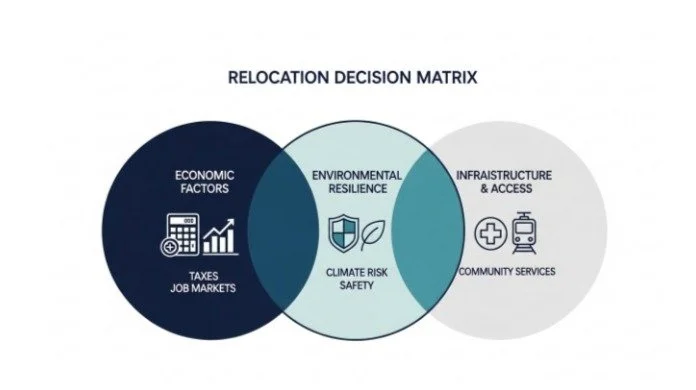
The Decision-Matrix: A Framework for Choosing Your New Zip Code

The three core pillars to evaluate when choosing your new out-of-state home.

Economic Factors: State Income Taxes, Job Markets, and Local Costs

Before moving, perform a rigorous tax analysis. Compare state income taxes and property levies against your current locale. A move to a tax-friendly state can effectively grant you an immediate raise.

Environmental Resilience: Evaluating Risks of Hurricanes, Earthquakes, and Wildfires

Climate risk is a non-negotiable factor. Assess the environmental vulnerabilities of your prospective home. Whether it is fire-prone zones or coastal areas, prioritize structural and financial resilience.

Infrastructure and Access: Transit-Accessible Trails, Greenbelts, and Community Services

Infrastructure extends beyond roads. Evaluate access to quality healthcare, greenbelts, and community services. A truly livable city provides easy access to these essential amenities.

Financial Literacy for the Long-Distance Move

Understanding the Moving Budget: Estimating Costs by Cubic Footage and Distance

Moving costs are rarely flat fees. Professional moving companies calculate quotes based on weight or cubic footage. Request detailed estimates to avoid surprises during the loading process.

Valuation Options: Full Value Protection vs. Basic Carrier Liability

Understand your protections. "Basic Carrier Liability" offers minimal coverage, often by weight. "Full Value Protection" is a higher-cost alternative that covers the replacement cost of your belongings, providing necessary peace of mind for high-value items.

Navigating the Industry: Vetting Moving Companies vs. Moving Brokers via FMCSA

Always use the Federal Motor Carrier Safety Administration (FMCSA) website to verify the credentials of your movers. Distinguish between carriers, who own the trucks, and brokers, who sell your move to third parties.

Logistics and Operational Planning for a Cross-Country Transition

Comparing Moving Methods: Full-Service Carriers, U-Haul, and PODS

Your choice of logistics depends on budget and control. Hiring a certified Full-service long-distance moving company is the ideal solution for those looking for a completely hands-off experience, as professionals manage everything from packing to transport. On the other hand, PODS or U-Haul rentals offer more flexibility and potentially lower costs for DIY-inclined families who prefer to manage the labor themselves. 

The Master Inventory List: Managing Furniture, Valuables, and Temperature-Sensitive Items

Create a comprehensive master inventory using digital tools or spreadsheets. Tag every box and track temperature-sensitive goods that require specialized storage.

Tech-Savvy Moving: Using Spreadsheets, Automation Tools, and Digital Organization

Automation is your best friend. Use digital apps for inventory tracking and project management to ensure you do not miss deadlines during the weeks leading up to your transition.

Moving the "Whole Family": Beyond the Moving Truck

Helping Children Transition: Navigating New School Holidays and Safety Protocols

Relocation is hardest on children. Research new school districts, curriculum differences, and local safety protocols well in advance. Establishing a consistent routine immediately upon arrival is critical for their emotional health.

Diversity and Representation: Evaluating Community Inclusivity for BIPOC and Black Families

For BIPOC families, evaluating the demographic landscape and community support is essential. Look for local organizations, diverse cultural hubs, and inclusive neighborhood networks to ensure a welcoming environment.

Specialized Logistics: Relocating Pets and High-Value Hobbyist Equipment

Do not overlook your specialized items. Transporting pets requires veterinary health certificates, while hobbyist equipment might require crating or climate-controlled transport.

The Psychological Reality of Relocation

Managing Culture Shock and the "Expat" Mindset within the U.S.

Moving across the country can trigger "expat" anxiety—the feeling of being an outsider in your own nation. Acknowledge this transition as a major life event and grant yourself time to acclimate to local customs and social cues.

Mental Health and the Isolation of a New State: Strategies for Building a Support Network

Isolation is common after a move. Prioritize building a support network early by joining local hobby groups or community organizations to mitigate feelings of loneliness.

The "Landing Phase": Using Familiar Comforts (Costco, Local Breweries) to Settle In

Anchor your new life with familiar comforts. Finding a local brewery or a nearby Costco provides a sense of continuity that helps bridge the gap between your old life and your new reality.

Strategic Decluttering: What to Keep and What to Leave Behind

The Cost of Transporting vs. Replacing: The "Amazon Couch" Dilemma

Every item you move adds to your cubic footage cost. If the cost of moving an item exceeds the price of buying a new one, sell or donate it. This "Amazon Couch" approach keeps your move efficient and cost-effective.

Conclusion

Relocating is a significant life event that requires the operational rigor of a business transition. By vetting your moving companies, calculating your cubic footage carefully, and prioritizing your family’s emotional and social integration, you turn a chaotic process into a structured success. Use this framework to manage the logistics, keep your finances secure, and prioritize your well-being throughout the journey. A successful cross-country move is not just about the truck—it is about the intentionality you bring to your new chapter.