Cross-Country Relocation Trends: Everything You Need to Know Before Moving Out of State
Introduction: The Evolving Landscape of American Migration
The American landscape of migration is undergoing a profound transformation. What was once a predictable pattern of career-driven relocation has morphed into a complex "Great Reset," with families reconsidering their geography based on lifestyle, values, and economic agility. Moving out of state today is less about physical displacement and more about a strategic re-alignment of one's life.
The Post-Pandemic Shift and the "Great Reset"
The pandemic acted as a catalyst for geographic mobility. As traditional office ties loosened, Americans realized that living in high-density hubs like New York City or Los Angeles was no longer a prerequisite for career success. This shift prompted a wave of departures as households sought more space and stability.
How Remote Work and Digital Nomadism Changed Relocation Patterns
Remote work turned the "American Dream" into a mobile experience. With the ability to work from anywhere, the reliance on proximity to metropolitan centers decreased. Digital nomadism has evolved from a niche lifestyle into a mainstream strategy, allowing families to relocate to regions that better align with their long-term financial and personal goals.
Analyzing Current Trends: Why Americans are Packing Up
The Cost-of-Living Exodus: From Coastal Hubs to the Sun Belt
Rising costs in major cities are driving a significant population exodus. Families are trading the high overhead of coastal metropolises for the Sun Belt, where the cost of living is lower and the purchasing power of their dollar is higher.
The "Big Sort": How Values and Lifestyle Drive Geographic Choices
Beyond finances, a "Big Sort" is occurring. Americans are increasingly choosing states that mirror their personal values, seeking communities that prioritize specific lifestyle metrics, from outdoor recreation to political and social environments.
Popular Destination States: Why Texas, Florida, Arizona, and Idaho Lead the Pack
Texas, Florida, Arizona, and Idaho remain at the forefront of this trend. These states offer a combination of tax advantages, expansive living space, and rapid economic growth, making them magnets for those seeking a fresh start.
The Decision-Matrix: A Framework for Choosing Your New Zip Code
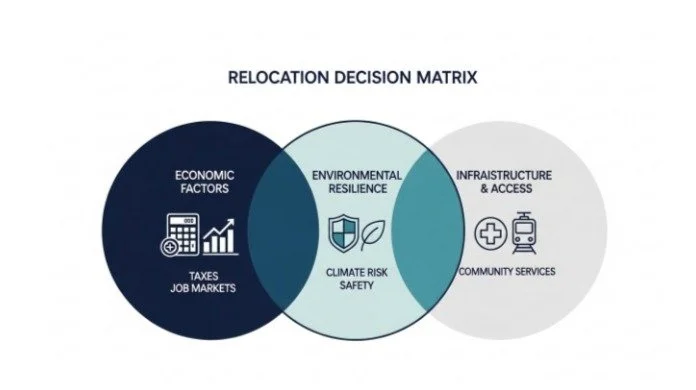
The three core pillars to evaluate when choosing your new out-of-state home.
Economic Factors: State Income Taxes, Job Markets, and Local Costs
Before moving, perform a rigorous tax analysis. Compare state income taxes and property levies against your current locale. A move to a tax-friendly state can effectively grant you an immediate raise.
Environmental Resilience: Evaluating Risks of Hurricanes, Earthquakes, and Wildfires
Climate risk is a non-negotiable factor. Assess the environmental vulnerabilities of your prospective home. Whether it is fire-prone zones or coastal areas, prioritize structural and financial resilience.
Infrastructure and Access: Transit-Accessible Trails, Greenbelts, and Community Services
Infrastructure extends beyond roads. Evaluate access to quality healthcare, greenbelts, and community services. A truly livable city provides easy access to these essential amenities.
Financial Literacy for the Long-Distance Move
Understanding the Moving Budget: Estimating Costs by Cubic Footage and Distance
Moving costs are rarely flat fees. Professional moving companies calculate quotes based on weight or cubic footage. Request detailed estimates to avoid surprises during the loading process.
Valuation Options: Full Value Protection vs. Basic Carrier Liability
Understand your protections. "Basic Carrier Liability" offers minimal coverage, often by weight. "Full Value Protection" is a higher-cost alternative that covers the replacement cost of your belongings, providing necessary peace of mind for high-value items.
Navigating the Industry: Vetting Moving Companies vs. Moving Brokers via FMCSA
Always use the Federal Motor Carrier Safety Administration (FMCSA) website to verify the credentials of your movers. Distinguish between carriers, who own the trucks, and brokers, who sell your move to third parties.
Logistics and Operational Planning for a Cross-Country Transition
Comparing Moving Methods: Full-Service Carriers, U-Haul, and PODS
Your choice of logistics depends on budget and control. Hiring a certified Full-service long-distance moving company is the ideal solution for those looking for a completely hands-off experience, as professionals manage everything from packing to transport. On the other hand, PODS or U-Haul rentals offer more flexibility and potentially lower costs for DIY-inclined families who prefer to manage the labor themselves.
The Master Inventory List: Managing Furniture, Valuables, and Temperature-Sensitive Items
Create a comprehensive master inventory using digital tools or spreadsheets. Tag every box and track temperature-sensitive goods that require specialized storage.
Tech-Savvy Moving: Using Spreadsheets, Automation Tools, and Digital Organization
Automation is your best friend. Use digital apps for inventory tracking and project management to ensure you do not miss deadlines during the weeks leading up to your transition.
Moving the "Whole Family": Beyond the Moving Truck
Helping Children Transition: Navigating New School Holidays and Safety Protocols
Relocation is hardest on children. Research new school districts, curriculum differences, and local safety protocols well in advance. Establishing a consistent routine immediately upon arrival is critical for their emotional health.
Diversity and Representation: Evaluating Community Inclusivity for BIPOC and Black Families
For BIPOC families, evaluating the demographic landscape and community support is essential. Look for local organizations, diverse cultural hubs, and inclusive neighborhood networks to ensure a welcoming environment.
Specialized Logistics: Relocating Pets and High-Value Hobbyist Equipment
Do not overlook your specialized items. Transporting pets requires veterinary health certificates, while hobbyist equipment might require crating or climate-controlled transport.
The Psychological Reality of Relocation
Managing Culture Shock and the "Expat" Mindset within the U.S.
Moving across the country can trigger "expat" anxiety—the feeling of being an outsider in your own nation. Acknowledge this transition as a major life event and grant yourself time to acclimate to local customs and social cues.
Mental Health and the Isolation of a New State: Strategies for Building a Support Network
Isolation is common after a move. Prioritize building a support network early by joining local hobby groups or community organizations to mitigate feelings of loneliness.
The "Landing Phase": Using Familiar Comforts (Costco, Local Breweries) to Settle In
Anchor your new life with familiar comforts. Finding a local brewery or a nearby Costco provides a sense of continuity that helps bridge the gap between your old life and your new reality.
Strategic Decluttering: What to Keep and What to Leave Behind
The Cost of Transporting vs. Replacing: The "Amazon Couch" Dilemma
Every item you move adds to your cubic footage cost. If the cost of moving an item exceeds the price of buying a new one, sell or donate it. This "Amazon Couch" approach keeps your move efficient and cost-effective.
Conclusion
Relocating is a significant life event that requires the operational rigor of a business transition. By vetting your moving companies, calculating your cubic footage carefully, and prioritizing your family’s emotional and social integration, you turn a chaotic process into a structured success. Use this framework to manage the logistics, keep your finances secure, and prioritize your well-being throughout the journey. A successful cross-country move is not just about the truck—it is about the intentionality you bring to your new chapter.