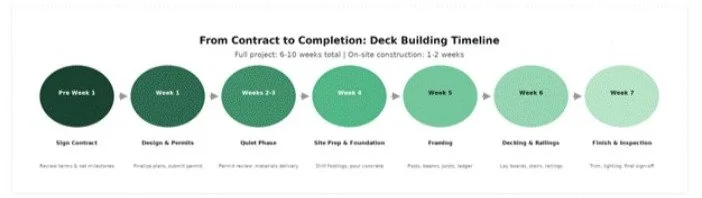
From Contract to Completion: A Week-by-Week Deck Building Timeline

Most homeowners sign the contract on a Friday and expect workers in their backyard by Monday. Then a week passes. Then two. And suddenly it's been a month, and not a single board has gone down. Sound familiar? The truth is, the full journey from signed contract to a finished deck takes 6 to 10 weeks, and every stage has a reason behind it. The best deck builders will tell you this upfront and hand you a written schedule. Here's what that schedule actually looks like.

Before Week 1: Right After You Sign

Most people think the clock starts when the crew shows up. It doesn't. It starts the moment you sign.

The contract itself matters a lot here. A solid agreement should spell out the exact materials being used, payment milestones (not just a lump sum at the end), a change order process, and projected start and end dates. If your contractor is asking for 50% upfront before a single permit is filed, that's a red flag. A normal deposit sits between 10% and 30%. Nothing more.

Good contractors also lock in milestone dates in the contract itself. "We'll start construction by X date" is not a milestone. "Permit application submitted by X, materials ordered by Y, construction start by Z," that's what a real schedule looks like.

Week 1: Design Lock-In and Permit Application

This is the last chance to adjust anything meaningful, like size, shape, materials, or custom features. Once plans go to the permit office, changes get expensive and slow things down.

The permit application goes out during this week. And here's where homeowners often get frustrated: depending on your county or state, permit approval can take anywhere from a few days to four weeks. Some jurisdictions are fast. Others are backed up. That's just the reality.

While the application is pending, materials get ordered. This matters because composite decking, specialty railings, and lighting systems often have long lead times. A contractor who waits for permit approval before ordering anything is setting you up for unnecessary delays.

If you live in an HOA community, now is also the time to submit for written approval. HOA reviews can take two to three weeks on their own, so don't push this to the back burner.

Weeks 2 and 3: The Quiet Phase

Nothing looks like it's happening. This is the part that tests homeowner patience the most.

Permits are in review. Materials are on order. The crew is not in your yard. It can feel like everyone forgot about you. They didn't. Behind the scenes, the permit office is reviewing plans, your supplier is pulling the order, and the contractor is finalizing the crew schedule.

Permit timelines are the biggest wildcard here. Some building departments move in three to five days. Others sit on applications for three to four weeks, depending on workload and how complete your submission was.

Here's the thing: the best deck builders keep you updated during this phase. Even a quick message every few days ("still waiting on permits, materials arrive Thursday") makes a big difference. If your contractor goes completely silent for two weeks, start asking questions.

Week 4: Site Prep and Foundation

Finally, boots on the ground.

First comes site prep: clearing vegetation, marking the layout, and calling 811 to locate underground utilities before anyone digs. Skipping that last step is dangerous and illegal in most states.

Then comes the foundation. Post holes get drilled, and in northern states, they go deep, at least 30 inches to get below the frost line. Concrete gets poured and needs 24 to 48 hours to cure before anything gets stacked on top.

Many local building departments also require a footing inspection at this stage before the crew moves forward. Common delays at this step include rocky soil, unexpected underground lines, or rain hitting at the worst possible time.

Week 5: Framing the Structure

This week is the backbone of the whole project. Literally.

Posts, beams, joists, and the ledger board all go in during framing. The ledger is what attaches the deck directly to your house, so if this is done wrong, everything that follows is compromised. Proper framing means pressure-treated lumber, the right spacing, and correct hardware throughout.

A lot of states require a mid-construction inspection right after framing, before any decking goes on top. The inspector needs to see the structure before it gets covered. It's a pause point, but it's there for good reason.

Week 6: Decking, Railings, and Stairs

This is the week the deck actually starts looking like a deck.

Boards go down with precise spacing: about 1/8 inch for composite material, a bit more for natural wood to allow for seasonal expansion. Composite also requires hidden fasteners, which takes more time than face-screwing traditional lumber. Figure an extra day or two if you went that route.

Railings go up next, and building codes are strict here on post spacing, baluster gaps, and rail height. Get any of it wrong, and it fails inspection. Then come the stairs, which homeowners consistently underestimate. A simple stair run with a landing can take a full day by itself.

Here's a rough breakdown of what each element adds to the schedule:

Week 7: Finishing Touches and Final Inspection

The crew handles trim, lighting, built-in features, and any custom details during this final push. If the deck is natural wood, staining or sealing happens here too, but only when the weather cooperates. You need at least 48 consecutive dry hours for the finish to cure properly. Rain mid-stain means starting over.

Then comes the final inspection. Without a passed inspection, the project is not officially complete, no exceptions. After that, do a full walkthrough with your contractor before signing off. Check every railing, every stair, every fastener. That's your moment to flag anything before the crew packs up.

What Can Add Time to Your Project

Even a well-run project can push past 10 weeks. The most common culprits:

●   Permit delays, which are the most frequent reason projects stall

●   Material backorders, especially for specific composite colors or custom railings

●   Bad weather during concrete pours or staining

●   Scope changes mid-project (each one typically adds one to two weeks)

●   Complex designs like multi-level builds or steeply sloped lots

Realistic Expectations

The full cycle is 6 to 10 weeks, with only 1 to 2 weeks of actual on-site construction buried inside that window. That's the honest answer most contractors won't lead with.

The best deck builders won't just quote you a price. They'll hand you a written schedule at the start, update you during the quiet weeks, and walk the finished project with you before calling it done. If a contractor can't give you a timeline in writing, that's your first red flag and probably not your last.

Cisco Certification: Your Complete Roadmap to Networking Excellence and Career Advancement

In today's interconnected world, networking expertise has become one of the most valued competencies across virtually every industry. Cisco Systems, the global leader in networking infrastructure, has long established a certification framework that serves as the gold standard for validating the skills of networking professionals. Whether you are a fresh graduate stepping into the IT workforce or a seasoned professional looking to formalize your expertise, Cisco certifications offer a structured, globally recognized pathway to career growth and professional credibility.This article explores the Cisco certification ecosystem in depth — from understanding the different levels and tracks available, to preparing effectively and making the most of your certification journey.

Understanding the Cisco Certification Framework

Cisco's certification program is structured into multiple levels, each designed to measure a specific degree of expertise. These levels progress logically, allowing professionals to build foundational knowledge before advancing into more specialized or complex domains. The program is broadly divided into five tiers: Entry, Associate, Professional, Expert, and Architect.The Entry level is where most beginners start. The Cisco Certified Technician (CCT) certification at this level verifies fundamental skills in diagnosing, restoring, repairing, and replacing critical Cisco networking and system devices on site. It is ideal for field technicians who need to understand basic Cisco equipment and interfaces.

The Associate level is perhaps the most widely recognized entry point for networking careers. The Cisco Certified Network Associate (CCNA) certification covers foundational networking concepts including IP connectivity, IP services, network access, security fundamentals, and automation. The CCNA is a single, comprehensive exam that replaced numerous separate tracks, making it a versatile credential for professionals entering the field.The Professional level elevates the bar significantly. The Cisco Certified Network Professional (CCNP) certification is available in multiple domains — Enterprise, Security, Data Center, Service Provider, Collaboration, and others. It is designed for professionals who have hands-on experience and want to specialize and deepen their knowledge in a particular area of networking.

Read more: https://www.exam-topics.com

Cisco Certification Tracks and Specializations

One of the strengths of the Cisco certification program is its breadth. It does not confine professionals to a single narrow path. Instead, there are several domain-specific tracks that allow individuals to align their certification journey with their career goals and the demands of their organization.

Enterprise Networking

The Enterprise track covers routing and switching, SD-WAN, wireless networking, and network automation. It is one of the most popular tracks and directly relevant to professionals managing campus or wide-area network infrastructures. The CCNP Enterprise and CCIE Enterprise Infrastructure certifications in this track are widely sought by network engineers globally.

Security

With cyber threats growing in frequency and sophistication, the Security track has become increasingly important. Cisco's security certifications cover network security, cloud security, endpoint protection, and threat intelligence. The CCNP Security and CCIE Security certifications are highly regarded in the cybersecurity community and are frequently required by organizations managing critical infrastructure and sensitive data.

Data Center

As organizations migrate to data center and cloud architectures, professionals with Data Center certifications are in strong demand. This track covers data center infrastructure, automation, virtualization, and storage networking. The CCNP Data Center and CCIE Data Center certifications validate expertise in designing and managing modern data center environments.

Service Provider

Targeted at professionals working in telecommunications and internet service environments, the Service Provider track covers core networking, MPLS, segment routing, and optical networking. It is particularly relevant for engineers working at internet service providers and large carrier networks.

Collaboration

This track focuses on unified communications, including voice, video, messaging, and conferencing solutions built on Cisco platforms. With the rise of remote work and distributed teams, collaboration certifications have gained renewed importance for IT professionals supporting modern communication infrastructure.

DevNet and Automation

Cisco's DevNet certification program is a forward-looking track designed for professionals at the intersection of software development and networking. As networks become increasingly programmable, skills in APIs, automation, and infrastructure as code have become essential. DevNet certifications range from Associate to Professional and Expert levels, covering topics such as network automation, cloud-native development, and security automation.

Read more: https://www.testking.com

Why Cisco Certifications Matter

Cisco certifications carry genuine weight in the professional world for several important reasons. First and foremost, they are vendor-specific, meaning they validate practical knowledge of Cisco products and platforms that are deployed in real networks worldwide. Because Cisco equipment dominates a significant share of the global networking market, employers actively look for Cisco-certified professionals to manage their infrastructure.Beyond vendor relevance, Cisco certifications are widely respected because of the rigor involved in earning them. The exams are not trivial. They require a deep understanding of networking concepts and hands-on skills. The higher-level certifications — particularly the CCIE — include lab exams that test the ability to build, troubleshoot, and optimize complex network topologies in real time.

From a career perspective, Cisco certifications frequently translate to tangible benefits. Certified professionals often command higher salaries than their non-certified peers. Studies and surveys in the IT industry consistently show that certifications like CCIE and CCNP lead to measurable salary increases. Additionally, having a recognized certification accelerates hiring decisions, as HR departments can use certifications as objective benchmarks during candidate screening.For organizations, having Cisco-certified staff ensures that their network environments are managed by individuals with verified competencies. This reduces the risk of misconfigurations, outages, and security vulnerabilities that can arise from unqualified management of complex network infrastructure.

How to Prepare for Cisco Certification Exams

Preparation is key to success in any Cisco certification exam. Given the technical depth required, a structured study approach significantly improves the chances of passing on the first attempt.The first step is to review the official exam topics published by Cisco. Each exam has a detailed blueprint that outlines all the domains and sub-topics covered. This blueprint should serve as the backbone of your study plan, ensuring you do not miss critical areas.Cisco provides official learning resources through Cisco Learning Network, including digital courses, instructor-led training, and authorized training partner programs. These resources are developed specifically to align with exam objectives and are often the most reliable source of study material.

In addition to official materials, third-party study guides from reputable publishers, online courses from platforms such as CBT Nuggets, INE, and Udemy, and practice labs are all valuable. Lab practice is especially critical for hands-on exams like the CCIE. Setting up a home lab using physical Cisco equipment or virtualized environments using tools like Cisco Packet Tracer or GNS3 allows candidates to apply theoretical knowledge in practical scenarios.Practice exams are another essential preparation tool. They familiarize candidates with the format of questions, help identify knowledge gaps, and build the confidence needed for the actual exam environment. 

Maintaining and Recertifying Your Cisco Credentials

Cisco certifications are not lifetime credentials. They require periodic recertification to ensure that certified professionals remain current with evolving networking standards, protocols, and best practices. The validity period varies by certification level: CCNA certifications are valid for three years, while CCNP, CCIE, and other higher certifications also follow a three-year cycle.Cisco introduced a continuing education program that allows professionals to recertify by earning Continuing Education credits rather than retaking exams. Credits can be earned by completing approved training courses, attending Cisco Live events, authoring technical content, or participating in other designated learning activities. This program offers greater flexibility and encourages continuous learning.Alternatively, professionals can recertify by passing a current exam within their certification's technology track, passing any professional-level or expert-level exam, or passing the CCIE/CCDE written exam.

The Value of Cisco Certifications in the Modern Job Market

The demand for networking expertise shows no signs of slowing. As enterprises continue to expand their digital infrastructure, migrate workloads to cloud environments, and implement software-defined networking, the need for skilled professionals who understand both traditional and modern networking paradigms is substantial.Cisco certifications remain a relevant and trusted signal of competence in this landscape. Entry-level roles in network administration, support engineering, and systems administration frequently list CCNA as a desired or required qualification. Mid-level roles in network engineering, security analysis, and infrastructure management often require CCNP-level credentials. Senior roles in network architecture, design consultancy, and systems engineering frequently specify CCIE or equivalent expertise.

Read more:  https://www.prepaway.biz

Cisco Certifications for Career Transitions

One often overlooked aspect of Cisco certifications is their value for professionals making career transitions. Someone working in a non-IT role who wants to move into networking can use the CCNA as an accessible, structured entry point. The certification provides both the knowledge and the credential that helps bridge the gap between prior experience and a new career direction.Similarly, professionals already working in IT in a different domain — such as systems administration, database management, or software development — can leverage Cisco certifications to pivot into networking or security roles. The structured learning path and recognized credential make the transition more credible and less daunting for both the professional and potential employers.

Frequently Asked Questions (FAQs)

Q1. What is the best Cisco certification for beginners?

The CCNA (Cisco Certified Network Associate) is the most recommended starting point for beginners. It covers fundamental networking concepts, is widely recognized by employers, and provides a solid base for advancing to higher-level certifications.

Q2. How long does it take to prepare for the CCNA exam?

Preparation time varies based on prior experience and study intensity. On average, most candidates spend between three to six months preparing for the CCNA exam. Those with some existing networking background may be ready in a shorter time frame.

Q3. Is the CCIE certification worth pursuing?

Yes, the CCIE is highly regarded and can significantly boost career prospects and earning potential. However, it requires substantial time, effort, and financial investment. It is best suited for experienced professionals who are serious about building a long-term career in advanced networking.

Q4. Can I take Cisco certification exams online?

Yes, Cisco offers many of its written exams through Pearson VUE, with options for testing at authorized test centers or through online proctored examinations from home. The CCIE and CCDE lab exams, however, must be taken at designated Cisco lab locations.

Q5. What is the difference between CCNP and CCIE?

The CCNP (Cisco Certified Network Professional) is the professional-level certification that demonstrates advanced knowledge in a specific domain such as Enterprise, Security, or Data Center. The CCIE (Cisco Certified Internetwork Expert) is the expert-level certification that requires both a written qualification exam and a rigorous hands-on lab exam, making it significantly more challenging and prestigious than CCNP.

Conclusion

Cisco certifications represent more than just credentials — they are a commitment to professional excellence, continuous learning, and mastery of one of the most critical domains in modern infrastructure. From the foundational CCNA to the elite CCIE, the Cisco certification program offers a well-defined, globally recognized pathway for professionals at every stage of their networking career.

Whether your goal is to secure your first networking role, advance into specialized domains, earn a higher salary, or establish credibility as a senior architect, Cisco certifications provide the structure, validation, and recognition to help you achieve those goals. The investment in time, effort, and preparation pays dividends not just in employment outcomes but in the depth of knowledge and confidence that come from truly understanding complex networking environments.

As networks continue to evolve — embracing automation, programmability, cloud integration, and advanced security architectures — the professionals who hold Cisco certifications will remain at the forefront of building and managing the infrastructure that powers modern organizations. If you are considering embarking on the Cisco certification journey, there has never been a better time to start.
Best Study Strategies for CompTIA Certification Success: The Ultimate Preparation Guide for IT Professionals

Preparing for a CompTIA certification exam is not simply about reading a textbook from cover to cover and hoping for the best. It is a deliberate, structured process that demands the right combination of learning techniques, practice tools, time management, and mental discipline. The difference between candidates who walk out of the exam room with a passing score and those who do not rarely comes down to raw intelligence — it comes down to how effectively they studied. Whether you are targeting CompTIA A+, Network+, Security+, or any other credential in the portfolio, the strategies you employ during preparation will determine the outcome. This comprehensive guide presents the most proven, field-tested study strategies that consistently produce results for CompTIA candidates at every level.

Start With a Strong Foundation: Know What You Are Being Tested On

Every effective study plan begins at the same place — the official CompTIA exam objectives document. Available as a free download from the CompTIA website, this document outlines every single domain, topic, and sub-topic that could appear on your exam. It is the authoritative source of truth for what you need to know, and no study guide, video course, or practice test should take priority over it. Before purchasing a single resource or watching a single video, download the exam objectives and read through them carefully. Highlight areas where you feel confident and flag areas where your knowledge is thin. This initial self-assessment gives you a realistic picture of how much ground you need to cover and where your preparation effort should be concentrated most heavily. Understanding the domain weightings — expressed as percentages — also tells you which areas carry the most exam questions and therefore deserve the most study time.

Build a Study Plan That Is Realistic and Time-Bound

One of the most common reasons candidates fail their first CompTIA attempt is not lack of ability — it is lack of structure. Studying randomly, whenever motivation strikes, produces inconsistent results and leaves dangerous gaps in knowledge. A well-constructed study plan solves this problem by giving every study session a clear purpose and ensuring the entire exam syllabus is covered before test day. Begin by setting a firm exam date, which creates urgency and prevents indefinite postponement. Work backward from that date to determine how many weeks of preparation you have, then divide the exam domains into weekly study blocks. Assign specific topics to specific days rather than simply blocking out vague "study time." Build in a review week before the exam for consolidation and practice testing, and schedule at least one rest day per week to prevent burnout. A plan that you will realistically follow is always superior to an ambitious plan that collapses under real-life pressure.

Visit here:  https://www.examtopics.info

Use Multiple Learning Formats to Reinforce Retention

The brain retains information most effectively when it is exposed to the same concept through multiple different formats. Relying exclusively on one type of study material — reading a textbook, for example — is a single-channel approach that produces weaker retention than a multi-format strategy. For CompTIA preparation, a powerful combination includes video courses for conceptual explanations, written study guides for depth and detail, flashcards for rapid vocabulary and definition reinforcement, hands-on lab work for practical application, and practice exams for knowledge testing and gap identification. Video courses from respected instructors like Professor Messer, Jason Dion, or Mike Meyers bring abstract concepts to life through visual demonstration and real-world context. Written guides allow deeper engagement with complex topics at your own pace. 

The Power of Active Learning Over Passive Consumption

There is a significant and often underestimated difference between passive learning and active learning. Passive learning means watching a video, reading a chapter, or listening to an audio lesson without engaging critically with the material. You feel productive, but the information tends to fade quickly because your brain is not being forced to process it deeply. Active learning, by contrast, involves deliberate engagement — taking notes in your own words, creating concept maps, teaching a topic back to yourself out loud, writing summaries without looking at your source material, or immediately applying a concept in a lab environment. Research in cognitive science consistently demonstrates that active recall — the act of retrieving information from memory rather than simply re-reading it — is one of the most powerful learning techniques available. 

Visit here: https://www.testkings.com

Spaced Repetition: Study Smarter, Not Longer

Spaced repetition is a scientifically validated learning technique that involves reviewing material at gradually increasing intervals over time rather than massing all study of a topic into a single session. The concept is built on the psychological principle known as the spacing effect — the brain retains information far more effectively when it is reviewed multiple times with gaps in between. For CompTIA preparation, this means that rather than spending an entire week on networking and then never revisiting it, you should return to networking concepts at regular intervals throughout your preparation — perhaps reviewing key topics once a week after your initial deep study. 

Hands-On Lab Practice: Bridging Knowledge and Application

CompTIA certifications are not purely academic qualifications — they are intended to validate practical competence in real IT environments. This is reflected in the performance-based questions that appear in most CompTIA exams, which require candidates to demonstrate skills in simulated scenarios rather than simply selecting a memorized answer. Candidates who study exclusively from books and videos without any hands-on practice are consistently disadvantaged when they encounter these question types. Building a home lab does not need to be expensive. Free virtualization tools like Oracle VirtualBox or VMware Workstation Player allow you to run multiple operating systems simultaneously on a single computer, giving you a safe environment to practice installations, configurations, troubleshooting procedures, and command-line operations.

Master Subnetting and Command-Line Skills Early

Two areas consistently trip up CompTIA candidates across multiple certification levels — subnetting for Network+ and command-line proficiency for A+ and Security+. These are not areas where surface-level familiarity is sufficient. Subnetting questions can appear in multiple forms on the Network+ exam, and candidates who have not practiced calculating subnet masks, usable host ranges, and network addresses under time pressure often struggle significantly. The solution is early, repetitive practice using dedicated subnetting tools and exercises until the calculations become near-automatic. Similarly, command-line commands — whether Windows Command Prompt, PowerShell, or Linux terminal commands — appear regularly across CompTIA exams and must be known from memory. 

Visit here: https://www.prepaway.net

Join Study Communities and Leverage Peer Learning

Studying in isolation is functional, but studying within a community significantly accelerates learning and provides motivational support during the difficult stretches of preparation. The CompTIA Reddit community (r/CompTIA) is one of the most active and valuable free resources available, populated by candidates at every stage of preparation as well as recently certified professionals sharing exam experiences, study tips, and resource recommendations. Discord servers dedicated to CompTIA certifications offer real-time discussion, study group formation, and peer accountability. Professor Messer's website hosts a study group community tied to his free course materials. 

Strategic Use of Practice Exams

Practice exams are among the most effective preparation tools available, but their value depends entirely on how they are used. Taking practice tests too early — before you have adequately covered the material — is discouraging and counterproductive. The optimal time to begin practice testing is after you have completed your initial study of all exam domains, at which point practice exams serve as diagnostic tools that reveal exactly which areas still need attention. Quality matters enormously with practice tests — low-quality question banks with inaccurate or poorly written questions can actively mislead your preparation. Jason Dion's practice exam bundles and CompTIA's own CertMaster Practice platform are widely regarded as the most reliable options. When reviewing your practice exam results, never simply tally your score and move on. Read the explanation for every single question you answered incorrectly, and also verify your reasoning for questions you answered correctly. 

The Final Week Strategy: Consolidate, Do Not Cram

How you spend the final week before your exam has a significant impact on your performance. Many candidates make the mistake of trying to push through new material right up until the night before, which tends to increase anxiety without meaningfully improving readiness. A more effective approach is to treat the final week as a consolidation phase rather than a learning phase. Focus on reviewing your notes, working through additional practice exams, revisiting flagged weak areas, and ensuring that the material you have already covered is firmly cemented. In the final two days, reduce study intensity and prioritize mental and physical preparation. Ensure you are sleeping adequately — sleep plays a critical role in memory consolidation and cognitive performance. 

Frequently Asked Questions (FAQ)

Q1: How many practice exams should I take before my CompTIA exam? Most preparation experts recommend taking a minimum of five to ten full-length practice exams before sitting the real test. More important than the number is the consistency of your scores — aim to be consistently scoring above 80% on practice exams before booking your actual exam date, as this provides a reasonable buffer for the variability of the real test.

Q2: Is Professor Messer's free course sufficient on its own to pass? Professor Messer's video courses are excellent and have helped thousands of candidates pass their CompTIA exams. However, combining them with hands-on lab practice and quality practice exams produces significantly better outcomes than using any single resource in isolation. Think of Professor Messer as a core component of a broader strategy rather than a complete solution on its own.

Q3: Should I use physical flashcards or a digital app like Anki? Both options work effectively, but digital tools like Anki offer the significant advantage of built-in spaced repetition algorithms that optimize review timing automatically. Physical flashcards require you to manage your own review schedule. For candidates with busy schedules, a digital app is generally more practical and efficient.

Q4: How do I stay motivated during a long preparation period? Breaking your preparation into small, weekly milestones makes the process feel more manageable and provides regular moments of accomplishment. Joining a study community gives you accountability and peer support. Visualizing the career opportunities that the certification will unlock can also help sustain motivation during difficult stretches of preparation.

Q5: What is the best way to handle performance-based questions on the exam? Performance-based questions appear at the beginning of most CompTIA exams and can be time-consuming. A widely recommended strategy is to flag them immediately, proceed through the rest of the exam answering multiple-choice questions, and then return to the performance-based questions with your remaining time. This ensures you do not run out of time before answering questions you could answer quickly.

Conclusion

Passing a CompTIA certification exam is not a matter of luck or innate ability — it is the product of deliberate, strategic preparation applied consistently over time. The candidates who succeed are those who align their study with the official exam objectives, use diverse learning formats to reinforce retention, engage actively rather than passively with the material, practice hands-on skills in real or simulated environments, and approach the final stretch of preparation with discipline and calm. Every strategy outlined in this guide has been validated by thousands of successful CompTIA candidates who started exactly where you are today. The path to certification is demanding, but it is also well-marked and navigable for anyone willing to commit to it. Apply these strategies with consistency and intention, and you will walk out of that exam room with the result you worked for.

The Certification Edge: How Microsoft Credentials Transform Careers and Command Respect Across Industries

Every professional reaches a point in their career where experience alone no longer tells the full story. The ability to demonstrate verified, structured competence becomes the differentiating factor between those who advance and those who stagnate. Microsoft Certifications have carved out a unique and powerful position in the professional development landscape precisely because they fulfill this need with exceptional credibility. They offer a rigorous, globally acknowledged system through which individuals across every career stage can prove their mastery of Microsoft platforms, earn the trust of employers, and chart a deliberate course toward sustained professional growth. Understanding this system in its entirety is the first step toward leveraging it effectively.

The Foundation of Trust: What Makes Microsoft Credentials Globally Respected

Not all professional credentials are created equal. Many certificates can be obtained through passive course completion or attendance alone, which limits their value in the eyes of discerning employers. Microsoft Certifications operate on an entirely different standard. Each credential is earned through a proctored examination that demands genuine preparation, applied understanding, and the ability to work through complex, scenario-driven problems under real testing conditions. There is no participation shortcut and no attendance-based reward — the credential is either earned through demonstrated competence or it is not earned at all.

This examination-based integrity is precisely what gives Microsoft Certifications their weight. Employers across the globe have come to understand that a Microsoft-certified professional has been tested against a consistent, objective standard. This understanding translates directly into hiring decisions, salary negotiations, project assignments, and promotion considerations. The credential speaks before the candidate does, communicating a level of verified readiness that experience claims and informal training certificates simply cannot match.

Mapping the Terrain: A Clear Look at Microsoft's Certification Tiers

Navigating Microsoft's certification program becomes significantly easier once the underlying tier structure is understood. Microsoft has organized its credentials into four distinct levels — Fundamentals, Associate, Expert, and Specialty — each representing a specific stage of professional development and serving a well-defined audience. This structure is not incidental; it is the product of deliberate program design intended to give every professional, regardless of where they currently stand, a clear and achievable path forward.

The tiered framework also creates natural momentum. Earning a credential at one level provides both the motivation and the conceptual groundwork needed to pursue the next. This progression encourages professionals to think of certification not as a single achievement but as an ongoing journey, one in which each milestone builds meaningfully upon the last. For employers, the tier system provides an immediately interpretable signal of a candidate's depth of expertise, simplifying the evaluation process and increasing confidence in hiring decisions.

Website link:  https://www.exam-topics.net

Stepping Into the Ecosystem: Entry Credentials That Welcome All Professionals

The Fundamentals tier represents Microsoft's invitation to every professional, regardless of background, to begin engaging with its platform ecosystem in a structured and rewarding way. These certifications carry no experience prerequisites and impose no technical entry barriers, making them genuinely accessible to anyone motivated enough to study and sit for an examination. Students, career changers, administrative professionals, business analysts, and project coordinators have all found meaningful value in Fundamentals credentials that speak directly to the platforms shaping their daily work environments.

Microsoft Azure Fundamentals, identified by the AZ-900 exam code, serves as the most recognized gateway into this tier. It covers essential cloud computing principles, core Azure service categories, fundamental identity and compliance concepts, and basic pricing and support structures. Complementing it are credentials such as Microsoft 365 Fundamentals, Dynamics 365 Fundamentals, and Power Platform Fundamentals, each providing a structured introduction to a different segment of Microsoft's expansive product portfolio. These entry-level certifications deliver standalone professional value while simultaneously preparing candidates for the more rigorous study that awaits at higher tiers.

Where Competence Gets Tested: Diving Deep Into Associate Certifications

The Associate tier is where the character of Microsoft's certification program shifts decisively from conceptual orientation to practical, job-ready validation. Candidates pursuing credentials at this level must demonstrate not merely an awareness of Microsoft solutions but a genuine ability to implement, configure, manage, and troubleshoot them in realistic professional environments. Exam scenarios at this level are constructed to reflect the kinds of challenges practitioners encounter in actual workplaces, demanding judgment and applied reasoning rather than straightforward memorization.

The Azure Administrator Associate credential, delivered through the AZ-104 examination, remains one of the most actively pursued certifications across the entire Microsoft program. It validates comprehensive proficiency in managing Azure subscriptions, configuring virtual networks, administering storage solutions, overseeing compute deployments, and maintaining identity and access management frameworks. Other prominent certifications at this level include the Azure Developer Associate for professionals engineering cloud-native applications, the Azure Database Administrator Associate for those overseeing data platform operations, and the Microsoft 365 Administrator Expert pathway that begins at the Associate level before ascending toward advanced administration credentials.

Elite Designation: What It Truly Means to Earn an Expert Credential

Attaining an Expert-level certification is a milestone that sets a professional apart in ways that few other credentials can replicate. These designations are not simply elevated versions of Associate exams — they represent a categorically different standard of achievement that requires candidates to synthesize technical depth with strategic breadth. Expert candidates must be capable of designing complex, multi-component solutions, navigating competing architectural trade-offs, and making decisions that balance performance, security, compliance, and cost efficiency across an entire solution landscape.

The Azure Solutions Architect Expert, assessed through the AZ-305 examination, consistently ranks among the most prestigious credentials available in the cloud computing domain. It demands mastery of solution design across identity management, data storage architectures, business continuity planning, infrastructure deployment, and application integration — all evaluated through intricate scenario-based questions that simulate genuine architectural challenges. 

Website link: https://www.certkiller.com

Targeted Expertise Acknowledged: The Strategic Value of Specialty Certifications

Outside the linear progression from Fundamentals through Expert, Microsoft maintains a distinct category of Specialty certifications that serve a fundamentally different purpose. Rather than measuring breadth of platform knowledge, these credentials recognize an exceptional concentration of expertise within a tightly defined solution domain. They exist to honor the fact that certain professionals develop a level of focused, specialized knowledge that deserves its own form of formal recognition — one that cannot be adequately captured by the standard tiered progression alone.

Specialty credentials currently available include the Azure Virtual Desktop Specialty, Azure for SAP Workloads Specialty, and the Fabric Analytics Engineer credential, among a growing roster of domain-specific designations. For independent consultants, enterprise solution architects, and implementation specialists whose professional identity is built around a particular platform environment, these certifications provide an unambiguous signal of concentrated expertise. They complement rather than replace tier-based credentials, and many professionals strategically combine them with Associate or Expert certifications to construct a multi-dimensional professional profile that is both broad and deep.

Website link: https://www.certkiller.com

The Preparation Blueprint: Strategies That Separate Passing Candidates From the Rest

Approaching a Microsoft Certification exam without a well-constructed preparation strategy is one of the most common reasons candidates fall short on their first attempt. The most effective preparation plans share several key characteristics — they are active rather than passive, multi-resourced rather than single-sourced, and rooted in genuine platform engagement rather than theoretical study alone. Microsoft Learn, the official free learning platform, forms the indispensable backbone of any serious preparation effort. Its structured learning paths, interactive modules, and integrated sandbox environments provide direct alignment with exam objectives and allow candidates to practice within live platform environments without incurring any additional cost.

Beyond Microsoft Learn, high-quality practice assessments serve as an essential preparation companion. Working through realistic exam simulations builds familiarity with question formats, sharpens time management instincts, and surfaces knowledge gaps that can be addressed before exam day arrives. Candidates who also invest in genuine hands-on project experience — whether through professional assignments, personal sandbox accounts, or guided lab platforms — develop the kind of deep, instinctive platform understanding that makes scenario-based questions feel approachable rather than intimidating. The combination of official learning content, realistic practice assessments, and genuine hands-on engagement consistently produces the strongest results.

Frequently Asked Questions (FAQs)

Q1. How do Microsoft Certifications compare to other vendor certifications in the market? Microsoft Certifications are consistently ranked among the most recognized and respected vendor credentials globally. Their examination-based integrity, regular content updates, structured tier progression, and the widespread adoption of Microsoft platforms across industries combine to make them highly competitive with — and in many contexts superior.

Q2. Is there a recommended sequence for pursuing multiple Microsoft Certifications? A sequential approach aligned with career goals produces the best outcomes. Professionals should begin with a Fundamentals certification in their target domain, transition to the corresponding.

Q3. What support does Microsoft offer to candidates who need exam accommodations? Microsoft provides examination accommodations for candidates with documented disabilities or specific needs. Accommodation requests must be submitted through the testing provider — either Pearson VUE or Certiport — prior to scheduling the exam. 

Q4. Can earning a Microsoft Certification lead to partnerships or business opportunities? Yes. Microsoft operates a Partner Network through which organizations and individuals with sufficient certified staff can qualify for partner status at various levels. Partner organizations gain access to product benefits, marketing resources, technical support, and co-selling opportunities.

Q5. What is the difference between a Microsoft Certification and a Microsoft Applied Skills credential? Microsoft Certifications are broad, role-based credentials earned through proctored examinations that validate comprehensive job-role readiness. Microsoft Applied Skills credentials, introduced more recently, are narrower, scenario-based credentials earned through practical assessments that validate proficiency in a specific task or solution area. 

Conclusion

Microsoft Certifications represent a professional investment that pays measurable, lasting dividends across every stage of a career. They are built on a foundation of examination integrity, supported by free and comprehensive learning resources, organized within a logical and motivating tier structure, and maintained through an annual renewal cycle that ensures their ongoing relevance. Whether a professional is taking their very first step into the Microsoft ecosystem with a Fundamentals credential or is pursuing an Expert designation that reflects years of accumulated mastery, each certification earned is a tangible, globally recognized declaration of verified competence. In a professional world where credibility is currency, Microsoft Certifications remain one of the most reliable and respected ways to build, demonstrate, and continually grow that credibility over the course of an entire career.

Most In-Demand CompTIA Certifications: The Definitive Guide to the Credentials Employers Are Actively Seeking Right Now

The IT job market in 2026 is characterized by one overriding reality — the demand for qualified, credentialed professionals continues to significantly outpace the supply of individuals who can demonstrate verified competence in the disciplines that organizations need most urgently. Cybersecurity threats have grown more sophisticated and more frequent. Cloud infrastructure has become the operational backbone of businesses across every sector. Networking complexity has expanded with the proliferation of remote work, edge computing, and hybrid environments. Data-driven decision-making has become a fundamental business expectation rather than a competitive differentiator. In this environment, employers are not simply looking for IT professionals with general experience — they are looking for professionals whose specific, relevant competencies have been independently verified against recognized standards. 

Why Employer Demand for CompTIA Certifications Continues to Grow

Before examining specific certifications, understanding the forces driving employer demand for CompTIA credentials provides important context for every individual ranking and recommendation that follows. Several converging trends have combined to make verified IT credentials more valuable to employers than at any previous point in the industry's history. The global cybersecurity workforce gap remains one of the most significant structural challenges in the IT industry, with millions of unfilled positions creating intense competition for qualified candidates and strong incentives for professionals who can demonstrate relevant verified competence. 

CompTIA Security+: The Undisputed Leader in Employer Demand

No CompTIA certification generates more consistent, more widespread, or more urgent employer demand than Security+. It appears in more IT job postings than any other CompTIA credential, is listed as a required or preferred qualification across an extraordinary range of roles and industries, and has maintained its position as the world's most recognized entry-level cybersecurity certification through multiple exam version updates that have kept its content aligned with the evolving threat landscape. The reasons for Security+'s dominance in employer demand are deeply rooted in structural factors that are unlikely to change in the near term. The U.S.

CompTIA A+: Foundational Demand That Never Diminishes

While cybersecurity certifications dominate discussions of high-value credentials, CompTIA A+ maintains a level of employer demand that reflects its fundamental importance as the entry point into the IT profession. Every organization that employs IT staff needs professionals who can support hardware and software, troubleshoot technical issues, manage operating systems, and provide reliable technical assistance to end users — and A+ remains the most universally recognized signal that a candidate can perform these functions competently. The demand for A+ certified professionals spans every industry sector, every organization size, and every geographic market, making it one of the most broadly distributed sources of employment opportunity in the entire IT field. 

Also read: https://www.examtopics.biz

CompTIA Network+: Essential Demand in an Increasingly Connected World

As organizations continue expanding their network infrastructure to accommodate remote work, cloud connectivity, Internet of Things deployments, and increasingly complex security requirements, the demand for professionals with verified networking competence continues to grow. CompTIA Network+ sits at the center of this demand as the most recognized vendor-neutral credential validating foundational networking knowledge and skills. Network+ certified professionals are sought for roles including network administrator, systems administrator, network support specialist, and IT infrastructure technician — positions that exist across virtually every industry and that form a critical component of organizational IT operations. The vendor-neutral nature of Network+ is particularly valuable in an environment where organizations operate increasingly heterogeneous network environments combining equipment and services from multiple vendors. 

CompTIA CySA+: Rising Demand for Mid-Level Security Analysts

The demand for CompTIA CySA+ has grown substantially in recent years as organizations have recognized that foundational security knowledge represented by Security+ is necessary but not sufficient for the mid-level analyst roles that form the operational backbone of mature security programs. CySA+ validates the behavioral analytics, threat detection, vulnerability management, and incident response skills required for security analyst roles that go beyond entry-level awareness into genuine operational competence. Several factors are driving the accelerating employer demand for CySA+ certified professionals. The expansion of security operations center functions across organizations that previously lacked formal security monitoring capabilities has created demand for analysts who can perform the specific functions that SOC operations require. 

Also read:  https://www.test-inside.com

CompTIA Cloud+: Surging Demand Driven by Global Cloud Adoption

If there is a single technology trend that has most dramatically reshaped IT employer demand over the past several years, it is the acceleration of cloud adoption across every sector of the economy. Organizations that were cautiously experimenting with cloud infrastructure five years ago have in many cases completed wholesale migrations that make cloud competency a baseline expectation for a wide range of IT roles rather than a specialized skill. CompTIA Cloud+ has benefited enormously from this trend, with employer demand for cloud-competent professionals creating strong interest in a vendor-neutral credential that validates cloud knowledge applicable across multiple platforms simultaneously.

CompTIA Linux+: Specialized Demand in a Linux-Dominated Infrastructure World

Linux powers a dominant share of the world's server infrastructure, cloud environments, networking equipment, and containerized application platforms — yet the Linux administration skills that this reality demands are frequently self-taught and therefore under-credentialed in the professional workforce. CompTIA Linux+ addresses this gap directly, and the employer demand it generates reflects the genuine shortage of formally credentialed Linux administrators in a market where Linux expertise is increasingly essential. The evolution of Linux+ in recent years to incorporate modern Linux usage patterns — including container management, automation scripting, cloud-based Linux deployments, and DevOps toolchain integration — has made the certification increasingly relevant to contemporary employer needs rather than simply validating traditional system administration skills. 

CompTIA PenTest+: Growing Demand in Offensive Security Roles

The demand for penetration testing professionals has grown substantially as organizations have come to recognize that reactive security postures — waiting for attacks to occur before responding — are insufficient against the sophistication of current threat actors. Proactive security testing through penetration testing engagements, red team exercises, and vulnerability assessments has become an increasingly standard component of mature security programs, creating sustained demand for professionals with verified offensive security skills. CompTIA PenTest+ generates employer demand in a specific and specialized segment of the cybersecurity market — organizations looking for credentialed professionals who can conduct structured penetration testing engagements within defined scopes, document findings professionally, and communicate results to both technical and non-technical stakeholders. 

Also read: https://www.braindumps.com

CompTIA CASP+: Elite Demand for Senior Security Practitioners

At the apex of the CompTIA certification hierarchy, CASP+ generates demand in a fundamentally different segment of the employer market than the certifications discussed above — one characterized by smaller volume but exceptional quality of opportunity. The organizations seeking CASP+ certified professionals are those that need senior security practitioners capable of architecting, engineering, and leading enterprise security programs at the highest level of organizational complexity. These include large financial institutions, federal government agencies, defense contractors requiring DoD 8570 compliance at higher classification levels, healthcare organizations managing complex regulatory environments, and critical infrastructure operators with sophisticated security requirements. 

CompTIA Data+: Emerging Demand in a Data-Driven Business Environment

As data analytics has moved from a specialized function confined to dedicated analytics teams to a broadly distributed capability expected across IT and business roles, employer demand for professionals with verified data skills has expanded substantially. CompTIA Data+ reflects this trend by validating the foundational data analytics knowledge — data concepts and environments, data mining, data analysis, visualization, and data governance — that is increasingly expected in a wide range of IT and business intelligence roles. The demand for Data+ certified professionals is particularly notable among organizations undergoing data maturity initiatives, deploying business intelligence platforms, or building internal analytics capabilities that require professionals who understand both the technical dimensions of working with data and the governance and quality management principles that ensure data reliability. 

How to Prioritize Among In-Demand Certifications

With multiple high-demand CompTIA certifications competing for a professional's attention and preparation investment, a strategic prioritization framework is essential. The most important prioritization principle is alignment — the certification that will generate the greatest career impact is the one that best aligns with your current career stage, your existing knowledge base, and your specific career direction. Entry-level professionals should prioritize A+ as the foundational gateway, followed by Network+ and Security+ to complete the Core stack. Mid-career professionals in cybersecurity roles should evaluate CySA+ as their highest-priority next credential. IT professionals in or targeting cloud and infrastructure roles should consider Cloud+ their most relevant specialization credential. Professionals with offensive security interests should build toward PenTest+.

Frequently Asked Questions (FAQ)

Q1: Which CompTIA certification is generating the most job postings in 2026? CompTIA Security+ consistently generates more job postings than any other CompTIA credential, appearing across cybersecurity, government, defense contracting, financial services, and managed security services roles at entry and mid-career levels. Its DoD approval status and its position as the global standard entry-level cybersecurity certification create a floor of institutional demand that makes it the most consistently sought CompTIA credential across all market conditions.

Q2: Are newer CompTIA certifications like Data+ gaining traction with employers? Yes, newer certifications including Data+ are generating growing employer interest as the disciplines they address become increasingly mainstream business priorities. However, they have not yet achieved the depth of employer recognition that longer-established certifications like Security+, A+, and Network+ carry. Professionals pursuing newer certifications benefit from pairing them with established credentials that provide broader market recognition alongside the specialized value of the newer credential.

Q3: Does holding multiple in-demand CompTIA certifications multiply career opportunities? Significantly so. Each additional relevant CompTIA certification expands the range of roles for which a professional qualifies, strengthens their negotiating position for compensation, and deepens the professional profile that employers evaluate during hiring processes. The combination of Security+ and CySA+, for example, creates a cybersecurity credential profile that is considerably more compelling than either certification alone — demonstrating both foundational competence and operational depth in a way that a single credential cannot communicate.

Q4: How quickly does employer demand shift for specific CompTIA certifications? Demand for foundational certifications like A+, Network+, and Security+ is structurally stable and shifts slowly because the roles these credentials support are perennial features of IT organizations. Demand for specialized certifications is more responsive to technology trends — Cloud+ demand has grown substantially with cloud adoption acceleration, while demand for emerging certifications tracks the pace at which new disciplines become mainstream employer priorities. Monitoring job postings in your target role categories regularly provides the most current and specific demand intelligence for your individual situation.

Q5: Is CompTIA Security+ still worth pursuing given the availability of other cybersecurity certifications? Security+ remains one of the most valuable certifications in the IT market. Its combination of universal employer recognition, DoD approval status, entry-level accessibility, and foundational curriculum that supports multiple cybersecurity career directions makes it a uniquely positioned credential that competing certifications have not displaced. For cybersecurity professionals who hold Security+ and are evaluating next steps, adding CySA+ or CASP+ builds on and amplifies the value of Security+ rather than replacing it.

Conclusion

The most in-demand CompTIA certifications of 2026 reflect the most urgent capability priorities of organizations navigating an IT landscape defined by escalating cybersecurity threats, accelerating cloud adoption, expanding networking complexity, and growing data-driven operational requirements. Security+ leads employer demand by a substantial margin, followed by the foundational strength of A+ and Network+, the operational depth of CySA+, the cloud relevance of Cloud+, the specialized value of Linux+ and PenTest+, the elite practitioner authority of CASP+, and the emerging analytics relevance of Data+. 

For IT professionals making strategic decisions about certification investment, understanding which credentials generate the strongest employer demand — and which among those align most closely with their individual career direction — is the foundation of a professional development strategy that delivers maximum return on every hour of preparation and every dollar of investment. The market is clear about what it needs. The pathway is well-defined. The professionals who align their credential development with genuine employer demand will find that the IT job market in 2026 rewards their investment with opportunities that justify every moment of the preparation journey.

Becoming an AWS Solutions Architect: Certification Skills, Salary Insights, and Exam Preparation

The AWS Solutions Architect certification includes two distinct levels: Associate and Professional. Each level represents increasing expertise, experience requirements, and specialization depth. The Solutions Architect Associate certification targets professionals with approximately one to two years of hands-on AWS experience and foundational architectural understanding. This associate-level credential validates your ability to design solutions addressing common business requirements using AWS services. The Associate exam consists of 65 questions you must complete within 130 minutes, using a scaled scoring system with a passing score of 720 out of 1000.

The Solutions Architect Professional certification represents the advanced credential requiring substantially greater experience, typically three or more years of production AWS deployment and architectural design. Professional certification validates advanced architectural expertise enabling you to design complex, enterprise-scale solutions addressing sophisticated requirements. The Professional exam contains 75 questions requiring 180 minutes, with a passing score of 750 out of 1000. Professional certification demonstrates mastery of AWS services, architectural best practices, and the ability to make sophisticated design trade-offs when multiple viable solutions exist.

Essential Skills for Solutions Architect Certification

Successful solutions architects possess diverse skills extending well beyond AWS service knowledge. Understanding these essential competencies helps you develop expertise that transcends simple exam passage. Solutions architects must deeply understand AWS services, their capabilities, limitations, and appropriate use cases. This knowledge enables architects to recognize when specific services solve particular problems most elegantly. Beyond individual service knowledge, architects understand how services integrate together, creating cohesive solutions addressing complex requirements.

Architectural design patterns represent critical knowledge for architects. Common patterns like multi-tier architecture, serverless architecture, event-driven architecture, and containerized microservices address recurring architectural problems. Understanding patterns, their benefits, their limitations, and when to apply each pattern enables designing solutions that proven approaches have validated. Architects must recognize when to apply established patterns and when novel situations require custom approaches.

Click here: https://www.exam-topics.info

Solutions Architect Associate: Salary and Career Benefits

Professionals holding Solutions Architect Associate certification enjoy significant career and financial benefits. Entry-level associate architect positions typically offer salaries ranging from $90,000 to $130,000 annually, substantially above non-certified professionals in comparable positions. These positions appeal to recent graduates seeking to launch architect careers and experienced professionals transitioning from other IT specializations. Associate certification provides the credential demonstrating you possess fundamental architectural knowledge, even if you lack extensive experience.

Mid-career professionals with associate certification often advance into senior architect roles within 2-3 years, with salaries escalating to $140,000 to $200,000 range. Organizations managing substantial cloud infrastructure actively recruit certified architects capable of leading architectural initiatives. The credential demonstrates commitment to professional development and cloud expertise, appealing to advancement-focused organizations. As your experience accumulates and you pursue professional certification, compensation continues increasing proportionally.

Solutions Architect Professional: Advanced Expertise and Premium Compensation

Solutions Architect Professional certification represents the pinnacle of AWS architectural credentials, validating mastery of complex, enterprise-scale architectural design. Professional architects command premium compensation reflecting their advanced expertise. Senior architect and technical fellow positions typically offer salaries of $160,000 to $250,000 plus substantial bonuses, stock options in tech companies, and other benefits. Senior architects often transition into Chief Architect roles, Chief Technology Officer positions, or independent consulting commanding even higher compensation.

The professional credential enables leadership of large-scale architectural initiatives that shape organizational technical direction. You become the person executives consult when deciding whether to migrate to cloud, how to structure cloud environments, or how to optimize existing deployments. This leadership responsibility brings both influence and compensation premium reflecting your strategic importance to organizational success.

Examination Content and Knowledge Domains

The Solutions Architect Associate exam covers five primary knowledge domains, each comprising specific percentages of exam questions. Design secure architectures accounts for 30% of exam content, emphasizing security best practices throughout architecture design. This domain covers encryption, network security, identity management, and compliance implementation. Designing resilient architectures comprises 26% of exam content, focusing on high availability, disaster recovery, and fault tolerance. You must demonstrate understanding of multi-region architectures, database replication strategies, and failover mechanisms.

Designing high-performance architectures represents 24% of exam content, emphasizing scalability, caching, content delivery, and performance optimization. This domain requires understanding how to architect applications supporting millions of concurrent users without performance degradation. Designing cost-optimized architectures comprises 20% of exam content, covering pricing models, cost optimization strategies, and architectural decisions influencing total cost of ownership. This domain reflects AWS's emphasis on financial responsibility in cloud environments.

Preparation Strategies for Solutions Architect Certification

Successful Solutions Architect preparation requires 100-150 hours of dedicated study combined with hands-on architectural experience. This substantial time investment ensures comprehensive mastery of architectural principles, AWS services, and design patterns. Create a study schedule spanning 3-6 months of consistent effort, dedicating 10-15 hours weekly to preparation.

Begin by assessing your baseline knowledge across exam domains. Identify which domains represent strengths and which require additional focus. This assessment prevents wasting time reviewing material you already understand while ensuring weak areas receive adequate attention. Establish baseline knowledge by taking diagnostic practice exams or reviewing sample questions before commencing primary study.

Click here:  https://www.passguide.com

Mastering Exam Questions and Scenarios

Solutions Architect exams emphasize scenario-based questions requiring you to apply architectural knowledge rather than simply recall facts. A typical scenario describes an organization's requirements, constraints, and current infrastructure, then asks you to select the best architectural approach. Mastering these scenario questions represents critical exam success factor.

Develop strategies for approaching scenario questions systematically. First, read the scenario completely, identifying the organization's key requirements, constraints, and current situation. Second, note what the question specifically asks; sometimes multiple architecturally sound solutions exist, but one best addresses the specific scenario requirements. Third, eliminate obviously incorrect answers that don't meet critical requirements. Fourth, compare remaining options considering trade-offs between cost, performance, security, complexity, and other factors.

Common architectural scenarios on the exam present situations requiring you to choose between multiple viable approaches. An organization might need to serve global users with low latency; the question asks whether to use a multi-region architecture, CloudFront content delivery network, or edge location deployment. All three approaches address the requirement, but the specific scenario details determine the best answer. Practitioners experienced with real architectural decisions recognize that such scenarios reflect genuine architectural challenges requiring sophisticated analysis.

Frequently Asked Questions

Q: How much experience do I need before attempting Solutions Architect Associate? A: AWS recommends one to two years of hands-on AWS experience before pursuing Associate certification. However, some candidates with strong IT backgrounds and self-study preparation succeed with less experience. Assess your knowledge honestly; if you lack practical AWS experience, consider Cloud Practitioner certification first.

Q: What's the difference between Solutions Architect Associate and Professional? A: Associate certification targets professionals with 1-2 years of experience and covers foundational architectural design. Professional certification requires 3+ years of experience and covers advanced, complex architectural scenarios. Most professionals pursue Associate first, then Professional after gaining additional experience.

Q: How much does Solutions Architect certification cost? A: Associate certification costs $150. Professional certification also costs $150. These costs are reasonable given the career benefits and salary premiums associated with the credentials. Many employers reimburse certification costs.

Q: How long do Solutions Architect certifications remain valid? A: Both Associate and Professional certifications remain valid for three years. Maintain your certification through renewal exams costing approximately $75 (50% of original cost) or by retaking the full exam. Renewal exams focus on new AWS features released since your original certification.

Q: What should I study to prepare for Solutions Architect? A: Study AWS services in architectural contexts, not just individual service features. Master architectural design patterns and how they apply to different scenarios. Review AWS whitepapers and case studies. Practice hands-on with real multi-service architectures. Complete numerous practice exams. This comprehensive approach builds genuine architectural expertise.

Q: Can I skip Associate and go directly to Professional? A: AWS allows candidates with sufficient experience to attempt Professional directly, but most professionals benefit from Associate preparation first. Associate content establishes foundational knowledge making Professional content more accessible. The credential progression matches typical experience progression.

Q: How do I get hands-on experience needed for Solutions Architect preparation? A: Design and implement multi-service architectures addressing realistic requirements. Build three-tier applications, implement disaster recovery, create cost-optimized solutions, and design security-focused architectures. Free AWS Tier and inexpensive implementations enable extensive hands-on learning without prohibitive costs.

Q: What percentage of questions must I answer correctly to pass? A: Scaled scoring means passing percentages vary, but approximately 70% correct answers typically results in passing. This variation exists because the exam adjusts question difficulty based on your performance. Focus on genuine understanding rather than hitting specific percentage targets.

Q: How important are practice exams for Solutions Architect preparation? A: Practice exams prove critical for Solutions Architect preparation. They reveal knowledge gaps, familiarize you with exam question styles, and build confidence. Complete at least 5-10 full-length practice exams during preparation, targeting 75-80% scores before attempting official exams.

Q: Should I pursue other AWS certifications alongside Solutions Architect? A: Focus on one certification at a time; pursuing multiple simultaneously dilutes preparation effort. After obtaining Solutions Architect Associate, you might pursue Professional certification or specialty certifications in specific domains. This sequential approach ensures thorough mastery of each credential.

Conclusion

The AWS Solutions Architect certification represents a transformative credential opening doors to lucrative, fulfilling careers in cloud architecture. This comprehensive guide has explored the skills required to succeed as a solutions architect, the substantial salary benefits and career advantages the credential provides, and practical examination strategies maximizing your chances of success. Solutions architects sit at the intersection of business and technology, translating organizational requirements into elegant architectural designs that enable digital transformation. The credential validates your ability to make sophisticated architectural decisions considering security, performance, cost, scalability, and compliance simultaneously. The preparation journey requires substantial effort—typically 100-150 hours of study combined with hands-on architectural experience—but yields career benefits justifying this investment. 

Most professionals recoup certification costs within months through salary increases and career advancement, with benefits compounding throughout careers lasting decades. Whether you're pursuing Solutions Architect Associate to establish foundational architectural credentials or Professional to validate mastery of complex enterprise architectures, this guide has equipped you with understanding necessary for success. Begin your Solutions Architect certification journey by assessing your experience level, selecting the appropriate certification target, and developing a systematic study plan. Dedicate consistent effort to mastering architectural principles, AWS services, and design patterns. Build real architectures through hands-on experimentation. Complete numerous practice exams building confidence in your expertise. Approach exam day with the preparation and mental strategies enabling you to demonstrate the architectural knowledge you've developed. Success awaits those who commit to the effort required.