How to Choose the Right Brow Shape for Your Face?

Eyebrows might seem like a small detail, but they can completely change how your face looks. A well-shaped brow can lift your eyes, frame your features, and even make you look more awake or expressive. But there’s no one-size-fits-all approach—what flatters one person might look completely off on another. That’s why figuring out the right brow shape for your face is such a game-changer. It’s less about trends and more about finding something that naturally fits your features.

Also, getting it right doesn’t mean committing to a high-maintenance routine or spending a fortune at the salon. It starts with understanding your own face—its shape, its structure, and the natural direction of your brows. From there, it’s just about enhancing what’s already there. Whether you’re doing it yourself or getting a little help, shaping your brows the right way can be one of the simplest, most effective upgrades to your overall look.

Identify your face shape first

Before you even pick up a brow pencil, it helps to figure out what kind of face shape you actually have. Oval, round, square, heart-shaped, or long—each has its own balance and angles. And the right brow shape? It’s there to support that balance, not fight against it. Think of it like pairing the right shoes with your outfit—it’s not about flashy or trendy, it’s about what fits and flatters.

Round faces usually benefit from higher arches, since that upward angle adds some vertical lift. On the other hand, square faces often look better with softer curves to balance out a strong jawline. Oval faces are considered the most versatile, but even then, you want to avoid going too flat or overly arched. It’s all about enhancing, not distracting.

The brow shape doesn’t exist in a vacuum. It works with your bone structure and proportions. Trying to force a particular style because it’s trending might look good on someone else, but it could throw off the balance of your own face. What works for one face won’t necessarily work for another, and that’s okay.

Also, when you understand your face shape, choosing a brow becomes way less confusing. You’re no longer just guessing or copying what someone else is doing. You’re matching form with form, shape with shape. It just makes sense.

Work with your natural brow line

You don’t need to fight your face. That’s really what it comes down to. Your natural brow line is already trying to work with your features—it knows what it’s doing. When people overpluck, overfill, or try to impose a completely different shape, that’s when things start looking off. Or just plain weird.

Sticking close to your natural arch usually means way less maintenance in the long run. You’re not constantly reshaping something that doesn’t want to be reshaped. Instead, you’re grooming and enhancing what’s already there. That’s easier to maintain and almost always looks more authentic.

One of the best things you can do is get a professional brow shaping session at least once. It’s not about starting from scratch, but about understanding the potential of your brows. They can map out where your arch should peak, how long the tail should be, and help you avoid the dreaded uneven look.

There’s something to be said about letting your brows grow back if you’ve overdone it in the past. It takes patience, sure, but those new hairs can change the entire shape and give you back that structure you didn’t realize you missed. Sometimes the best move is to just leave them alone for a bit.

Match brow thickness to facial features

Big eyes, bold lips, defined cheekbones—if you’ve got strong features, you can definitely carry a thicker brow. In fact, it might even feel incomplete without it. On the flip side, if your features are more delicate, an overly bold brow can look a bit overpowering. It’s all about proportion.

There’s no strict rule that says you have to go super thick or razor thin. There’s a middle ground, and it’s usually the best option for most people. The goal is harmony, not drama—unless you’re purposely going for that kind of dramatic editorial look. But for day-to-day wear? Balance always wins.

Filling in sparse brows doesn’t mean turning them into bold caterpillars. A few soft strokes with a pencil or some light powder can go a long way. The idea is to enhance, not redraw. A good brow should feel like it belongs there, not like it was stamped on with a stencil.

Thickness can be just as much about confidence as it is about structure. When you find that sweet spot—where your brows echo the strength of your other features—you’ll probably stop overthinking it. They’ll just feel right. And honestly, that’s the best place to be.

Use your eyes as a guide

There’s a reason brow maps are a thing. They work. Lining up the start of your brow with the bridge of your nose, placing the arch right above the outer edge of your iris, and finishing the tail near the outer corner of your eye creates natural flow and lift. And it’s not that hard.

Following these proportions can help you avoid common mistakes, like making the brows too short or ending them at a weird angle. When the tail dips too low, it can actually drag the face down. That’s the opposite of what you want. Brows should lift and frame, not weigh things down.

Your eyes are the central feature of your face, and your brows are their frame. So when the shape is right, everything feels more symmetrical—even if your eyes themselves are slightly uneven. That’s the magic of getting it right. It’s subtle, but it makes a difference.

When you’re doing your own brows at home, keeping these placement tips in mind can save you from hours of tweaking. You’ll know when something’s off and how to fix it, because you’ve got a structure to return to. It’s like having a template—but one that’s tailored to your own face.

Wrap up

The right brow shape isn’t about following a chart or copying someone else’s style - it’s about balance, proportion, and playing up what you already have. When your brows suit your face, everything else just clicks into place. 

When Language Errors Become Clinical Liability

Language mistakes in healthcare aren’t just inconvenient—they can be dangerous. A single misunderstanding can derail a diagnosis, delay treatment, or compromise a patient’s safety. As hospitals serve increasingly diverse populations, communication gaps grow wider, especially when multiple languages come into play.

These errors aren’t limited to clinical outcomes—they carry serious legal and financial consequences. Interpreter shortages, unclear discharge instructions, and miscommunications during emergencies all expose providers to risk. Language access isn’t a courtesy or a box to check—it’s an important foundation for safe, lawful, and effective care that demands immediate, system-wide attention.

Why Healthcare Translation Services Act as a Legal Safety Net

Healthcare decisions often carry profound consequences, where even minor miscommunication can result in serious clinical errors and expose organizations to costly litigation. Clear, verified communication supports patients’ ability to make informed decisions about their care while reducing misunderstandings that can escalate into malpractice claims.

To address these vulnerabilities, healthcare translation services provide essential support by facilitating accurate information exchange and contributing to the creation of documented records that confirm patients received and comprehended key treatment details. Integrating language services into clinical workflows strengthens legal protections for healthcare organizations while promoting safer, more transparent interactions between providers and patients.

Where Translation Breakdowns Happen in Emergency Care

Emergency departments present some of the most acute risks for language-related errors, where time pressures and patient acuity heighten the consequences of miscommunication. Language barriers can disrupt triage accuracy, delay key interventions, and cause patients to receive incorrect treatments or overlook vital discharge instructions. Such breakdowns do not only affect immediate care outcomes but can result in adverse events that carry long-term health and legal consequences.

Implementing dedicated language support within emergency settings reduces communication-related vulnerabilities, providing real-time interpretation that supports both clinical decision-making and documentation. Instant connection to spanish interpreters strengthens such services and reinforces the organization’s capacity to deliver safe, compliant care during the most time-sensitive encounters, while simultaneously reducing the likelihood of litigation arising from communication failures.

Why Localizing Medical Device Instructions Matters for Safety

In markets with many languages, translating medical device instructions correctly is vital for keeping users safe. When warnings or guidelines aren’t clearly translated, the risks rise fast. Users might misunderstand key instructions, leading them to use devices the wrong way. These mistakes can cause injuries, harming individuals and exposing companies to legal liability.

The pressure is higher when regulatory agencies check device instructions for accuracy. Translation mistakes can cause agencies to reject the documentation, creating delays and financial losses for companies trying to release their products. Even minor phrasing inconsistencies—such as a misused verb in a warning label—can create enough ambiguity to raise red flags. Prioritizing high-quality translations reduces risk and helps users understand how to safely use devices, leading to better health outcomes.

When Interpretation Errors Affect Mental Health Treatment

In mental health care, misunderstandings can be harmful, especially with language barriers. Interpretation mistakes might lead to wrong diagnoses or overlooked symptoms. Psychiatric terms often depend on cultural context and subtle details. For instance, anxiety in one culture might appear as another issue elsewhere, making accurate diagnosis and treatment harder.

When mental health professionals misinterpret patients, it can lead to wrong treatment plans, unnecessary medications, or mismatched therapies. Teaching providers cultural awareness and communication skills helps them understand patients better, reduces these risks, and builds stronger relationships—leading to more accurate care that truly supports each patient’s individual needs.

What Legal Cases Say About Language Access in Healthcare

Recent court rulings have reinforced that healthcare organizations hold a legal obligation to provide meaningful language access, framing it as a core component of equitable care delivery. Inadequate translation and interpretation services are increasingly viewed as violations of civil rights, exposing organizations to lawsuits, regulatory penalties, and reputational damage.

Recent rulings signal a clear shift in how language barriers are treated—not as isolated operational gaps, but as systemic failures that compromise patient safety, widen disparities, and violate established legal standards. As expectations change, healthcare organizations must integrate robust language services into all areas of care to meet both ethical and regulatory demands.

Clear communication can be the difference between healing and harm. In healthcare, language support isn't a bonus—it’s a fundamental safeguard. Misunderstandings don’t just delay care; they cost lives, trigger lawsuits, and erode trust. Patients deserve to be heard and understood, no matter what language they speak. Real commitment means hiring certified interpreters, translating medical materials accurately, and training staff to meet patients with cultural respect. Language access must be treated as a core part of care, not an afterthought. The stakes are too high to wait. Protecting patients starts with listening—and making sure they’re truly understood. Every time.

What's behind the play button - an exploration of digital traps

In the era of digital entertainment, pressing the play button seems like a simple act, yet it triggers a complex web of algorithms, data collection, and hidden monetization strategies. Understanding these digital traps is crucial for a healthier interaction with online content. Nearly 70% of streaming service users are unaware of how their viewing habits generate tailored recommendations, which can create echo chambers that limit content diversity. Furthermore, in-app purchases and loot boxes in digital games often exploit psychological triggers, leading to consumer spending exceeding their expectations. For instance, Viperspins and similar platforms utilize gamified elements that can enhance user engagement but require responsible interaction to avoid unintended financial expenses. Adopting tools like spending limit notifications and exploring diverse content outside algorithmic suggestions are effective strategies to mitigate these digital pitfalls.

The Psychology of Engagement: From Trigger to Addiction

The digital world is built on the foundation of user engagement, which often begins with a simple trigger. This trigger is strategically designed to capture your interest, pulling you into an experience that can quickly become compelling. Once you're engaged, the digital ecosystem skillfully leverages psychological principles to keep you coming back, transforming routine interactions into an addictive cycle.

Understanding the mechanisms behind these designs is crucial. For example, variable reward schedules, which provide unpredictable rewards, have been shown to increase user retention significantly. This unpredictable nature triggers a release of dopamine in the brain, similarly to gambling, setting the stage for addiction. Behavioral science reveals that our brains are most engaged when there's a balance between effort and reward–ensuring the task isn't too easy but rewarding enough to be worth pursuing.

From Engagement to Habit: A Strategic Progression

  • Initial Trigger: The first interaction is crucial. Notifications, personalized recommendations, or time-limited offers can act as effective triggers. These are the entry points that tap into curiosity or urgency, prompting an immediate response.

  • Action: Once triggered, users perform a specific action. This can be a click, swipe, or any form of engagement. Simplifying this action–reducing cognitive load or minimizing steps–ensures a seamless user experience.

  • Variable Reward: The subsequent stage involves providing a reward that varies in frequency or magnitude. This keeps the user engaged, as the brain craves unpredictability and the satisfaction of discovery or surprise.

  • Investment: When users invest time or resources, such as creating content, customization, or forming connections, they become more committed. This creates a cycle where personal investment encourages continued use.

The intricate dance between these stages transforms a simple interaction into a potentially addictive habit. Addressing this involves both design ethics and user awareness. Encouraging conscious consumption, offering detox options, or incorporating mindful breaks can assist in reducing the toxic impact of digital addiction.

While digital platforms continue to evolve, integrating ethical considerations and promoting user well-being will be essential in shaping a healthier digital landscape. Balancing innovation with responsibility is key to fostering environments where engagement enhances, rather than ensnares, our digital lives.

How Traps Are Created: The Design Process

The creation of digital traps involves an intricate design process aimed at capturing user attention, often without their explicit realization. At the heart of these traps are psychological principles like operant conditioning and the Zeigarnik effect, which designers exploit to hold users captive. By understanding these principles, developers craft interfaces that promote continuous interaction.

One key element is the use of variable rewards, akin to the intermittent rewards found in slot machines. This unpredictability encourages repetitive actions, as users keep engaging with the hope of experiencing a gratifying outcome. To better grasp this concept, consider applications that provide sporadic notifications highlighting 'likes' or 'followers.' The irregularity in timing triggers a compulsive need to check for updates.

The Design Stages of a Digital Trap

  • Research and Behavioral Analysis: Designers gather data on user behavior patterns, employing analytics to understand engagement triggers. By analyzing these patterns, they can tailor features that exploit known biases.

  • Wireframing and Prototyping: Initial layouts and prototypes are developed to test interactions. The focus is on seamless navigation and incorporating elements that reinforce habitual use. Feedback loops become integral at this step.

  • User Experience Optimization: Usability tests reveal friction points where users may disengage. Adjustments are made to streamline continuous use, often involving simplifying tasks to reduce the cognitive load.

  • A/B Testing: Multiple design variants are deployed to identify which configurations yield the highest user retention rates. This stage is crucial for optimizing the intensity of digital traps.

  • Implementation of Persuasive Design Elements: Elements such as infinite scroll or autoplay are integrated. These features function to minimize user control over session time, transforming passive interaction into prolonged engagement.

An important consideration lies in ethical responsibility. While the main intent of maximizing user engagement is often commercial gain, designers should be aware of mental health implications. Adopting responsible design practices involves setting usage limits, offering opt-out features, and ensuring transparency in how user data feeds back into the engagement cycle.

Ultimately, the process of creating digital traps is a sophisticated combination of psychological manipulation and design strategy. Recognizing these processes empowers users to make informed choices about their digital consumption habits, and encourages designers to prioritize ethical considerations in their work.

Behavioral Design and Dark Patterns

Behavioral design leverages insights from psychology to influence user decisions on digital platforms. Companies employ it to create seamless user experiences, enhancing engagement and driving conversion rates. However, some exploit these principles to craft dark patterns: deceptive design techniques that manipulate users into actions they might not consciously choose.

Dark patterns often manifest in various forms, such as tricky unsubscribe links, hidden costs, or confusing user interfaces. The aim is to benefit the business at the user's expense, often compromising user satisfaction and trust. Understanding these patterns is crucial for both users and designers who wish to maintain the integrity and ethical standards of their platforms.

Recognizing Common Dark Patterns

  • Roach Motel: Easy to get into, difficult to escape. For example, a subscription service that's a breeze to join but nearly impossible to cancel.

  • Forced Continuity: Free trials that secretly roll into paid subscriptions, often due to overlooked fine print.

  • Hidden Costs: Unexpected fees revealed only at the last moment during checkout.

  • Trick Questions: Misleading phrasing intended to manipulate user responses, typically in form submissions or polls.

To combat these manipulative designs, users should critically assess digital interactions, keeping an eye out for psychological triggers like urgency or scarcity messages. Being informed about the potential for manipulation can arm users against its effects.

Designers, on the other hand, should prioritize transparency and user control. Crafting interfaces with clear, ethical guidelines not only preserves user trust but also fortifies brand reputation. Applying standard usability principles, conducting user testing for genuine feedback, and upholding data protection policies are essential steps.

Real Cases: Where Traps Are Most Visible

Digital traps are increasingly pervasive, often hiding behind interfaces and experiences that seem trivial or harmless at the first glance. These traps manipulate user behavior, exploiting psychological weaknesses that can have significant impacts, both financially and in terms of privacy.

In this overview, we delve into real-world examples where digital traps are glaringly apparent, analyzing their mechanisms and suggesting ways to safeguard against them. Our focus will be on concrete cases that illustrate the diverse forms these traps can take.

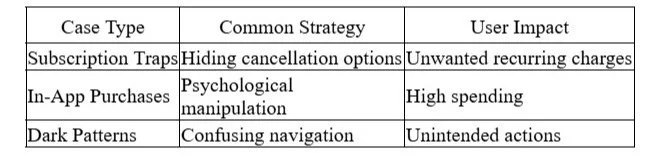
Subscription Traps

  • Case: A music streaming service that initially offers a "free" trial but makes unsubscribing a convoluted process. Users are often unaware of automatic renewals.

  • Impact: Many subscribers incur unwanted charges, as they miss the narrow window for cancellation.

  • Recommendation: Always read the terms of service and mark important dates, such as the end of the trial period, in your calendar.

In-App Purchases in Gaming

  • Case: A mobile game that induces players to make frequent in-app purchases through "loot boxes" promising rare items.

  • Impact: Players, particularly younger users, can spend significant money without realizing due to the addictive nature of rewards.

  • Recommendation: Set spending limits on app stores and educate players about the odds and real cost of these "deals".

Dark Patterns in Interface Design

  • Case: E-commerce sites using misleading buttons or complex navigation paths to prevent canceling an order or subscription.

  • Impact: Users may inadvertently commit to purchases they intended to back out from.

  • Recommendation: Scrutinize confirmation and summary pages carefully before finalizing any transaction.

Ethical and Legal Aspects

The rapid proliferation of digital content has led to numerous ethical and legal challenges. Innovations like artificial intelligence and machine learning have expanded the realm of possibility for digital platforms while also amplifying the potential for misuse. As users increasingly rely on digital services for entertainment, socialization, and work, understanding the ethical and legal ramifications becomes crucial. This section aims to explain the specific issues related to data privacy, content manipulation, and intellectual property within digital environments.

Data privacy emerges as a core issue in the digital landscape. The ability of platforms to track user behavior has raised alarm over how personal information is collected, stored, and utilized. GDPR in Europe and CCPA in California set frameworks for user protection, emphasizing consent and user rights. However, effective enforcement demands that both users and platforms are educated about privacy norms.

Content Manipulation and Misrepresentation

Digital platforms often grapple with the issues of content manipulation. Algorithms engineered to maximize user engagement can foster echo chambers, leading to misinformation. Ethical concerns intensify when manipulation is not merely incidental but a deliberate design embedded in algorithms to maximize profit or influence. Developers and digital platforms must conduct regular audits to ensure algorithms function responsibly.

Intellectual property rights face unprecedented challenges in the digital era. The ease of content reproduction online makes it challenging to protect creators' rights. Platforms should implement effective content identification and management systems to prevent unauthorized use. Blockchain technology offers promising solutions for managing rights and protecting original content.

  • Data Privacy: Adopt strict data protection guidelines. Educate users on privacy settings.

  • Algorithmic Accountability: Build transparency into algorithm designs. Conduct regular ethical audits.

  • Intellectual Property: Implement robust content tracking. Explore innovative solutions like blockchain for IP protection.

In conclusion, the digital landscape is rife with ethical and legal challenges that cannot be ignored. Addressing these issues requires collaborative efforts between legislators, platforms, and users. All stakeholders must prioritize transparency, user rights, and accountability to navigate the complexities of digital traps effectively. These measures will ensure a safer and more equitable digital future.

What Are the Challenges Foreigners Face When Getting Loans in Singapore: Top 5 Common Obstacles

Many people who move to Singapore for work or study may look for extra funds to help with living costs or other needs. They often consider getting a foreigner loan in Singapore to help manage their expenses and make life in a new country easier.

Understanding the key challenges foreigners face with local lenders gives people a better idea of what to expect before applying for a loan. Knowing these issues can help individuals prepare, save time, and avoid problems when trying to secure financial support.

Higher interest rates compared to locals

Foreigners in Singapore often face higher interest rates on loans than residents. This difference comes from the way lenders view risk. Lenders may believe there is a greater chance of non-payment with foreign borrowers.

Because of this, banks and financial companies add a higher rate to foreign loans. Even a small difference in the interest rate can mean paying a lot more over time.

Compared to locals, foreigners might not have a long credit history in the country. This can make lenders less sure about their ability to repay the loan. The higher rates help cover this uncertainty.

In some cases, foreigners are also offered shorter loan terms. This can lead to higher monthly payments. Information shows that foreigners usually pay slightly higher rates than citizens when taking out loans in Singapore.

Stricter income and employment requirements

Foreigners in Singapore often face higher income requirements when applying for loans. Many lenders want to see an annual salary of at least S$30,000 to S$60,000 before they will consider an application. This is usually higher than the amount required for local residents.

Lenders also check employment status closely. Foreigners must hold a valid work pass and show they have stable employment. Most financial institutions want to see that the work pass is valid for at least six months to one year.

Proof of income is another common hurdle. Lenders may ask for recent payslips, bank statements, and an employment contract. These documents prove not just salary, but also job stability. If a foreigner’s work pass is close to expiring, the lender might reject the loan right away.

Limited access to local financing options

Foreigners often face difficulties when trying to get loans from local lenders. Many financial institutions have stricter policies for people without long-term residence or citizenship. This means foreigners may not qualify for some loan products or may face delays in approval.

Lenders usually want to see a proven credit history in Singapore. New arrivals may not have this, making it harder to access certain financing options. Some may be required to show higher income or submit extra documents to support their application.

There are usually fewer options available compared to residents. Loan amounts may be lower, and interest rates can sometimes be higher. These restrictions make it important for foreigners to do research and prepare the needed paperwork in advance.

Overall, foreigners should expect the process to take more time and face stricter checks when applying for financing in Singapore. This limited access can make borrowing more challenging for those new to the country.

Additional paperwork and documentation

Foreigners who want a loan in Singapore often need to provide more paperwork than local citizens. Lenders usually ask for more forms to confirm identity, income, and address. This step helps lenders make sure the applicant is who they say they are and has a steady income.

Some lenders may also request work permits, bank statements, and proof of residence. These documents prove the person’s legal status and help the lender check their ability to pay back the loan.

Extra paperwork can mean the process takes longer. There is often a need for translated documents, especially if the original papers are not in English. This adds another step to the application.

Applicants may be asked for more than one document for each requirement. This can feel like a lot of work, but it is a standard part of many loan applications for foreigners in Singapore. These steps help protect both the lender and the borrower.

Requirement to provide Singapore-based income or collateral

Foreigners who apply for loans in Singapore often need to show proof of income that was earned within Singapore. Lenders prefer this because local income is easier to verify and track.

If an applicant cannot provide Singapore-based income, lenders might ask for collateral. Collateral can include property, a car, or other valuable assets in Singapore. This gives lenders more confidence that the loan can be repaid.

Collateral loans mean that if the borrower fails to pay back the money, the lender can take the asset as payment. This requirement for collateral helps protect lenders when lending to foreigners.

Without local assets or income, it may be harder for foreigners to get approval. These requirements can limit the loan options for those working or living outside of Singapore. It also means extra paperwork and legal checks during the loan process.

Conclusion

Foreigners looking for loans in Singapore face higher income requirements, increased paperwork, and sometimes higher interest rates. Lenders often ask for valid permits or passes and steady employment.

Proof of financial stability plays a key role in the process. Property loans may also involve higher taxes for foreigners.

Understanding these challenges helps borrowers better prepare before applying.