What to Look for in a Mattress If You Wake Up With Back Pain but Sleep Fine in Hotels
Wake up at home with back pain but spring out of a hotel bed feeling brand-new? You're not alone. Plenty of people notice the same pattern, and that gap usually points to your mattress, pillow, or foundation—not your body—so we'll show you how to fix it.
You'll:
- Confirm whether the mattress is the culprit.
- Run a test.
- Pin down the support, firmness, and tech that keep your spine neutral.
- Know when to shop, tweak, or call a clinician.
(Educational guide—no medical diagnosis. Seek professional care for severe or worsening symptoms.)
The symptom pattern test
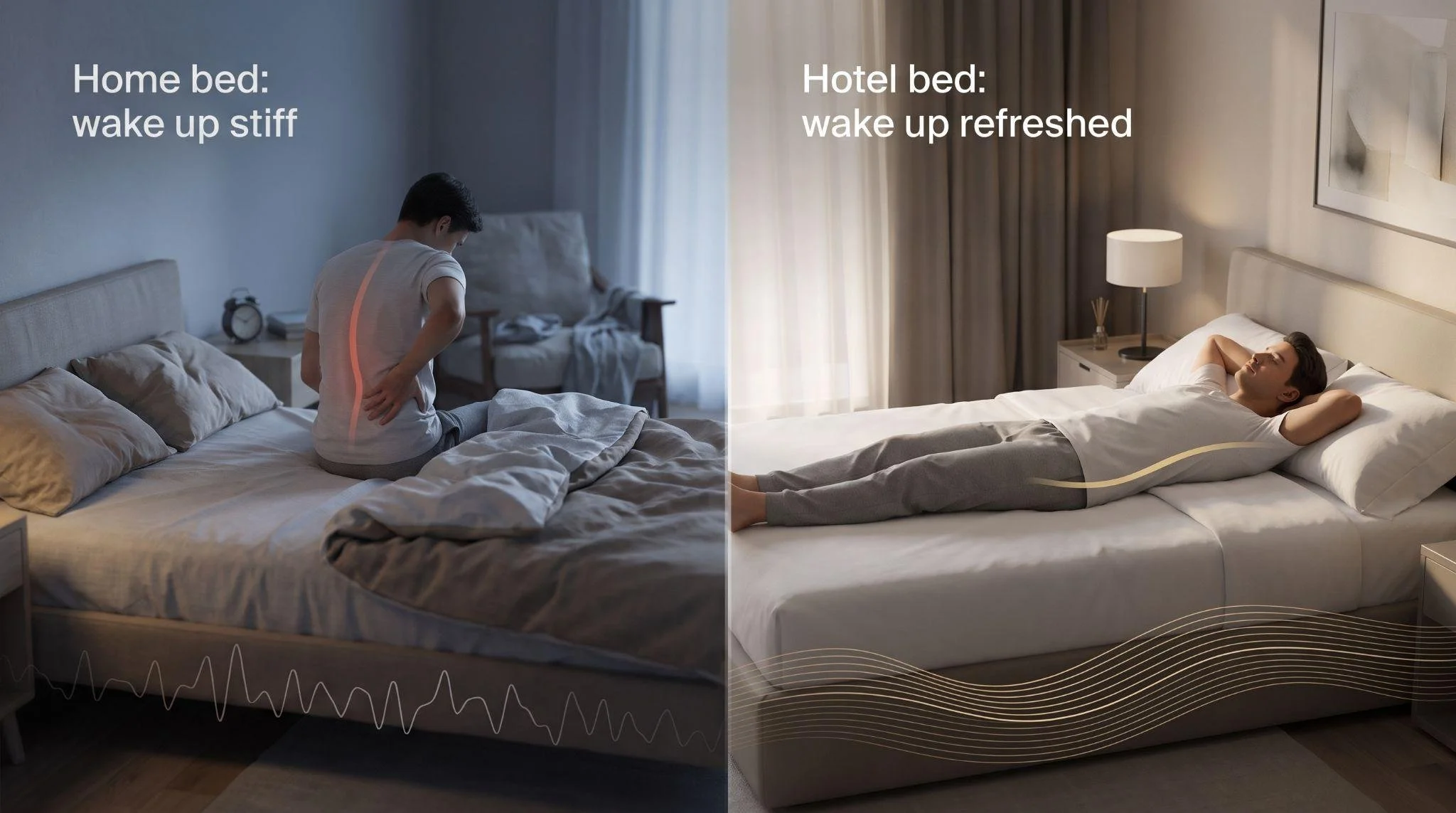
Original illustration created for this article.
1. Time-stamp the pain.
You go to bed comfortable, yet wake stiff. If the stiffness fades after a shower or a few minutes of movement, your sleep surface is a likely contributor.
2. Look for a repeatable contrast.
Track a few nights at home and at least two nights elsewhere (hotel, guest room, or even a sofa). Consistent relief away from home points to your own setup, not an underlying illness.
3. Inspect the support.
Lie still and notice whether you roll toward the middle. Place a broom handle or straightedge across the mattress; any gap wider than one finger signals sag that can misalign your spine.
Medical red flags: call a clinician, not a mattress store
Sudden leg weakness, numbness, loss of bladder or bowel control, fever, unexplained weight loss, or severe night pain all need prompt medical care, according to MedlinePlus.
No red flags and a steady "better elsewhere" pattern? You have a working hypothesis. Next is a seven-night hotel-to-home comparison to confirm it.
Why hotel beds feel better than your bed at home
Plush on top, solid underneath
Upscale hotels usually pair a cushioned surface with a firm support core. Picture a pillow-top that lets your shoulders and hips sink a few millimeters, resting on pocketed coils or a dense foam grid that keeps your pelvis level. Westin's Heavenly Bed, for example, combines a quilted pillow-top with individually wrapped springs (a bed the brand introduced in 1999 and refreshed in 2024).
That soft-plus-steady formula delivers two wins at once:
- Surface comfort: pressure spreads out, so joints stay happy.
- Structural alignment: the core stops your midsection from sagging, so back muscles can relax.
Many home shoppers chase the initial plush feel but forget the scaffold beneath, ending up with a mattress that feels cozy for ten minutes and caves by dawn.
No single "hotel firmness"
Hotels order different firmness levels to match their guest profile; a chain might stock three variants of the same model. What you want to copy is the balance of cushion and lift, not a brand label or a single firmness number.
(We'll unpack temperature, light, pillows, and partner factors in the next section.)
Run a seven-night hotel-to-home audit
Nights 1–3 | record your home baseline
Sleep as usual and, the moment you wake, jot down:
- Pain score (0–10)
- Location (low back, hips, shoulders)
- Minutes until stiffness eases
- Night-time awakenings you recall
If you share the bed, have your partner log the same four numbers. Three nights give you a useful control group.
Nights 4–6 | sleep on a different surface
Book a hotel, use a guest room, or borrow a friend's mattress. Keep bedtime, caffeine, and alcohol habits the same. Bring your own pillow for one night to isolate the mattress variable. Each morning, record the same four data points next to your home scores. If the alternate bed cuts pain by at least 50 percent, the mattress or foundation at home jumps to the top of the suspect list.
Night 7 | inspect the home sleep system
Surface check. Lay a straightedge across the mattress; a gap wider than one finger signals sag.
Foundation check. Look for slats that bow, sit more than three inches apart, or lack a center leg.
Pillow check. Fold it in half; if it doesn't spring back, replace it.
Height check. Your knees should bend roughly 90 degrees when you sit on the edge.
Stop the audit and call a clinician if pain spikes or neurological symptoms appear at any point.
With seven nights of notes and a hardware check complete, you'll know whether to replace the mattress, shore up the base, or explore other causes. We'll decode those patterns in the next section.
Neutral spinal alignment: not maximum hardness
Think of your spine as a gentle stack of poker chips. When each chip stays centered, muscles can rest; let the hips sink or the shoulders jam and the whole stack strains overnight.
Hospital for Special Surgery physiatrist Dr. Naimish Baxi puts it simply: "Choosing the right mattress is really about balancing comfortable spine alignment with enough pressure relief."
How to check that balance in a showroom:
- Side-sleep test. Lie on your usual side, slide a hand along your waist, and have a friend take a photo. Your neck through tailbone should form one smooth line.
- Back-sleep test. Slip a hand under the small of your back. A gap wider than four fingers means the surface is too firm; no space at all means the hips are sinking.
- If you need to brace your abs to feel supported, the mattress fails.
Medium-firm is the research-backed starting point
The best-known evidence is a landmark 313-person randomized trial in The Lancet, where people with chronic nonspecific low-back pain who slept on medium-firm beds reported greater pain relief and functional improvement at 90 days than those on extra-firm models.
Treat medium-firm as a launch pad, not a prescription. A 120-pound side sleeper may need more surface give, while a 220-pound back sleeper could require extra resistance under the pelvis. Brand "6-out-of-10" labels vary, so always test in person.
The best mattress keeps your spine neutral and your muscles relaxed, firm enough for support yet soft enough for relief. Next, we'll match that feel to specific materials and constructions.
Pressure relief without hammocking
Support feels great until it pinches. Your shoulders and hips are rounded, bony landmarks; press them into a board and blood flow stalls fast. A good mattress lets those points sink just enough to spread pressure while a firm core keeps the pelvis level.
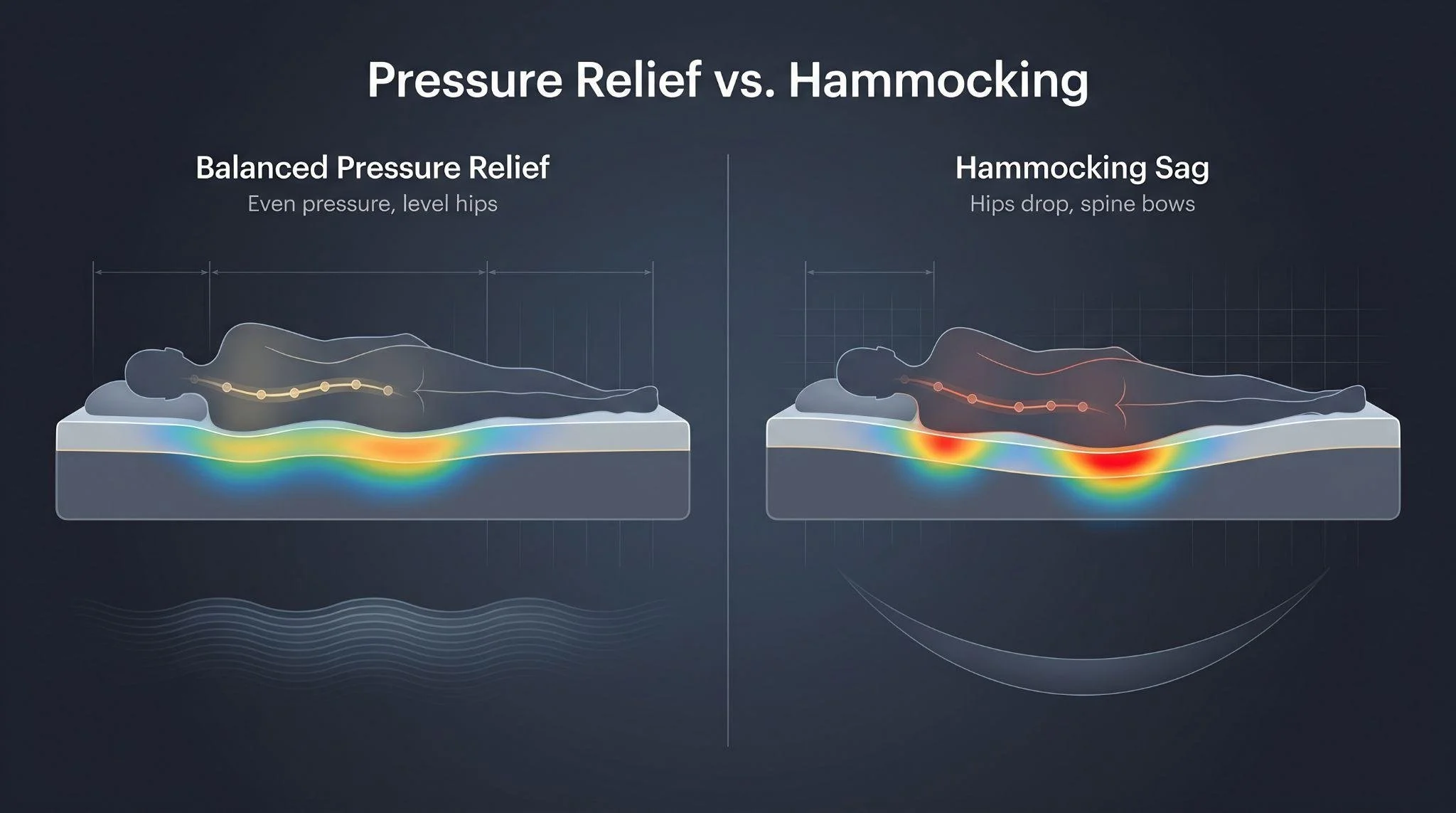
Original illustration created for this article.
Imagine floating on a calm lake: the surface holds you up, but elbows dip slightly below the waterline, easing point stress. A sagging hammock does the opposite. Hips drop deepest, the spine bows, and you wake crooked. An over-soft mattress works the same way, plush at first touch and punishing by sunrise.
Showroom check
Lie on your usual side for at least ten minutes. If your shoulder tingles or you feel the urge to roll off, the comfort layer is either too thin or too stiff. Roll to your other side; if you have to push yourself out of a deep impression, the foam is recovering too slowly, signs of excess sink.
Aim for a quick bounce-back feel: responsive latex, high-density (≥4 lb/ft³) memory foam, or a hybrid pillow-top can cushion joints yet spring back so you stay mobile through the night. Balanced pressure relief lets muscles stop guarding joints and keeps morning hip or shoulder burn at bay.
Match support to your real sleep position
We often shop lying flat yet spend the night curled on our sides or sprawled on our stomachs. Each posture loads the spine differently:
- Side sleepers need extra give at the shoulder and hip plus gentle lift at the waist. Too firm and joints protest; too soft and the pelvis drags the lumbar spine into a curve.
- Back sleepers need even pelvic support with a light cradle under the lumbar arch. If hips sink more than about 2 cm deeper than the chest, stiffness is almost guaranteed.
- Stomach sleepers must prevent midsection sag without jamming the rib cage. A slightly firmer surface, paired with a low-loft pillow, keeps the spine closer to neutral.
- Combination sleepers or couples should look for responsive hybrids or dual-zone designs so each person can move freely and fine-tune firmness.
Choose a feel that supports the posture you hold for hours, not the one you test for minutes. Stop testing and seek professional advice if numbness or sharp pain appears during any trial.
Static zoning, adjustable firmness, and adaptive support
Not all support is locked in foam and coils. Bryte's 2026 guide to the best adjustable bed for back pain notes that adults change sleep position 11 to 13 times a night, and a static surface can only suit one of those positions at a time. Mattress technology now ranges from fixed zones that suit a single posture to real-time adaptive surfaces that readjust with every roll.
Static zoning hides firmer foam or extra coils under the hips while softening around the shoulders. It works best if you keep the same sleep position most of the night.
Adjustable-firmness beds let you change feel by inflating air bladders or moving support inserts. Dual models give each partner an independent setting and end late-night "your side is too hard" debates.
Adaptive systems add sensors that read pressure as you roll, then use air cells or micro motors to adjust support automatically, like cruise control for spinal alignment.
Current clinical research on adaptive mattresses is promising but still limited, so treat the tech as comfort personalization, not medical treatment.
Before investing, test the bed in person. Check motor noise, remote apps, and whether you have a nearby socket or surge protector. Smart support is only helpful if it stays quiet and seamless all night.
Take the Bryte Balance as a working example. Up to 90 Active Balancers sense pressure and adjust firmness silently through the night, and each sleeper sets their own side on a 0 to 100 scale in the Bryte app. The same beds are in more than 20 luxury hotels, including the Park Hyatt New York, which brings the hotel clue full circle.
Bryte reports a 46 percent average improvement in restorative sleep across more than 2 million hours of sleep data. That is a company figure, not a clinical trial, so treat it as a benchmark to test against your own sleep log during the 100-night trial.
Responsiveness keeps you moving pain-free
Great alignment at 10 pm means little if you can't roll at 2 am. When foam rebounds slowly, you fight the mattress, tense muscles, and wake stiff. A responsive surface—latex, pocketed coils, or a high-bounce hybrid—springs back quickly so your core stays relaxed.
Quick test: Lie near the centre, cross one leg over, and roll to the other side. If the bed swallows your hip and makes the pivot feel like a squat, pick a livelier build. Couples can sit on opposite edges and fall back at the same time; minimal ripple shows the mattress isolates motion without trapping you.
Responsiveness matters even more for combination sleepers and anyone with arthritic joints. Easy movement lets your body's natural repositioning ease pressure and boost circulation, both key to waking up pain-free.
Strong edges and a sensible bed height
If you sleep near the edge or share space with a partner who hogs the middle, a weak border steals usable inches and strains your back every time you sit down. Press a knee along the perimeter; it should push back like a firm sofa cushion, not collapse.
Edge support does more than add seating. When borders bow, you instinctively hug the centre, limiting the position changes that relieve pressure. Look for a perimeter rod, high-gauge coils, or reinforced foam rails to keep the outline square.
Aim for knee-height seating
Your knees should form a right angle when you sit on the mattress edge. Measure from the floor to the top of the sleep surface; 19 to 21 inches suits most adults. Beds set ankle-low force stiff backs to squat, while ultra-tall setups can require a hop and raise the risk of a pulled lumbar at 6 am. Adjust the frame or add risers until the height feels effortless.
Keep cool and curb partner motion
Overheating or being jostled can shorten deep-sleep stages, amplifying morning pain. Choose a mattress that:
- Breathes. Open coils allow natural airflow, and ventilated or gel-infused foams help wick heat away. Active cooling pads mainly improve perceived comfort, not spinal mechanics.
- Isolates motion. Individually wrapped coils reduce bounce better than linked Bonnell springs, while high-density (≥4 lb/ft³) foams absorb shock. In the showroom, have a friend sit and stand on their side while you rest on yours; minimal ripple signals restful nights for both of you.
Stay cool, stay still, and your spine gets the uninterrupted break it needs to greet the morning without a grumble.
Durability starts at the core and at the foundation
A mattress's long life begins with materials you can measure:
- Foam density. High-density memory foam (≥ 4 lb/ft³) resists body impressions far longer than 2-lb alternatives.
- Coil gauge. Pocketed coils in the 13–15-gauge range keep their spring years after lighter wire sags.
- Foundation requirements. Most brands specify rigid slats no more than 2–3 inches apart and at least one center leg; wider gaps can void the warranty and fast-track sagging.
Check below the mattress
- Slat spacing. Measure the gap; anything wider than 3 inches risks bowing.
- Center support. Frames larger than full size usually need a middle leg.
- Platform integrity. Replace cracked or bowed boards before blaming the mattress.
Smart-bed extras
For tech models, confirm that electronics carry a separate warranty, ask how firmware updates arrive, and test how the bed feels if Wi-Fi drops. An expensive smart surface frozen on outdated software ages faster than plain foam.
Read the small print
Body-impression clauses vary: some brands call 0.5 inch "normal wear," others allow up to 1.5 inches before replacement. Know the threshold before filing a claim.
A dense support core on a solid base keeps alignment trustworthy year after year, saving you from warranty headaches and premature replacements.
Mattress type comparison: strengths and watch-outs
| Construction | What it does well | Potential drawbacks | Key spec to check |
|---|---|---|---|
| Innerspring + pillow-top | Responsive bounce and airflow; familiar hotel feel | Thin comfort layer can leave shoulders sore; thick topper can let hips sink | Coil count (≈ 800+ in a queen) and pillow-top thickness |
| Hybrid | Modern foams add contouring above sturdy coils | Quality varies; "hybrid" label alone means little | Foam density (≥ 1.8 lb/ft³ poly, ≥ 4 lb/ft³ memory) and coil gauge |
| Memory foam | Deep pressure relief, strong motion isolation | Can trap heat and impede easy turning | Density (≥ 4 lb/ft³ lasts longer than 2 lb) and cooling features |
| Latex | Naturally springy, cooler, resists body impressions | Buoyant feel isn't for everyone; higher cost | ILD firmness rating (20–30 ILD suits most side/back sleepers) |
| Adjustable air | Firmness dialled per side; helpful for couples | Single pressure number may not give enough lumbar zoning | Adjustment range (e.g., 20–50 mm Hg) and pump noise level |
| Adaptive / smart | Sensors tweak support or temperature in real time | Higher price, electronics warranty, limited clinical evidence | Separate foam vs. electronics warranty and offline functionality |
Bottom line: Pick the construction whose natural strengths match your sleep position, temperature needs, and durability goals, then verify the specs, because brand labels alone do not ensure spinal neutrality. (Recent reviews note adaptive systems are promising but still short on long-term, peer-reviewed outcome data.)
Recreate hotel-quality sleep at home
Skip the logo hunt and focus on three controllable factors: the specs, the room environment, and a few small accessories.
Get the build sheet. Email the hotel and ask for the mattress brand, internal SKU, topper thickness, and pillow specs. Many properties will share them. Match those numbers to your seven-night notes. If the hotel bed used a plush pillow-top over firm coils, copy that architecture, not just the brand name, because retail versions often swap layers.
Match the environment. Luxury rooms are cool, dark, and quiet, typically 60–67 °F according to the Sleep Foundation's bedroom-environment guide (sleepfoundation.org). Install blackout shades (about $100), set the thermostat to the mid-60s, and use breathable linen or percale sheets so you can fine-tune warmth instead of adding another inch of foam.
Refresh small gear first.
- Replace flattened pillows; choose a loft that keeps your neck level with your spine.
- Add a 2-inch, high-density (≥4 lb/ft³) latex or memory-foam topper only when the mattress is supportive but slightly too firm. A topper cannot rescue a sagging core or wobbly foundation.
Focus on specs, climate, and accessories first, and you'll capture most of the hotel benefit for a fraction of the price.
The showroom protocol
Walk in rested, wearing soft clothing that lets you feel subtle pressure, and bring the pillow you sleep on every night, since that familiar prop removes one variable.
Short-list three beds. More than three and every foam starts to blur.
Lie in your normal position for ten minutes on each candidate. Use a phone timer so you don't cheat. Note hip or shoulder sink, low-back arch, and any heat build-up.
Roll exactly as you do at 3 am. If you have to push off the surface to turn, cross that model off the list.
Edge test. Sit and lace an imaginary sneaker; the border should keep you upright without tipping.
Document. Jot quick notes on feel, support, temperature, and edge strength. Ask a friend to snap a side photo of your alignment.
Confirm policies before you leave. Request the store's written return or exchange terms, including mandatory break-in days and pickup fees, so trial logistics don't surprise you later.
By the time you leave, you'll have data, not hunches, guiding your sleep investment.
Track the sleep-trial scorecard at home
A single dreamy night proves nothing; bodies usually need 2–4 weeks to adapt. Keep a simple log (paper, spreadsheet, or notes app) every Sunday morning:
- Wake-up pain (0–10)
- Minutes of stiffness
- Night-time awakenings you remember
- Ease of turning (smooth / effortful / stuck)
- Hot spots (shoulders, hips, low back)
- Temperature comfort and partner disturbance
Graph the scores to see trends. If numbers fall week by week, the mattress is earning its keep. If pain climbs or stays high, start an exchange while the window is open.
Most brands require at least 30 nights before accepting a return, so continue logging until then unless severe or spreading pain appears.
Read the trial and return terms before you swipe
Generous trials can hide hurdles. Confirm:
- Mandatory break-in. Many brands block returns until day 30.
- Fees. Pickup, restocking, or exchange shipping may run $50–$150.
- Condition rules. Stains or missing law tags void refunds; use a waterproof, breathable protector from day one.
- Excluded items. Adjustable bases, pillows, or smart modules may be "final sale."
Review the contract with clear eyes. Solid terms ensure the only surprise you get is a pain-free morning.
Navigate NYC delivery without a back-breaking surprise
City living adds hurdles rural shoppers never see. Before you click "Buy," grab a tape measure and check:
- Pathway clearances. Elevator depth, hallway turns, and that tight stairwell corner. A queen mattress in a box usually fits, but split kings or rigid bases may require white-glove service and a Certificate of Insurance (COI) because most co-ops ask for at least $1 million in liability coverage.
- Building rules and fees.
- Confirm whether the carrier handles COI paperwork and elevator reservations.
- Ask about walk-up surcharges (often $10–$20 per flight above the first) and weekend or evening premiums.
- Arrange old-mattress removal; New York sanitation requires mattresses to be sealed in a plastic bag for curbside pickup, and private haul-away can top $100.
- Power and cables. For smart beds or adjustable bases, count outlets near the headboard, verify surge protection, and measure cord reach. Pre-war apartments may need a heavy-duty extension rated for motor loads.
- Ceiling clearance. Measure from floor to ceiling, subtract mattress and base height, and leave pillow space. Low lofts or sloped ceilings can turn bedtime into a head-bump hazard.
Handle these logistics now, and delivery day feels like unwrapping a gift instead of negotiating a loading dock.
Separate essentials from luxury extras
Essentials: fix pain first
- Consistent support that keeps the spine neutral
- Pressure relief at shoulders and hips
- Durable materials (e.g., ≥ 4 lb/ft³ memory foam, 13–15-gauge coils)
- Solid foundation that meets the brand's slat or platform specs
- Sleep trial with a clear, fee-transparent exit
Miss any one of these and cashmere covers will not save your mornings.
Extras: comfort, not correction
- Hand-tufted wool, organic cotton, app-based sleep scores, active cooling water loops, designer upholstery, or white-glove turndown service feel fantastic, but they do not change the physics of pelvic alignment or shoulder cushioning. Add them only after the core checklist is locked.
Pain relief lives in geometry and density; pampering lives in fabrics and features. Invest in function first, then upgrade the frills when the budget allows.
Common mattress mistakes that keep pain hanging around
- Confusing hardness with support. Sliding plywood under a sagging mattress or buying the firmest bed in the store often leads to numb shoulders and a swayback spine.
- Adding softness without structure. A plush topper on a worn-out core only buries the sag deeper, letting hips sink farther by dawn.
- Trusting a generic "6 / 10" tag. Each brand uses its own scale; always test in person or during a home trial.
- Ignoring pillow height and foundation integrity. A pillow that lifts your neck more than 2 inches above neutral or slats spaced wider than 3 inches twist alignment faster than any faulty coil.
- Pushing through red-flag pain to satisfy a break-in period. Persistent numbness, radiating leg pain, or night pain that steals sleep signals a medical check, not another layer of foam.
Replace, tweak, or call the doctor?
Use your seven-night log plus the mechanical checks to choose the next step:
- Replace the mattress when pain disappears in other beds and your home surface shows sag of at least 1 inch (2.5 cm). A topper or new base cannot rescue a collapsed core.
- Add a topper about 2 inches thick (latex or ≥ 4 lb/ft³ memory foam) only when the mattress is flat and supportive but feels slightly too firm.
- Fix or upgrade the foundation if slats bow, center legs wobble, or gaps exceed 3 inches. A sound base can extend a still-healthy mattress.
- Consider zoned, dual-side, or adaptive support when alignment improves in one position but fails in another, or when partners need different firmness.
- Call a clinician today if pain radiates down a leg, numbness spreads, bladder or bowel control changes, fever appears, or night pain wakes you repeatedly. Mattresses fix mechanics; doctors rule out pathology.
Frequently asked questions
How do I know if my mattress causes my back pain?
If pain shows up only after a night in your own bed and fades once you move, or disappears during hotel stays, the mattress moves to the top of the suspect list. Visible sagging, rolling toward the center, or hips sinking deeper than your chest seal the case.
Is a firm or medium-firm mattress better for back pain?
Most evidence points to medium-firm as the safest starting point. A 313-person Lancet trial (2003) found greater pain relief and functional improvement at 90 days versus extra-firm models. Adjust up or down to match your weight and sleep position.
Why does my back feel better in hotels?
Hotels combine a plush surface with a stable support core, run rooms at 60–67 °F, refresh pillows often, and usually let you sleep solo—factors that ease pressure points and keep alignment tidy.
Can a mattress topper fix morning stiffness?
Yes, but only when the base mattress is flat and supportive. A 2-inch latex or ≥ 4 lb/ft³ memory-foam topper can soften a too-firm surface; it cannot level a crater or reinforce broken springs.
How long should I test a new mattress?
Give it at least 30 nights, unless pain worsens sharply. Muscles and ligaments need time to adapt, and many brands will not accept a return before the 30-night mark.
When should I see a doctor instead of another showroom?
Call a clinician if pain radiates down a leg, numbness spreads, bladder or bowel control changes, fever appears, or night pain wakes you repeatedly. Mattresses fix mechanics; doctors rule out pathology.
For deeper detail, revisit the sections on testing, alignment, and materials above.
Conclusion
Better hotel sleep is a clue, not a brand endorsement. Turn that clue into evidence by:
- Tracking seven nights of pain data
- Comparing home and hotel beds under similar conditions
- Prioritizing neutral alignment, balanced pressure relief, and durable support
- Fixing the foundation or environment before buying luxury extras
- Consulting a clinician if red-flag symptoms appear
Follow the data—replace, tweak, or seek care based on what you find—and give your spine the restful night it earns every day. (Information here is educational and not a substitute for professional medical advice.)