What Minnesota Homeowners Actually Pay for a New Roof
Eighteen thousand dollars. That's the average my uncle paid for a tear-off on a 1,600-square-foot rambler in Blaine two winters ago, and he still isn't sure he got a fair deal. He shouldn't feel bad about that. Nobody hands you a cheat sheet when you buy a house with a twenty-year-old roof on it.
So here's yours. For a typical Minnesota single-family home, a full asphalt roof replacement generally lands somewhere between $8,000 and $20,000, with most homeowners settling in the low-to-mid teens once decking, venting, and disposal are counted. That's the number. The rest of this article is about why your neighbor paid less, and whether you should care.
If you want the long version with material-by-material breakdowns, there's a solid walkthrough of roof replacement cost in Minnesota that goes deeper than I can here. What I want to cover is the part that actually trips people up: the gap between the number on the estimate and the number on the final invoice.
Why two houses on the same street get different quotes
Square footage is the headline, but it's rarely the deciding factor. Two houses of identical size can differ by five thousand dollars, and the reasons are almost always buried in the fine print. My uncle's roof was a simple gable with two penetrations. The house three doors down has three dormers, a valley, and a chimney that needed new flashing. Same neighborhood. Very different job.
What moves the needle most:
Pitch and access. A steep roof slows crews down and requires more staging. So does a house with a fence, a detached garage, or a narrow driveway where a dumpster can't sit.
Layers. One layer of shingles comes off fast. Two or three layers doubles your tear-off labor and your disposal fees, and Minnesota's landfill tipping costs aren't trivial.
Decking condition. Rotted sheathing gets replaced at a per-sheet rate. On a house that's had ice damming for years, this can add a couple thousand dollars you didn't plan for.
Here's the part I'd push back on: homeowners obsess over shingle brand and ignore decking. That's backwards. You'll never see the shingle brand from the curb again, but you'll absolutely see the consequences of bad sheathing in five years.
The Minnesota weather tax, explained
Every contractor in the Twin Cities charges more than their cousin in Kansas City, and it isn't greed. It's freeze-thaw. Water gets into a seam, expands overnight, and pries things apart in a way that just doesn't happen in a milder climate. The National Weather Service maintains detailed climate records for the Twin Cities, and if you look at the swing between January lows and July highs, you start to understand why local roofs take such a beating. That's why ice and water shield along the eaves isn't optional here the way it might be in Arizona.
What does this mean for your wallet? Roughly this: expect to pay for underlayment upgrades and ventilation that a Florida homeowner wouldn't think twice about. Attic ventilation matters more here too, because a hot attic under a cold roof deck is what breeds ice dams. So when a contractor quotes you a ridge vent and intake baffles, that's not an upsell. That's basic Minnesota competence.
Materials, ranked by what I'd actually buy
You'll get pitched four or five options. Here's how I'd sort them if it were my house.
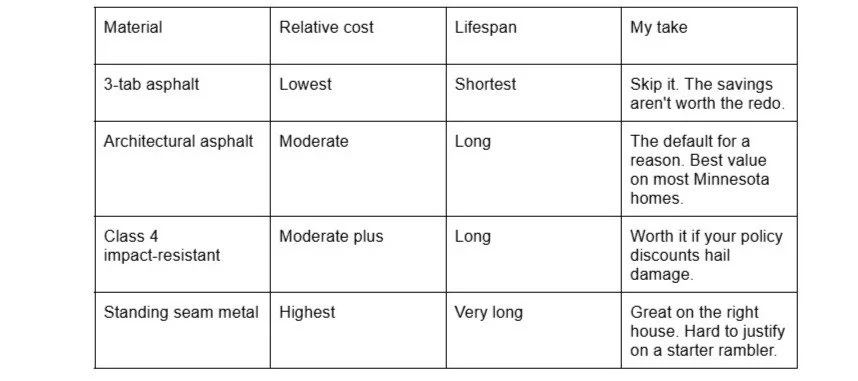
My honest recommendation sits with architectural asphalt for most people, and Class 4 if you've filed a hail claim before. Metal is wonderful and I'd put it on a cabin, but the payback math on a house you might sell in six years doesn't work.
What a fair estimate includes (and what a cheap one hides)
This is where I'd spend your attention. A low bid is frequently a low bid because something got left out, and you find out which something when the crew is already on your roof. Walk through this checklist with every contractor you talk to. Same questions, same order, so you can actually compare answers.
Tear-off and disposal. Is the dumpster in the price, or billed separately after the fact?
Decking. What's the per-sheet rate for replacement sheathing, and who decides how many sheets get swapped?
Ice and water shield. How far up from the eaves does it run?
Flashing. New flashing at chimneys, walls, and skylights, or reused?
Ventilation. Ridge vent plus intake, or just a ridge vent slapped on?
Permits and inspection. Pulled by the contractor or handed to you?
Warranty. Manufacturer and workmanship are two separate documents. Ask for both.
One tip that saved my uncle real money: ask each contractor to note on the written estimate whether the price changes if decking turns out fine. Some will hold the number. Some won't. That single question tells you more about a company than an hour of small talk.
Insurance, and when it's actually worth filing
If a storm took shingles off, your policy may carry most of the replacement. The Department of Housing and Urban Development publishes homeowner resources that explain how property insurance and disaster assistance interact, which is a decent starting point if you've never filed a claim on a roof before. The catch most people miss: filing a claim resets your clock with the insurer, and a small claim can raise your premium more than it pays out.
My rule of thumb. If the damage is cosmetic and the out-of-pocket repair is under your deductible, pay it yourself. If you're looking at a full replacement, file. Don't let a contractor talk you into filing a claim you didn't need to file.
The paperwork nobody warns you about
Roofing is one of the trades where the labor pool and the housing stock both matter, and the numbers behind that shift over time. The Census Bureau tracks both construction employment and housing characteristics nationally, and watching those broad trends is a more honest way to understand why pricing drifts than any single contractor's story about material shortages. If your neighborhood was built in one burst in the 1990s, half the roofs on your block are aging at the same rate, and crews know it. You'll get more competitive bids when you're not the only one on the street shopping.
Ask about certification while you're at it. The National Institute of Standards and Technology publishes building and construction standards that underpin a lot of what manufacturers and inspectors rely on, so a contractor who can speak to standards without fumbling is usually one who's been doing this a while.
Timing your project so you don't pay a premium
Spring and early summer are the busiest months in Minnesota, because everyone remembers the ice dam that wrecked their January and wants it handled before the next one. Demand drives price. Late summer and early fall are quieter, and a crew with an open calendar is a crew that will sharpen a bid.
Book your inspection in July. Schedule the work for September. You'll beat the rush, you'll have better luck getting the contractor you actually want, and you'll still be finished well before the first hard freeze.
What to do this week
Get three written estimates. Ask the decking question, the flashing question, and the warranty question on every one. Read the scope line by line before you sign anything, because that document is the only thing standing between you and a surprise invoice. Then pick the contractor who answered all three without flinching.
Your roof is the one part of your house that keeps everything else dry. Five thousand dollars of difference between two bids almost always shows up somewhere in the next fifteen years. Which bid do you think your future self would rather have taken?