
How to Buy Bulk Office Furniture and Adjustable Standing Workstations the Right Way
https://www.pexels.com/search/?q=office%20furniture%20wholesale
Table of Contents
Why Bulk Office Furniture Buying Goes Wrong
What Does an Office Furniture Wholesaler Actually Offer?
Wholesaler vs. Retailer vs. Manufacturer — Know the Difference
How to Evaluate a Wholesale Supplier
What Is an Adjustable Height Standing Workstation?
Key Specs to Check Before You Buy
Workstation Types Compared
Pricing and Bulk Discount Guide
Common Procurement Mistakes
FAQs
Conclusion
Why Bulk Office Furniture Buying Goes Wrong
Most procurement mistakes happen at the start — not at checkout. A facilities manager gets a deadline, a budget, and a headcount. They start ordering without a sourcing strategy.
Six months later, the chairs are failing. Workstation heights don't match the team. The supplier has gone quiet on warranty claims. The total cost of that "savings" decision is now double the original budget.
The global office furniture market was valued at $59.4 billion in 2025, growing at 8.2% annually through 2035. Businesses are spending — but a significant share is repeat spending caused by poor first purchases.
The solution isn't spending more. It's buying smarter, from the right source, with the right specs confirmed before a single unit ships.
What Does an Office Furniture Wholesaler Actually Offer?
An Office Furniture Wholesaler sits between the manufacturer and the end buyer. They purchase large volumes from multiple manufacturers and resell at bulk pricing — typically 20–40% below standard retail rates.
The practical advantages for business buyers:
Access to multiple brands and product lines under one roof
Bulk pricing without minimum order quantities as high as direct manufacturers
Faster lead times from existing stock
Consolidated invoicing across product categories
The tradeoff: less customization than buying direct from a factory, and quality control varies significantly between wholesalers.
Wholesaler vs. Retailer vs. Manufacturer — Know the Difference

For orders under 20 units, a wholesaler usually makes sense. For 20 or more units — especially if you need custom sizes, finishes, or branding — going manufacturer-direct saves significantly more per unit and gives full control over spec.
How to Evaluate a Wholesale Supplier
Not all wholesalers operate at the same standard. These are the questions that separate reliable partners from vendors who disappear after delivery.
Product verification first: Ask for verified specs, not marketing language. Steel gauge, foam density, frame material, and fabric rub ratings should all be in writing. If a supplier can't provide them, that gap is worth noting.
Request samples before committing: Any serious supplier allows this on B2B orders. Test the chair for a full hour. Open a loaded filing drawer. Adjust the workstation through its full height range under real equipment load.
Check warranty terms carefully: Frame and upholstery should be covered separately, not bundled into one vague term. A 1-year warranty on a commercial chair is a red flag. Look for a minimum of 5 years on frames for anything used daily.
Confirm lead times in writing: Standard stock: 1–3 weeks. Custom or made-to-order: 4–10 weeks. If your fit-out has a deadline, get the production schedule signed before any payment.
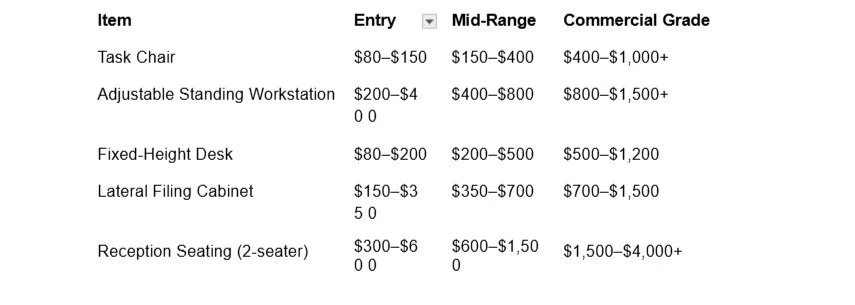
Volume pricing should reflect your actual order size: Listed wholesale prices are rarely the real B2B price. Always request a formal quote at your specific order quantity — discounts typically scale as follows:
5–10 units: 5–10% off
20+ units: 10–20% off
50+ units: manufacturer-direct pricing is almost always more competitive
For businesses equipping multiple locations or needing full customization,
manufacturer-direct suppliers like Meet&Co — operating since 2007, supplying across 100+ countries — offer factory-direct pricing with custom sizing, material, and finish options from a single source.
What Is an Adjustable Height Standing Workstation?
An adjustable height standing workstation is a complete desk setup that moves between sitting and standing heights, designed to keep the user in a neutral, ergonomic posture in both positions.
It typically includes a height-adjustable desk frame, work surface, monitor arm, and keyboard tray — all configured to eliminate static posture across the workday.
The global standing desk market was valued at $8.6 billion in 2025 and is growing at 5.3% annually through 2030. More than 67% of Fortune 500 companies have incorporated standing workstations into their employee wellness programs.
The health evidence is consistent:
78% of employees report reduced back pain after switching to a sit-stand setup
A 12-month CDC study found upper back and neck pain dropped by 54% among sit-stand desk users
65% of users report improved afternoon productivity
This isn't a trend. It's a documented workplace health intervention.
Key Specs to Check Before You Buy
Height range: The desk must reach low enough for your shortest user and high enough for your tallest. Minimum 24 inches for sitting, 48 inches for standing. For users over 6 feet, confirm the desk reaches 50 inches.
Frame stability: At full extension, the desk should not sway more than 1–2mm under normal load. Dual crossbar frames outperform single-bar designs significantly at height. Always test at maximum height — not just at sitting position.
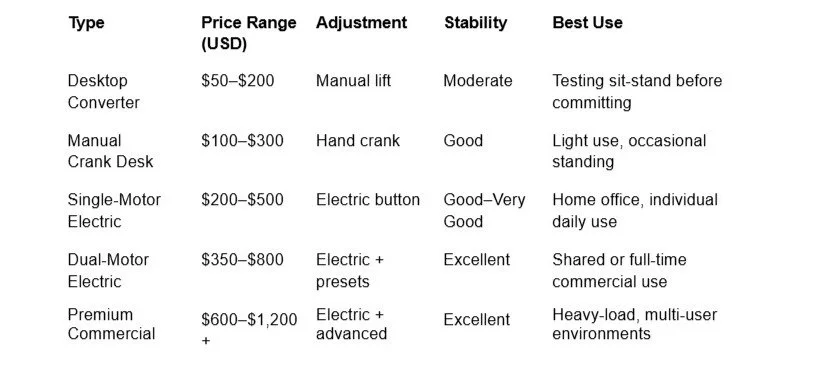
Motor type: Single motor handles basic home or light office use. Dual motor provides faster, quieter adjustment and far better stability under loads above 150 lbs. For commercial use with dual monitors, dual motors are the right choice.
Weight capacity: Minimum 150 lbs for single-monitor setups. 220+ lbs for dual monitors and accessories. Verify this under real load — advertised capacities don't always reflect
real-world stability at maximum height.
Memory presets: Essential for shared workstations. Two to four programmable height positions mean each user saves their setting without manual readjustment every time.
Anti-collision sensor: The desk stops automatically if it contacts an obstacle while rising. Prevents expensive monitor and equipment damage. Standard on quality commercial models.
Workstation Types Compared
Pricing and Bulk Discount Guide
Common Procurement Mistakes
Choosing supplier on price alone: The cheapest quote rarely reflects the real total cost. Factor in replacement frequency, warranty coverage, and installation support before comparing numbers.
Testing with the wrong person: One manager sitting in a chair for five minutes before ordering 40 units is not a product test. The person testing should represent the actual daily user — same height, same work pattern, same equipment load.
Ignoring post-delivery support: A supplier that disappears after delivery is not a partner. Confirm whether installation, reconfiguration support, and warranty service are included — before signing any purchase order.
Ordering without measuring: An adjustable workstation at full height needs vertical clearance. A lateral filing cabinet needs 24 inches of front clearance for the drawer to fully open. Size mismatches are expensive and avoidable.
FAQs
What is the minimum order for an office furniture wholesaler?
Most wholesalers start at 5–10 units. Meaningful discounts typically 10–20% begin at 20 units. For 50 or more units, request manufacturer-direct pricing. Always get a formal quote at your actual order quantity rather than estimating from published rates.
How is an office furniture wholesaler different from a manufacturer?
A wholesaler stocks products from multiple manufacturers and sells in bulk without full customization. A manufacturer produces to your specification including custom sizes, materials, and finishes usually at lower per-unit cost for larger orders, with longer lead times.
What makes an adjustable height standing workstation worth the cost?
Reduced back and neck pain, improved afternoon energy, and lower absenteeism linked to musculoskeletal complaints. A CDC-studied sit-stand intervention showed a 54% reduction in upper body pain over 12 months. For any team spending 6+ hours daily at desks, the productivity and health return justifies the price difference over a fixed desk.
What height range should I specify for a shared standing workstation?
A range of 24–50 inches covers approximately 95% of adult users in both sitting and standing positions. For teams with users taller than 6'2", confirm the desk reaches 52 inches. Cornell University's ergonomics guidelines recommend elbow height as the reference point
— arms at 90 degrees, wrists flat, in both positions.
How long should commercial-grade adjustable workstations last?
A quality dual-motor electric frame with a steel base: 8–12 years under daily commercial use. The surface typically wears faster than the frame. This is why separate warranty terms for frame and surface matter as bundled coverage usually favors the supplier, not the buyer.
What lead time should I plan for bulk furniture orders?
In-stock standard items: 1–3 weeks. Custom or made-to-order workstations: 4–10 weeks from confirmed order. For office fit-outs with fixed opening dates, get the production schedule confirmed in writing as verbal timelines are not accountable.
Can I mix standing and fixed-height desks in one office order?
Yes, and it's often practical. Standing workstations for roles with long desk hours — writers, developers, analysts. Fixed desks for meeting rooms, reception, or roles with frequent away-from-desk movement. Standardize within each zone to keep replacement parts consistent.
Conclusion
Buying office furniture through a wholesaler or direct from a manufacturer is a strategic decision — not just a procurement task. The supplier you choose determines product quality, post-sale support, and what happens when something needs replacing two years from now.
Key takeaways:
Wholesalers work well for orders under 20 units: manufacturer-direct is better above that threshold
Always verify specs in writing: steel gauge, foam density, height range, and warranty terms separately for frame and surface
Adjustable height standing workstations are a health investment: the evidence on back pain reduction and productivity is consistent and well-documented
Request a sample unit before any bulk commitment: no credible supplier refuses this
Get lead times, pricing, and warranty confirmed in writing before signing
Test workstations at maximum height under your actual equipment load: stability at full extension is what matters
Buy from a supplier who remains accountable after delivery. That's the only specification that can't be found on a product sheet.
External References
IMARC Group — Global Office Furniture Market Report, 2025 https://www.imarcgroup.com/office-furniture-market
Grand View Research — Standing Desks Market Size & Forecast, 2030 https://www.grandviewresearch.com/industry-analysis/standing-desks-market-report
BIFMA — Commercial Furniture Standards Overview https://www.bifma.org/page/standardsoverview
Cornell University Ergonomics — 20-8-2 Activity Guidelines https://ergo.human.cornell.edu/CUESitStand.html
Fortune Business Insights — Office Furniture Market Growth Report https://www.fortunebusinessinsights.com/office-furniture-market-106234
PMC/NCBI — Office Design and Employee Health (2021) https://pmc.ncbi.nlm.nih.gov/articles/PMC7826301/
CDC — Evaluation of a Sit/Stand Workstation Intervention https://www.cdc.gov/niosh/topics/ergonomics/
OSHA — Computer Workstation Ergonomics Guidelines https://www.osha.gov/etools/computer-workstations