The Ultimate Moving Checklist: How to Prepare for a Stress-Free Relocation
Most moving checklists fail for one reason: they list tasks without telling you when to do them. Knowing you need to forward your mail is easy. Knowing that forwarding can take up to two weeks to start, or that your building wants a certificate of insurance before the elevator can be booked, is what keeps moving day from falling apart.
This checklist is organized by lead time. It starts eight weeks out, because the things that go wrong in the final week were usually decided, or forgotten, a month earlier. Work through it in order, check items off as you go, and stretch the early stages by a couple of weeks if you are moving to another state or country.
How to Use This Moving Checklist
Count backward from your moving date and start at the matching section. If you are already four weeks out, do the eight-week and six-week items first, fast, before moving on. Keep everything in one place: a shared note, a spreadsheet or a paper folder. Two people working from two different lists is how the internet gets cancelled a week before anyone remembers to set it up at the new address.
8 Weeks Before Moving Day
Lock in your date and a realistic budget
Pick the date first, because every other booking hangs on it. Weekends, the last few days of the month and the summer months fill up fastest with movers and building elevators, so a midweek, mid-month date gives you more choice and often a better rate.
Build a budget that covers more than the moving company: packing supplies, cleaning, travel, a night or two in a hotel if your dates do not line up, takeout during the first chaotic days, and deposits for utilities at the new place.
Research and book your movers
Get at least three written estimates, and insist on an in-home or video walkthrough rather than a quote over the phone. A mover who has not seen your belongings is guessing, and guesses tend to grow on moving day. For an interstate move in the United States, check that the company has a USDOT number and look it up on the Federal Motor Carrier Safety Administration's website before you sign anything.
Ask every company what happens if something breaks. Under the FMCSA's released value option, a mover's liability is capped at 60 cents per pound, per article, so a 10-pound stereo component worth $1,000 would be covered for no more than $6. Full value protection costs more, but it is the option that pays to repair or replace items at their actual value. Read which one you are signing for.
If your relocation takes you north of the border, Real Estate Movers is a company worth calling: they have handled local and long-distance moves across Canada since 2012 and keep each household on a single trailer whenever the size of the move allows, which means fewer hands on your furniture between pickup and delivery.
Start decluttering, room by room
Every item you move costs money in weight, packing time and space in the new place. Go room by room and sort into four piles: keep, sell, donate and discard. Start with storage areas like the basement, garage, closets and kitchen cabinets, since they hide the most items you have not touched in years. Schedule donation pickups now; charity trucks book up weeks ahead in busy seasons.
Create a moving folder
Estimates, the signed contract, the inventory list, building forms, utility confirmation numbers and your new lease or closing documents all go in one folder, digital and paper. On moving day, that folder rides with you, not on the truck.
6 Weeks Before Moving Day
Gather packing supplies
Order more boxes than you think you need, in several sizes. Small boxes are for heavy things like books and dishes; large boxes are for light, bulky things like bedding and pillows. Add packing paper, bubble wrap, quality packing tape, markers, furniture pads and a few specialty boxes for dishes, wardrobes and flat-screen TVs if your movers do not supply them.
Pack what you will not miss
Start with off-season clothing, holiday decorations, books, guest room linens, spare kitchen gear and anything on a high shelf. By the end of this week, rooms you rarely use should be fully boxed.
Choose one labeling system and stick to it
Mark each box with the destination room, a short list of contents and a number. Write the label on the side, not just the top, because the top disappears once boxes are stacked. Color-coded tape or stickers per room help the crew unload quickly, and a numbered list lets you confirm that box 47 actually arrived.
Check the rules at both buildings
Apartment and condo moves have rules that a house move does not. Many New York co-ops and condos require movers to provide a certificate of insurance naming the building, limit moves to weekday hours, and need the service elevator reserved in advance, sometimes with a refundable deposit. Call both your current and new building managers now and ask about move hours, elevator booking, insurance paperwork, loading areas and whether floor or wall protection is required. Then send the requirements to your mover in writing.
If either home is a walk-up, tell your mover the number of flights before the estimate is final. Stairs change the crew size and the time a move takes.
Request school, medical and pet records
Ask your children's schools how records are transferred. Request copies of medical and dental records, and refill any prescriptions so you have enough to bridge the gap until you find new providers. Get vaccination records from your vet, since boarding facilities, groomers and new vets will ask for them.
4 Weeks Before Moving Day
Set up mail forwarding
According to USPS, standard forwarding on a permanent change of address lasts 12 months, magazines and other periodicals are forwarded for 60 days, and you can pay to extend forwarding for 6, 12 or 18 more months. Submit the request online now and pick a start date close to your move. Allow up to two weeks for forwarding to begin.
Make your address change list
Mail forwarding is a safety net, not a replacement for updating your address. Write a list and work through it over the next two weeks:
Your bank, credit card companies and any loan servicers.
Your employer's payroll and benefits team.
Health, auto, renter's or homeowner's and life insurance providers.
Subscriptions, streaming services, online stores and delivery apps that store your address.
Doctors, dentists, pharmacies and your vet.
Friends and family who still send cards by mail.
Schedule utilities and internet
Arrange to stop electricity, gas, water and trash service at your old home the day after you move out, and start them at the new home the day before you arrive. Book internet installation now. In many cities, technician appointments run two or three weeks out, and working from home without a connection is a quick way to lose the first week in a new place.
Update your insurance
Call your renter's or homeowner's insurer to move the policy to your new address on the right date, and ask whether your belongings are covered while they are in transit. If you are moving to a new state, ask your auto insurer how your premium and coverage will change.
Confirm your mover in writing
Get the moving date, arrival window, total estimate, payment method, valuation option and any building requirements confirmed in one written document. If something on it does not match what was promised on the phone, fix it now, not on moving day.
2 Weeks Before Moving Day
This is the heavy packing stretch. Aim to have everything boxed except the items you use every day.
Pack most of the kitchen, leaving a few plates, cups, utensils and one pan.
Eat through the freezer and pantry so there is less to throw away or move.
Set aside items movers will not carry, such as paint, propane tanks, gasoline, cleaning chemicals, aerosols and ammunition, and arrange to dispose of them or move them yourself where it is legal and safe.
Get your car serviced if you are driving a long distance, especially in winter.
Return borrowed items, pick up dry cleaning and repairs, and cancel or transfer local memberships like gyms and clubs.
Decide how houseplants will travel. Most movers will not take them on a long-distance truck.
1 Week Before Moving Day
Pack an open-first box
This box rides in your car and holds what you will need the first night: toilet paper, a shower curtain and towels, bed sheets, phone chargers, basic tools, a box cutter, medications, snacks, paper plates, a kettle or coffee maker, trash bags, cleaning supplies and a change of clothes for everyone.
Prepare appliances and furniture
Empty, defrost and dry the fridge and freezer at least a day before the move so water does not leak onto everything else in the truck. Take apart bed frames, table legs and shelving, and put the screws for each piece in a labeled bag taped inside a drawer or kept in a single hardware box.
Back up your computers and phones
Copy important files to an external drive that you carry yourself and to a cloud account. Hardware can be replaced; photos and documents usually cannot.
Arrange care for kids and pets
A moving day with open doors, heavy furniture and stressed adults is no place for small children or nervous pets. Book a sitter, ask a friend or reserve boarding for the day.
The Day Before
Charge phones, laptops and a portable battery.
Disconnect electronics and take a photo of the cables behind the TV and computer before unplugging them.
Check every drawer, closet, cabinet and storage space one more time.
Confirm the crew's arrival time, the elevator reservation and any parking or loading arrangements.
Put valuables, important documents, medications and your moving folder in your car or a bag that stays with you.
Clear walkways, take down curtains and pull up loose rugs.
Moving Day
Be at the home when the crew arrives and walk through every room with the crew lead. Point out fragile and high-value items, anything that is staying behind, and the order you want rooms loaded. Mark items that are not going with tape that reads DO NOT LOAD.
Read the bill of lading and inventory before you sign it, and keep a copy. Once the truck is loaded, do a final sweep of every room, closet, cabinet, balcony and storage unit. Take photos of the empty home, record meter readings if utilities are in your name, and hand over or lock up the keys as arranged.
For a long-distance move, get the delivery window in writing along with the driver's direct phone number, and plan where you will sleep if delivery takes a few days. An air mattress and a few days of clothes in the car make that gap easy.
Your First Week in the New Home
Before the crew leaves, open your most valuable items and inspect the furniture. Note any damage on the delivery paperwork before you sign, and take photos right away. Claim deadlines vary, so read your contract and file in writing promptly.
Unpack in this order: beds, bathroom, kitchen basics, then everything else. A home that has working beds and a usable kitchen on the first night feels settled far sooner than one where every room is half-unpacked.
If you moved in winter, let TVs, computers and game consoles warm to room temperature before turning them on. Sony's care guides for its VAIO laptops recommend waiting at least one hour when a computer comes from a cold place into a warm one, because moisture can condense inside.
Then handle the paperwork that has deadlines. If you moved to a new state, look up how long you have to update your driver's license and vehicle registration; according to ConsumerAffairs, deadlines range from about 10 days in states such as California and Ohio to 60 days in states such as Georgia and Nebraska. Update your voter registration, register children at their new schools, and start looking for a new doctor, dentist and vet before you need one.
Finally, find the main water shut-off valve and the electrical panel, test the smoke and carbon monoxide alarms, and save the building manager's or landlord's emergency number in your phone.
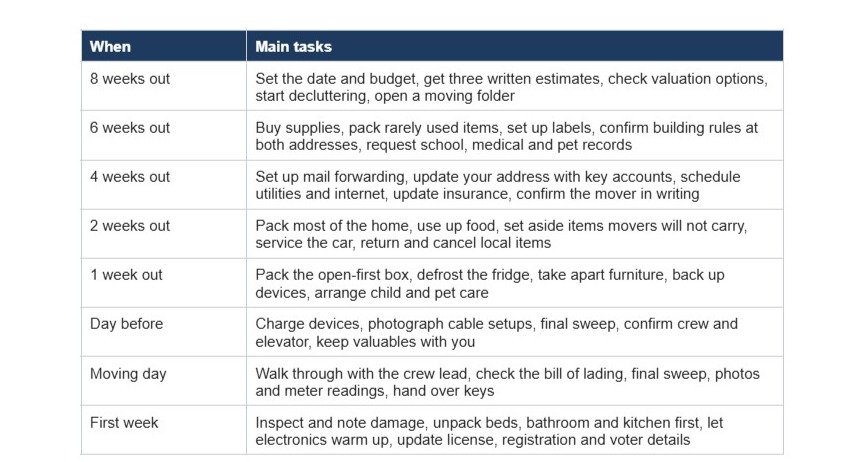
Moving Checklist at a Glance
Mistakes That Make a Move Harder Than It Needs to Be
Most moving day problems trace back to a handful of avoidable decisions. Booking movers too late leaves you with whoever is available, not whoever is good. Packing the kitchen first means two weeks of takeout. Skipping labels turns unpacking into a scavenger hunt. Forgetting building rules can leave a crew waiting in the lobby, on the clock, because the elevator was never reserved. And packing keys, documents or medication in a box on the truck is the one mistake that is very hard to fix the same day.
Frequently Asked Questions
How far in advance should I start preparing for a move?
Eight weeks is a comfortable runway for a local move. For an interstate or international move, or a move in peak summer season, start ten to twelve weeks out so you have a real choice of movers and dates.
When should I book a moving company?
Six to eight weeks before your date for a typical move, and earlier for summer, month-end or weekend dates. Booking early also gives you time to compare written estimates instead of taking the first available crew.
How long does USPS forward mail after a move?
Standard forwarding on a permanent change of address lasts 12 months for most mail, while periodicals are forwarded for 60 days. USPS offers paid extensions of 6, 12 or 18 months if you need longer.
What should I never pack on the moving truck?
Keep important documents, keys, medication, jewelry, laptops, backup drives and your moving folder with you. Movers will also refuse hazardous items such as paint, propane, gasoline and aerosols.
What does basic mover liability cover if something breaks?
Very little. Under the FMCSA's released value option, liability is limited to 60 cents per pound, per article, which is far below the value of most electronics and furniture. Ask about full value protection and check your renter's or homeowner's policy before the move.
Make the List Work for You
A move goes smoothly when the deadlines are handled early and the day itself has nothing left to decide. Print this checklist, put dates next to each section, and share it with everyone who is moving with you. When moving day comes, the only job left should be carrying boxes.