How to Tell If Your Industrial Floor Needs Repairing, Upgrading, or Both
Most facility managers know their floor has a problem long before they do anything about it. A forklift operator starts swerving around the same spot. A joint that was filled six months ago opens up again. A section of surface begins to flake near a high-traffic aisle. The signs are there, but the question of what to actually do about them is rarely straightforward.
The distinction between a floor that needs repairing and one that needs upgrading is more than semantic. It changes the scope of work, the cost, the timeline, and, most importantly, whether the intervention will last. Getting that diagnosis wrong means spending money on a solution that addresses the symptom rather than the cause, and returning to the same problem within a year or two.
Understanding the difference starts with asking a question that most contractors never raise: is the floor failing because something broke, or because it was never designed for what it is now being asked to do?
The Signals That a Floor Needs Repair
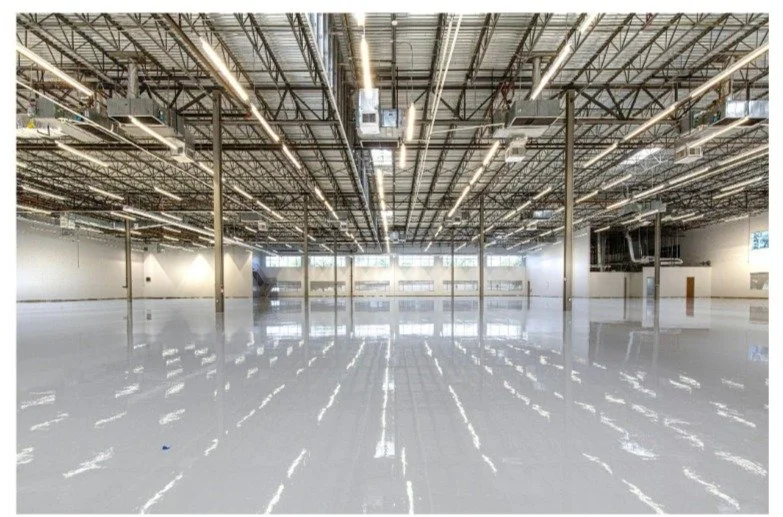
The most visible signs of a floor requiring attention are familiar to anyone who has managed a warehouse or distribution facility for any length of time.
Surface cracking is the most common presentation. Fine, hairline cracks caused by shrinkage during the original pour are generally cosmetic and carry no structural significance, though they should be monitored for any signs of widening. Larger cracks, especially those that are opening, stepping on one side, or appearing repeatedly in the same location, point to something more substantive. They may indicate restraint issues within the slab, inadequate reinforcement at the time of construction, or sub-base movement beneath the floor.
Joint failure is typically the most operationally disruptive problem a facility will encounter. The impact from hard-wheeled materials handling equipment passing over joints causes damage to the arris edges, and if joint sealant has de-bonded or perished, it is effectively no longer protecting the joint, which significantly increases the risk of further damage. What begins as minor edge chipping eventually escalates to wide, spalled joints that force operators to slow down, reroute, or avoid sections of the floor entirely.
Spalling and surface delamination, where layers of concrete separate or flake away from the structure beneath, are warning signs that should never be left to progress. Once concrete begins to break down, the deterioration accelerates rather than stabilising. The earlier the intervention, the more cost-effective the repair.
Other indicators include slab curling at edges and corners, drainage problems where water pools in areas that should run clear, and repeated damage to forklift tyres or suspension systems in specific zones, a reliable signal that surface transitions or joint conditions are creating impact loads the equipment was not designed to absorb.
In each of these cases, if the damage is localised and the underlying slab is structurally sound, targeted repair is the appropriate response. The key phrase is structurally sound. A repair applied over a compromised substrate does not solve the problem. Isolated joint repair in a deteriorated slab may resolve the visible damage while leaving underlying structural deficiencies unaddressed, producing recurrence at adjacent locations within twelve to thirty-six months.
When Repair Is Not Enough: The Case for an Upgrade
The harder conversation, and the one that facility managers are less often offered, concerns floors that are not so much damaged as they are mismatched to the operation running on top of them.
Operations evolve. Facilities that were built to accommodate counterbalanced forklifts in wide aisles are now running very narrow aisle trucks or autonomous guided vehicles. Distribution centres that originally handled pallet racking at eight metres have extended their racking to twelve or fourteen metres. Cold storage facilities have had their temperature profiles changed, increasing the stress on concrete that was specified for different conditions. In all of these scenarios, the floor may be performing exactly as it was designed to, but the design is no longer adequate.
The floor, in other words, was built for yesterday's operation.
This is the core distinction that separates a repair from an upgrade, and it is the lens through which specialists like Twintec Group approach the question. Rather than simply responding to visible defects, a genuine performance assessment examines whether the floor's current specification, its flatness tolerances, load capacity, joint configuration, and surface hardness, still matches the operational demands being placed on it. In many cases, particularly where automation has been introduced or loading patterns have changed, the answer is that it does not.
Performance upgrades address this gap through engineered improvement works that go beyond patching and filling. Structural slab overlays, joint reconstruction with armoured joint systems, surface grinding to restore flatness tolerances, and load transfer upgrades for high-stress zones are all interventions aimed at bringing the floor's capability back in line with what the operation actually requires.
The Scenario That Demands Both
There is a third category, and it is arguably the most common in older facilities: floors that exhibit clear physical damage and have also drifted out of specification due to operational change.
A cold storage facility that has experienced joint deterioration and surface wear while simultaneously seeing an increase in load due to expanded robotic racking is a representative example. The repair need is real, but if it is addressed in isolation, the upgraded loads will simply recreate the same failures within a short period. The upgrade need is equally real, but upgrading a floor that has active joint failures and spalling will not resolve those defects on its own.
In this scenario, the correct approach is a structured assessment that maps the full picture, identifying which areas need repair, which areas need their performance envelope extended, and which need both, before any work is specified. That sequencing matters. Repairs made prior to an upgrade that changes the load profile of the floor may need to be designed differently than repairs made in isolation.
The practical implication for facility managers is straightforward: if a floor inspection only produces a list of repair items without any evaluation of whether the current specification still serves the operation, it is an incomplete assessment. The visible damage is the symptom. The underlying question, whether the floor was designed for this, is the diagnosis.
Getting that diagnosis right, before committing to a scope of work, is the difference between a floor that performs reliably for the next decade and one that requires attention again within the next two years.