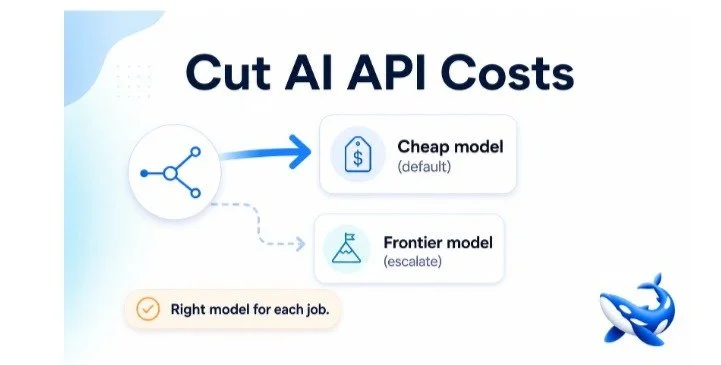
How to Cut AI API Costs Without Rewriting Your App
When an AI feature graduates from prototype to production, the bill often becomes the headline problem. The reflex is to trim prompts or call the model less — useful, but small. The biggest savings almost always come from a different lever: sending each request to the right-priced model instead of running everything on an expensive one. Best of all, with the right setup, you can capture those savings without rewriting your app.
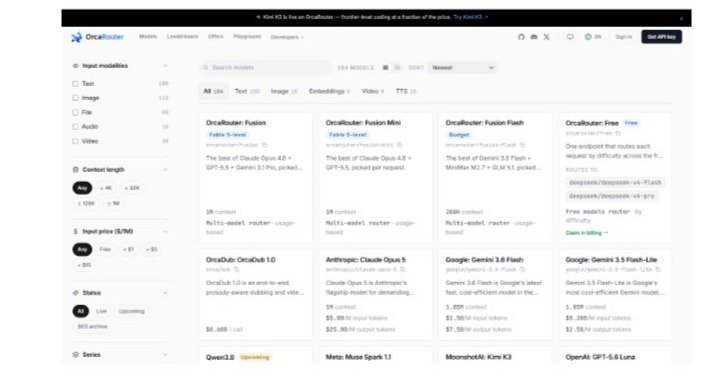
A concrete reference helps here: OrcaRouter fronts budget and frontier models behind one OpenAI-compatible endpoint, so you can measure the cost difference between models before you migrate anything. With that in mind, here is how to cut your AI API bill without touching your integration.
Where AI API money actually leaks
Most overspend isn't a few costly queries — it's a flood of easy ones running on a premium model out of habit. Classification, extraction, routing, summarization: individually trivial, collectively enormous. Paying frontier prices for intern-level work, millions of times over, is the single most common source of a bloated AI bill. Find that flood and you've found your savings.
Lever 1: right-size the model
The highest-impact move is matching model to task difficulty. Cheap, fast models in 2026 handle a huge share of everyday work — classification, extraction, summarization, light agents — at a small fraction of frontier prices. Move that high-volume, low-difficulty traffic to a budget model and reserve the expensive model for the genuinely hard minority. Because the easy bucket is usually 80–95% of calls, this alone can cut the dominant part of your bill by a large multiple.
Lever 2: route, don't standardize
Standardizing on one model is what creates the problem. A routing tier fixes it: default every request to a cheap model, and escalate only the fraction that need more — by task type, a confidence check, or a difficulty classifier. This captures most of the savings while keeping frontier quality available for the hard tail. The key is that routing should be a configuration decision, not a rebuild.
Why you don't have to rewrite
Here's the part that makes cost-cutting painless: if you're on an OpenAI-compatible AI API, switching or routing between models is a change of model name, not a change of integration. Your request code, parsing, and prompts stay put. A unified endpoint that fronts many models makes this especially clean — cheap model, frontier model, and everything between are all reachable through the same interface, so building a routing tier is a small amount of dispatch logic rather than a migration.
Lever 3: avoid markup and lock-in
Two structural costs are easy to miss. First, markup: some aggregators charge above provider rates — prefer one that passes through provider cost. Second, lock-in: if you can't easily switch to a cheaper model when one launches, you overpay by default. Staying OpenAI-compatible and provider-neutral keeps you free to chase the best price whenever the market moves.
A simple cost-cutting plan
• Instrument spend by feature to find the high-volume, low-difficulty traffic.
• Move that traffic to a cheaper model behind a quality check.
• Add a routing tier: cheap by default, escalate the hard minority.
• Verify quality on your own data before and after each move.
• Use an OpenAI-compatible, no-markup endpoint so switching stays free.
• Re-check quarterly — new cheap models keep absorbing more tasks.
A worked savings example
Numbers make the case. Say you run one million AI API calls a month, and today they all go to a frontier model. Suppose analysis shows 90% of those calls are simple — classification, extraction, short summaries — that a cheap model handles just as well, while 10% genuinely need the frontier model. If the cheap model costs roughly a fifth of the frontier one, your blended cost becomes (0.90 × cheap) + (0.10 × frontier). The 90% majority now costs a fifth of what it did, and only the 10% hard tail still pays frontier prices. The total lands far below running everything on the frontier model — often a majority reduction in spend.
The elegant part is what it took to get there: no rewrite. On an OpenAI-compatible endpoint, the routing tier is a small dispatch function that picks the model name, and switching the easy traffic to the cheap model is a config change. You didn't touch your prompts, your parsing, or your integration — you changed which model string each request uses. Then push the completion rate of the cheap tier higher (better prompts, a slightly better cheap model) and the expensive slice shrinks further. Re-run this exercise each quarter, because new cheap models keep absorbing tasks that used to require a frontier model, so the share you can safely route down tends to grow over time. The savings compound, and none of it costs you an integration project.
Frequently asked questions
What's the biggest way to cut AI API costs? Right-sizing the model — moving high-volume, low-difficulty traffic off an expensive model onto a cheap one — and routing, not prompt-trimming.
Do I have to rewrite my app? No, if you're on an OpenAI-compatible endpoint. Switching and routing between models becomes a model-name change.
What is a routing tier? Logic that sends easy requests to a cheap model by default and escalates only hard ones to a frontier model.
How do I avoid hidden costs? Choose a no-markup, provider-neutral, OpenAI-compatible API so you pay provider rates and can switch to cheaper models freely.
Will cheaper models hurt quality? On easy, high-volume tasks, usually not enough to matter — but verify on your own data and escalate the cases that need it.
Can I test savings before migrating? Yes — use free credits to benchmark a cheap model against your current one on real traffic.
Bottom line
Cutting AI API costs isn't about doing less AI — it's about matching each task to the cheapest model that does it well, and routing accordingly. On an OpenAI-compatible, no-markup endpoint, you capture those savings without touching your integration: switching models is a config change. Instrument your spend, move the easy majority to a cheap model, keep a frontier escalation path, and prove every move on your own data — starting with free credits so the evaluation itself costs nothing.