How Northeast Ohio Property Owners Protect Commercial Buildings From Winter Roof Damage
Two years ago a property manager in Mentor called me in February because a tenant had hung a bucket from a ceiling tile. The roof had been "fine" in October. By the time anyone looked up, water had been dripping between the membrane and the deck for weeks, and the repair bill had tripled.
That story repeats itself across the region every single winter, and it almost never starts with a dramatic failure. It starts with a seam you cannot see from the parking lot. If you own or manage a commercial building here, the difference between a two thousand dollar fix and a full replacement usually comes down to what you do between November and March.
Most owners only think about their roof when it is actively leaking, which is exactly backwards. A commercial roofing company in Northeast Ohio will tell you the same thing I will: the cheapest roof you will ever own is the one you inspect on a schedule instead of on a hunch. Winter is when the damage happens. Spring is when you pay for it.
Why Northeast Ohio Winters Are Brutal on Flat Roofs
Lake effect snow gets the headlines, but the real killer is what happens after the snow stops. Northeast Ohio swings above and below freezing constantly from December through March, and that swing is what destroys roofing systems. Water melts during a mild afternoon, runs into a seam or a flashing detail, then refreezes overnight and expands.
That expansion is relentless. According to the National Weather Service, this part of the country regularly cycles through freeze and thaw events all winter long, which means your roof is being worked over dozens of times in a single season. Each cycle widens a gap that was a hairline crack in the fall.
Flat and low slope roofs feel it worst. Ponding water sits in low spots, freezes into a solid block, and then the thaw turns that block into a slow leak that finds every weak point in the assembly.
Watch for These Five Warning Signs Before the Thaw
You do not need a drone or a thermal camera to catch most problems early. Walk the interior of your building with a notebook and look up. Here is what matters most.
Stained ceiling tiles or decking: any discoloration means water is already inside the building envelope, even if nothing is dripping yet.
Ice dams at the roof edge: a ridge of ice along the perimeter pushes meltwater backward under the membrane.
Bubbles or blisters on the surface: trapped moisture has turned to vapor and is trying to escape.
Ponding that lingers 48 hours or more after rain or melt: that is a drainage problem, not a weather problem.
Loose metal edging or torn flashing: wind and ice pull these apart faster than anything else on the roof.
Photograph everything you find and date it. When you eventually talk to a contractor, that timeline tells them more than any inspection report will.
The Pre Winter Checklist I Use on Every Building
This is the part most owners skip, and it is the part that actually saves money. Run through these items in late fall, before the first hard freeze.
Clear every drain, scupper, and downspout. Debris turns a working drain into a frozen dam.
Trim back tree limbs that hang within a few feet of the roof surface.
Check the perimeter for loose fasteners and reseal any flashing that has pulled away.
Look at rooftop equipment. HVAC curbs and pipe boots are where leaks start more often than the field of the roof itself.
Document interior conditions room by room so you have a baseline to compare against in March.
Set a snow removal trigger. Decide now how much accumulation is too much, and who you call.
If your building has a membrane system, hire someone to do a moisture scan every couple of years. Finding saturated insulation early lets you replace a section instead of the whole roof.
Repair or Replace? A Decision Framework
Owners ask me this constantly, and there is no universal answer. There is a framework, though, and I call it the Three Question Test. Ask it in this order.
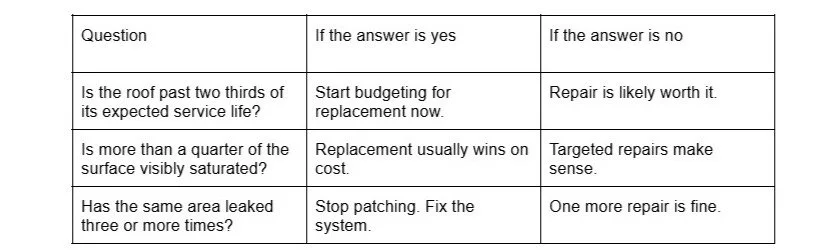
My honest take: most owners patch too long. I have watched people spend forty percent of replacement cost over five years on repairs, then replace anyway. That money is gone. If you are two answers deep into the right hand column above, get quotes now and stop guessing.
Roofing failures are not mysterious. The National Institute of Standards and Technology has studied how wind uplift and water intrusion work together to compromise building envelopes, and the pattern is consistent: small openings become structural problems once water gets behind the membrane and freezes.
What Good Snow Removal Actually Looks Like
Hiring a crew with shovels is not snow management. It is gambling with your roof. The wrong approach scratches membranes, crushes insulation, and occasionally puts a person through a skylight.
Proper removal starts with a plan that identifies structural weak points, keeps roof access clear, and uses plastic equipment rather than metal. Snow from the upper roof should never be piled onto a lower section, and roof drains need to stay open the whole time.
Safety rules on this are not optional. The Occupational Safety and Health Administration has clear requirements for fall protection on elevated work, and if the crew you hired does not mention them, that is your answer about whether they belong on your building.
Planning the Repair Before Spring Hits
Here is the practical part. Contractors get slammed in April and May, and the good ones book out weeks in advance. If you wait until you see a stain, you are competing with every other owner in the county for the same calendar slot.
So get an inspection on the books now, even if your roof looks fine. Get a written scope of work with photos, not a verbal estimate. Ask what materials they plan to use and why. Ask how they will handle tenant access and staging if it turns into a full replacement.
Those questions separate the operators from the guys with a truck and a ladder.
Winter will test your building whether you plan for it or not. The owners who come out of March with a dry interior are not lucky. They walked the roof in October, called someone in January, and spent a fraction of what the panicked phone call costs in April. Pick your month.