Heated tobacco at home: what to know about odor, devices and shared spaces
Heated tobacco has changed the way some adult nicotine users think about smoking-related routines at home. Instead of burning tobacco, compatible devices heat a specially designed stick, so there is no ash and the experience differs from a conventional cigarette. That does not make indoor use invisible, odor-free, or automatically acceptable in every home. Shared spaces, ventilation, lease rules, device compatibility, storage, and simple courtesy still matter, especially in apartments or homes where several people use the same rooms. For homeowners and renters, the practical question is less about the technology itself and more about how it behaves in an actual living space.
Heated tobacco is different from a conventional cigarette
Unlike conventional cigarettes, heated tobacco products warm tobacco without burning it. For example, terea sticks are designed specifically for IQOS ILUMA devices. Different TEREA varieties are available at Lovely Sticks USA. TEREA sticks contain tobacco and nicotine, and nicotine is addictive.
That difference changes some practical details at home. There is no loose ash falling onto furniture, no burning tip to manage, and no cigarette butt smoldering in an ashtray. The device stops heating after a session rather than continuing to burn, which changes the cleanup routine as well.
Still, “heated” should not be interpreted as “nothing enters the room". The device produces an aerosol during use, and other people may notice the smell or prefer not to be around it. A household may therefore treat heated tobacco differently from cigarettes without treating it as irrelevant to indoor air or shared-space rules.
Odor can still matter in a well-designed home
Scent changes the character of a room quickly, especially in smaller spaces. Homeowners may spend time choosing candles, diffusers, cleaning products, upholstery, and even wood finishes, yet any repeatedly used nicotine product can become part of that same sensory environment.
Heated tobacco can leave a noticeable scent. It is different from the smell of burned cigarettes, but the experience depends on the product, room size, airflow, frequency of use, and the materials in the room. A small bedroom with closed windows will hold smells differently from an open-plan living area with cross-ventilation.
Soft furnishings deserve particular attention because curtains, upholstered sofas, rugs, bedding, and fabric wall coverings can retain odors more readily than tile, stone, glass, or metal. Regular ventilation can help keep the room from feeling stale, but it should not be treated as a guarantee that other occupants will be comfortable with indoor use.
Shared spaces need their own rules
A private home can still contain several different comfort levels. One person may use nicotine products while a partner, roommate, guest, or family member wants the room kept free of aerosols and tobacco odors. It is easier to settle those boundaries in advance than to assume everyone has the same tolerance.
A few questions worth settling at home
Which rooms, if any, are acceptable for use?
Should it be limited to a balcony, patio, or another outdoor area?
Are children or pets regularly present in the space?
Does somebody in the household prefer a completely nicotine-free indoor environment?
Where will the device and unused sticks be stored?
Renters also need to check the lease
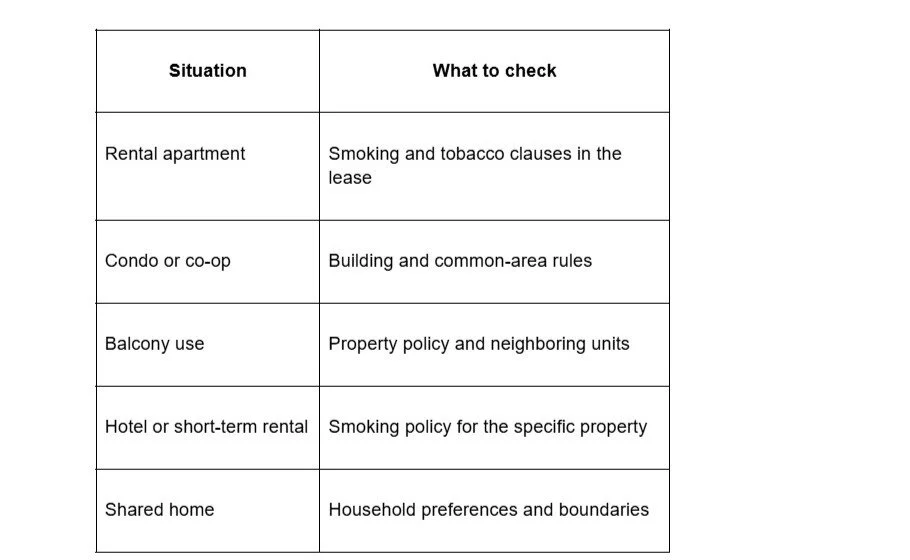
Apartment living adds another layer because a landlord, building manager, or homeowners’ association may have rules covering smoking, tobacco products, balconies, common areas, or indoor air quality. Those policies are not always written around one particular device type, so it is risky to assume that a heated tobacco product automatically falls outside them.
Rules can vary depending on the type of property, so it is worth checking the relevant restrictions before using a heated tobacco device. Condominiums and co-ops may apply building-wide rules even when the individual unit is privately owned, and balconies can be covered by separate policies where smoke or aerosol may affect neighboring units.
Hotels and short-term rentals need the same attention. A listing marked “non-smoking” may apply that restriction broadly rather than only to combustible cigarettes, and property managers can set their own rules for rooms, balconies, patios, and shared areas. Checking the property policy before use is safer than assuming a heated device is permitted because it does not produce ash.
Device compatibility is not interchangeable
Compatibility can become confusing when older and newer devices remain in the same household. Different IQOS generations use different systems, so sticks intended for one generation should not automatically be assumed to work with another. Earlier hardware and newer ILUMA devices are not interchangeable simply because they come from the same product family.
The same caution applies to chargers, holders, and accessories that may look similar but belong to different generations. Keeping each device with the consumables and accessories intended for it reduces mix-ups, especially in a household where more than one adult has used IQOS products over time. When in doubt, checking the model name and manufacturer guidance is more reliable than judging compatibility by appearance.
Storage deserves more thought than a kitchen drawer
Tobacco sticks should be kept away from excessive heat, moisture, and direct sunlight. A clean, dry, cool drawer or cupboard is generally more sensible than a windowsill, humid bathroom, or hot car. Storage conditions matter both for keeping the products in suitable condition and for preventing them from being left around the home unnecessarily.
Access matters just as much as temperature. TEREA sticks and device components should be kept out of reach of children and pets, and used sticks should be discarded promptly rather than left on tables or in open containers. This is particularly relevant in shared homes, where a coffee table, kitchen counter, or bedside surface may be accessible to other people or animals without the user noticing.
A closed cabinet, small storage box, or dedicated drawer can keep the area tidy without making nicotine products part of the room’s decor or leaving them within easy reach. Keeping used and unused sticks separate also makes the routine easier to manage and prevents discarded items from accumulating around the device.
A home routine should fit the people living there
Heated tobacco changes some practical details associated with conventional cigarettes, particularly ash, open flame, and the way the tobacco is heated. It does not remove the need to think about ventilation, household boundaries, property rules, storage, and the compatibility of the products being used.
For adult nicotine users, the most workable routine is one that fits both the device and the home around it. That means using compatible products, storing them securely, checking the rules in rented or shared spaces, and respecting the preferences of everyone else who uses the room. These details may be less visible than the device itself, but they determine whether heated tobacco can be managed at home without creating unnecessary problems for other occupants.