Identifying Critical Failures Requiring Emergency HVAC and Plumbing Repairs in Salt Lake City, Utah
When your central air conditioner fails unexpectedly during a hot Salt Lake City, Utah summer, it can feel like a disaster. Handling Emergency HVAC and Plumbing Repairs quickly and efficiently is vital. But what if we could prevent some of these crises? This guide explores how understanding the average lifespan of a central air conditioner in a hot dry Utah climate directly impacts the frequency and severity of breakdowns. We'll equip you with the knowledge to manage immediate emergencies and make informed decisions that can reduce the need for future emergency repairs and maintenance.
When it comes to your home's essential systems, some issues demand immediate attention to prevent further damage, ensure safety, and restore comfort. While a minor drip from a faucet might wait, a complete AC shutdown in July 2026 or a burst pipe flooding your basement requires an urgent response. Understanding the distinction between a minor inconvenience and a critical failure is the first step in effective emergency management.
Sudden AC Breakdown and Refrigerant Leaks
A central air conditioner working overtime in Utah's demanding climate is susceptible to various failures. When temperatures soar into the triple digits, as they often do in Salt Lake City during peak summer, an AC breakdown isn't just uncomfortable—it can be a health risk, especially for the elderly, young children, or those with respiratory conditions.
Common critical AC failures include:
Compressor Lockup: The heart of your AC system, the compressor, can seize due to overheating, electrical issues, or lack of lubrication. This often results in a loud grinding noise followed by complete system shutdown, leaving you without cooling.
Capacitor Blowout: Capacitors store electrical charges to start and run motors. When they fail, often with a popping sound or visible bulging, the outdoor unit may hum but the fan won't spin, or the compressor won't start. This is a common failure point in hot climates due to constant stress.
Refrigerant Loss: A leak in the refrigerant lines means your system can't effectively transfer heat. Signs include warm air blowing from vents, hissing sounds, or ice forming on the evaporator coil. This not only reduces cooling capacity but can also damage the compressor if not addressed.
Iced Coils: If your evaporator coil (indoor unit) freezes over, it's usually a symptom of another problem, such as low refrigerant, a dirty air filter, or a malfunctioning blower fan. An iced coil severely restricts airflow and prevents cooling, eventually leading to a complete shutdown.
Airflow Blockage: Beyond dirty filters, blockages can occur in ductwork, or the outdoor condenser coil can become heavily caked with dust and debris. Restricted airflow forces the system to work harder, leading to overheating and premature component failure.
Recognizing these signs early can save you from more extensive damage. For instance, a system that frequently cycles on and off (short cycling) or struggles to maintain your desired temperature could be hinting at impending failure.
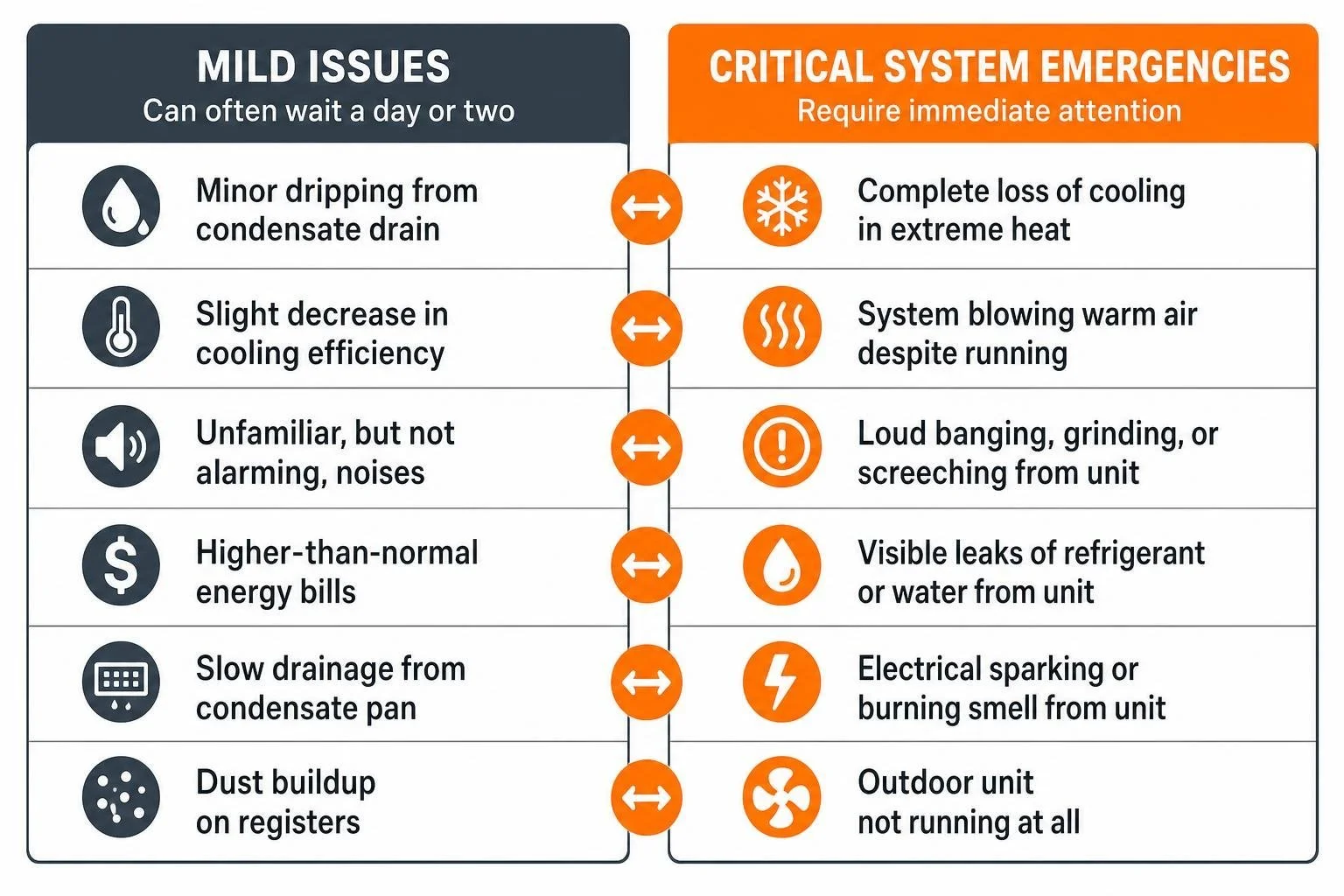
Here's a quick comparison of typical AC issues:
Mild Issues (Can often wait a day or two) Critical System Emergencies (Require immediate attention) Minor dripping from condensate drain Complete loss of cooling in extreme heat Slight decrease in cooling efficiency System blowing warm air despite running Unfamiliar, but not alarming, noises Loud banging, grinding, or screeching from unit Higher-than-normal energy bills Visible leaks of refrigerant or water from unit Slow drainage from condensate pan Electrical sparking or burning smell from unit Dust buildup on registers Outdoor unit not running at all
Major Pipe Ruptures and Water Heater Failure
Plumbing emergencies can be equally, if not more, destructive than HVAC failures, often leading to significant water damage.
Burst Pipes: Freezing temperatures in winter, corrosion, or excessive water pressure can cause pipes to rupture. This results in rapid, uncontrolled water flow, quickly leading to flooding and structural damage. Slab leaks, where pipes under the foundation burst, are particularly insidious as they can go unnoticed until significant damage has occurred.
Slab Leaks: These hidden leaks can erode your home's foundation, cause mold growth, and significantly increase water bills. Detecting them often requires specialized equipment and immediate professional intervention.
Tank Corrosion: Water heaters, especially older models, are prone to internal tank corrosion. This can lead to leaks, often starting as small drips that can escalate into a full tank rupture, releasing dozens of gallons of hot water into your home.
Pressure Buildup: Malfunctioning pressure relief valves or excessive water pressure can cause dangerous pressure buildup in water heaters, risking an explosion if not addressed immediately.
Flooding Risk: Any uncontrolled water leak poses a severe flooding risk, damaging flooring, walls, furniture, and electrical systems.
Shutoff Failure: If your main water shutoff valve fails or is inaccessible during a burst pipe incident, the damage can be catastrophic.
These plumbing issues require swift action to minimize damage and ensure the safety of your home and its occupants.
Climate Factors Accelerating Mechanical Deterioration
Utah's unique high desert climate, particularly along the Wasatch Front, is incredibly demanding on HVAC systems. The hot, dry conditions, coupled with other environmental factors, accelerate the mechanical deterioration of central air conditioners, often shortening their average lifespan compared to national averages. While a well-maintained AC unit might last 15-20 years nationally, in Utah, that figure often drops to 12-16 years. This is due to the constant stress placed on components by elevated UV radiation, extreme temperature swings, dry air, and heavy dust loading from inversions and dry soil. These factors contribute significantly to the need for more frequent emergency repairs and maintenance.
Thermal Stress and Metal Fatigue
Imagine your AC unit working tirelessly through a typical Utah summer day. Temperatures can climb above 100°F (38°C) in the afternoon, then drop by 20-40°F (11-22°C) overnight. This dramatic daily temperature swing creates immense thermal stress on all components.
Daily Swings: The constant heating and cooling cause materials to expand and contract repeatedly. Over time, this "thermal cycling" leads to metal fatigue, similar to bending a paperclip back and forth until it breaks. This can weaken solder joints in refrigerant lines, leading to micro-leaks that slowly deplete your system's refrigerant charge.
Joint Expansion: Different materials expand and contract at different rates, putting strain on connections and seals. This is particularly problematic for refrigerant lines and electrical connections.
Solder Cracking: The repeated expansion and contraction can cause tiny cracks in the solder joints of coils and refrigerant lines, creating pathways for refrigerant to escape.
Micro-leaks: These small, often undetectable leaks reduce system efficiency and force the compressor to work harder, shortening its life.
Capacitor Stress: Capacitors are particularly vulnerable to extreme heat. Prolonged exposure to high temperatures, especially when the electrical cabinet itself heats up to 150°F (65°C) on a 105°F (40°C) day, significantly reduces their lifespan. They are often the first component to fail in hot climates.
Particulate Load and Airflow Restriction
The dry, arid environment of Utah, especially near the West Desert, means a constant battle against dust and particulate matter. This isn't just annoying; it's highly damaging to your AC system.
Desert Dust: Fine dust and sand particles are abrasive. They act like microscopic sandpaper, grinding down moving parts like fan motors and bearings. When these particles accumulate on condenser coils, they create a thick insulating layer.
Sediment Deposits: This dust, combined with condensation, can form a sludge-like sediment that clogs condensate drains, leading to water backup and potential indoor water damage.
Clogged Drains: A clogged condensate drain can cause the indoor unit to overflow, leading to water damage to ceilings, walls, and flooring.
Coil Coating: The layer of dust on the outdoor condenser coil acts as a thermal blanket, preventing the unit from effectively shedding heat. This forces the compressor to work harder and longer, increasing energy consumption and accelerating wear. A 16 SEER system can effectively degrade to a 10 SEER system after just 10 years in desert conditions if coils are not regularly cleaned.
Motor Overheating: Restricted airflow due to dirty coils or filters forces the blower motor and condenser fan motor to work harder, leading to overheating and premature failure.
UV Degradation: Intense UV radiation, with summer indices often reaching 10-11, degrades plastic components and wiring insulation. This can lead to brittle fan blades, cracked wiring, and eventual electrical failures.
High Altitude: While not directly causing deterioration, Salt Lake City's altitude means thinner air. This makes outdoor fan motors work harder to move the same volume of air across the condenser coils, adding to their workload and stress.
These climate-specific challenges highlight why regular, professional maintenance is not just recommended but essential for extending the life of your AC unit in Utah.
Action Protocols and Decision Frameworks
When an emergency strikes, knowing what to do immediately can significantly mitigate damage and costs. Beyond immediate action, understanding when to repair versus replace an aging system is crucial for long-term financial and comfort planning.
Immediate Homeowner Action Plan for Emergency HVAC and Plumbing Repairs
In the chaos of an HVAC or plumbing emergency, a calm and structured response is your best defense.
Main Shutoff for Plumbing Emergencies: If you have a burst pipe or uncontrolled water leak, locate and turn off your home's main water supply valve immediately. This is typically found where the main water line enters your house, often in the basement, utility closet, or outside near the meter.
Breaker Isolation for Electrical/HVAC Issues: For electrical sparking, burning smells, or a completely dead AC unit, go to your electrical panel and switch off the circuit breaker corresponding to the affected appliance (e.g., "AC," "Furnace," "Water Heater"). If unsure, turn off the main breaker to cut power to the entire house, ensuring safety.
Thermostat Shutoff for AC/Heating: For HVAC issues, switch your thermostat to the "Off" position. This prevents the system from attempting to run and potentially exacerbating the problem.
Damage Containment: For water leaks, try to contain the water using buckets, towels, or wet/dry vacuums. Move furniture and valuables away from the affected area. For AC issues, ensure no debris is near the outdoor unit or blocking indoor vents.
Professional Dispatch: Once the immediate threat is contained and safety is ensured, contact a qualified HVAC and plumbing professional. Provide them with as much detail as possible about the issue and the steps you've already taken.
Mitigating Long-Term Costs of Emergency HVAC and Plumbing Repairs
Deciding whether to repair an aging system or replace it entirely is a common dilemma, especially when faced with an emergency breakdown. Several rules of thumb can help Utah homeowners make an informed decision.
The $5,000 Rule (or $X,000 Rule): This guideline suggests multiplying the age of your HVAC unit by the cost of the repair. If the result exceeds a certain threshold (often cited as $5,000, but can vary), replacement is generally more cost-effective. For example, if your 12-year-old AC unit needs a $500 repair, 12 x $500 = $6,000, suggesting replacement. This rule helps account for the diminishing return on investment for repairs on older systems.
The 50% Threshold: If the cost of a repair is 50% or more of the cost of a new system, it's usually wiser to replace. This is particularly true for units over 10 years old in Utah's climate, as other components are likely to fail soon.
Equipment Age: As of September 2026, a central AC unit in Utah that is 12 years old is already considered a "senior citizen" by industry standards. While some units might push to 16 years with exceptional maintenance, their efficiency significantly declines. Units beyond this age are often prime candidates for replacement rather than costly repairs.
SEER2 Standards: Modern AC units adhere to new SEER2 (Seasonal Energy Efficiency Ratio 2) standards, which became mandatory in 2023. These units are significantly more energy-efficient than older models, potentially reducing your cooling energy usage by 20-40%. Investing in a new SEER2 unit means lower utility bills and better performance, especially in extreme Utah heat.
Refrigerant Type (R-22 vs. R-410A): If your AC unit was installed before 2010, it likely uses R-22 refrigerant. This refrigerant has been phased out due to environmental concerns, making it extremely expensive and difficult to find for repairs. If an R-22 system has a refrigerant leak, replacement is almost always the more practical and economical solution.
Replacement Planning: Ideally, you should plan for AC replacement before total failure occurs. This allows you to research options, compare bids, and schedule installation at your convenience, avoiding the premium costs and limited availability often associated with emergency replacements during peak summer heatwaves.
Frequently Asked Questions About HVAC and Plumbing Emergencies
Homeowners often have similar questions when faced with unexpected system failures. Here, we address some of the most common concerns regarding HVAC and plumbing emergencies in Utah.
What constitutes an immediate HVAC or plumbing emergency?
An immediate emergency is any situation that poses a threat to safety, health, or significant property damage, or severely compromises essential home functions.
Extreme Temperatures: A complete AC failure during a 100°F+ Utah summer day or a heating system breakdown in sub-freezing winter temperatures is an emergency, especially if vulnerable individuals (elderly, infants, ill) are present.
Active Flooding: Any uncontrolled water leak, whether from a burst pipe, water heater, or overflowing toilet, that is actively flooding your home and cannot be contained by simple means.
Electrical Sparking: Visible sparks, burning smells, or smoke coming from an electrical panel, appliance, or outlet, particularly near your HVAC unit or water heater, indicates a severe electrical hazard.
Sewage Backup: Raw sewage backing up into your sinks, toilets, or drains is a major health hazard due to bacteria and pathogens.
Gas Leaks: The smell of rotten eggs, indicating a natural gas leak, is a critical emergency requiring immediate evacuation and contacting your gas provider and emergency services.
When should an aging system be replaced instead of repaired during a crisis?
The decision to replace an aging system during a crisis is often driven by a combination of factors related to its age, repair cost, and efficiency.
System Age: As discussed, central AC units in Utah typically last 12-16 years. If your unit is approaching or has exceeded this age, especially if it's 10 years or older, replacement becomes a stronger consideration. A 15-year-old AC unit in 2026 is considered old, with outdated technology and lower efficiency.
Component Cost: If a major component like the compressor or evaporator coil fails, the repair cost can be substantial. If this cost is 50% or more of a new system's price, or if the system's age multiplied by the repair cost exceeds a certain threshold (e.g., the $5,000 rule), replacement is usually the better long-term investment.
Obsolete Refrigerant: Systems using R-22 refrigerant (pre-2010 installations) are facing increasingly expensive repairs due to the phase-out of this refrigerant. A major leak in an R-22 system almost always warrants replacement with a modern R-410A or other compliant system.
Recurring Failures: If your system has required multiple significant repairs in the last 2-3 years, it's a strong indicator that it's at the end of its useful life. Throwing good money after bad on a failing system is rarely economical.
Efficiency: Older units are far less efficient than modern SEER2-rated systems. Even if an old unit can be repaired, it will continue to cost you more in energy bills than a new, high-efficiency model.
How often should equipment be serviced to prevent unexpected failures?
Proactive maintenance is the single most effective way to extend the lifespan of your HVAC and plumbing systems and reduce the likelihood of emergency breakdowns, especially in Utah's harsh climate.
Monthly Filter Checks: During peak cooling (summer) and heating (winter) seasons in Utah, check your air filters monthly. In dusty areas or homes with pets, they may need to be replaced every 30 days. In less demanding times, every 1-3 months is generally sufficient. Clean filters are crucial for airflow and system efficiency.
Seasonal Tune-ups: Schedule professional HVAC tune-ups twice a year—once in the spring for your AC and once in the fall for your furnace. These comprehensive checks ensure all components are functioning correctly, refrigerant levels are optimal, coils are clean, and electrical connections are secure. For plumbing, consider an annual inspection of water heaters, pipes, and drains.
Coil Cleaning: Professional cleaning of both the indoor evaporator coil and outdoor condenser coil is vital. In Utah's dusty environment, the outdoor coil can quickly become caked with dirt, significantly reducing efficiency and increasing wear. Professional cleaning ensures proper heat transfer.
Pressure Testing: During HVAC tune-ups, technicians can check refrigerant pressure and test for leaks. For plumbing, regular inspections can identify minor leaks or pressure issues before they become major ruptures.
By adhering to these maintenance practices, you can add years to your system's life, maintain efficiency, and significantly reduce the stress and cost associated with unexpected emergency repairs.
Conclusion
Understanding the average lifespan of a central air conditioner in a hot, dry Utah climate, and the specific environmental factors that impact it, is crucial for every homeowner. While the national average for AC longevity sits at 15-20 years, Utah's intense UV radiation, extreme temperature swings, and pervasive dust often shorten this to 12-16 years. Recognizing these challenges empowers us to be proactive, not just reactive, when it comes to our home's essential systems.
By implementing proactive upkeep, such as regular filter changes and professional seasonal tune-ups, we can significantly extend the life of our HVAC units and prevent many common emergencies. Knowing how to perform rapid isolation steps—like shutting off water or electrical power—during a crisis can dramatically limit damage. Furthermore, applying decision frameworks like the $5,000 rule or the 50% threshold helps us make informed choices between repairing an aging system and investing in a more efficient, reliable replacement.
Homeowner preparedness, combined with a deep understanding of lifecycle management for our HVAC and plumbing systems, is the best defense against the unexpected. Don't wait for a breakdown on the hottest day of the year; equip yourself with knowledge and a plan to ensure your home remains safe, comfortable, and efficient for years to come.