Can Mental Health Care Fit Into a Busy Work Schedule?
I once cancelled three therapy appointments in a row because of 9 a.m. meetings. Not because I didn't want to go. Because 9 a.m. was the only slot my old therapist had, and my calendar belonged to someone else by then.
That's the real reason most people quit on care, and it has nothing to do with motivation. A standard therapy hour plus a commute eats roughly two hours of your Tuesday. Then Slack starts pinging at minute forty. So the honest answer to whether care fits into a full work schedule is yes, but not by squeezing it into the cracks. You have to rebuild the week around it the same way you'd rebuild it around a standing lunch with a client. Here's how to pull that off without burning vacation days or telling your boss anything you'd rather keep private.
Why Does the Traditional Appointment Model Clash With a 9 to 5?
Most clinics run on the same hours you do. Their front desk opens at nine and closes at five, which means the only openings left for working people are early morning, late afternoon, or evening. Those slots fill first, so the newest client usually gets the leftovers, and the leftovers rarely match a commute.
There's a second problem working against you: recovery time. A hard session stirs things up. You walk out with your head somewhere other than your inbox, and then you're expected to join a budget call fifteen minutes later. That mismatch, more than the appointment itself, is what wears people down.
So the question stops being "can I find an hour" and starts being "can I find an hour that doesn't wreck the three hours around it." According to the U.S. Department of Labor, most full time employees in the United States work a fixed weekly schedule with limited flexibility during core business hours. That's a structural conflict, not a personal failing.
Where Virtual Care Actually Wins, and Where It Doesn't
Telehealth closed a lot of that gap. When your appointment happens through a video platform, you delete the drive time, the parking garage, and the waiting room magazine stack. A fifty minute session becomes a fifty minute session. For anyone with a packed calendar, that difference is the whole game.
Virtual visits also travel with you. You can take a session from a quiet room at home, an empty conference room before anyone else arrives, or a hotel on a work trip. For parents juggling pickup and a meeting, or people who live far from the nearest clinic, that flexibility is often what makes consistent care possible in the first place. Many practices now offer telehealth mental health services alongside in person sessions, which means you can pick the format that fits a given week instead of committing to one forever.
Here's where I'd push back on the hype. Virtual care is worse for anyone who needs a fully quiet, private, uninterrupted space and doesn't have one. A shared apartment, a car, a coworking booth. A good clinician will notice you're holding back and you'll both feel it. If your home is a fishbowl, in person may genuinely be the better call, or you need to book the room before you book the appointment.
A Realistic Week: How to Fit Sessions Around Actual Work
This is the part most articles skip. Scheduling advice that assumes you control your calendar is useless to anyone who doesn't.
Start with the anchor slot, one recurring block you defend the way you'd defend a flight. Early morning before the standup works for a lot of people because nothing has gone sideways yet. Lunch works if your team actually respects lunch, which many don't. Late afternoon works if you can end your day at four and log back on later, and I'd take that trade every time over a 7 p.m. session when you're already fried.
Then build a buffer on each side. Fifteen minutes before to settle, thirty minutes after to write down what came up and switch gears. That buffer is not optional, and it's the first thing people drop when work gets busy. Don't.
A few practical moves that have held up for me and for people I know who've done this for years:
Book the next appointment before you leave the current one. Gaps of a month kill momentum.
Put it on your calendar with a neutral label like "Focus block" if you don't want to explain it to colleagues.
Keep a running note between sessions, so you spend the first ten minutes talking instead of remembering.
Pick one backup slot per month for the week that falls apart.
What Do You Actually Tell Your Manager?
Less than you think. You are not obligated to disclose a medical appointment to your employer in most situations, and you don't owe anyone a diagnosis to get an hour on your calendar.
I'd use one of three scripts depending on your workplace. "I have a recurring appointment on Tuesdays at nine, I'll be offline for that hour." Full stop. Or, if you need to shift a meeting, "I have a standing commitment at that time, can we move it to two?" The third option, being open with a manager you trust, can genuinely help if you need flexibility later.
Know your floor. Under the Family and Medical Leave Act, eligible employees can take job protected leave for serious health conditions, and some workplaces offer intermittent leave for ongoing treatment. The details matter and they depend on your employer and your state, so check your handbook or an employment attorney rather than a blog post, including this one.
How to Decide What Fits You
Run this three question check before you commit to anything.
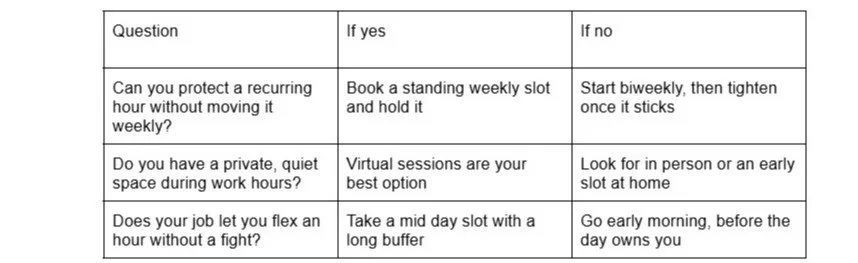
If you're not sure how much care you actually need, that's a fair place to start. The Substance Abuse and Mental Health Services Administration maintains national resources for finding treatment and understanding what different levels of care look like. It's a dry read, but it's honest, and it beats guessing.
One more thing worth saying: consistency beats intensity. A biweekly session you never miss will do more for you than a weekly one you reschedule every third week. That's my stance, and I'll defend it. The calendar you can actually keep is the only one that counts.
When Work Is the Reason You Need Care
Sometimes the job isn't just an obstacle to treatment. Sometimes it's the thing you're treating. Long hours, unclear expectations, a manager who messages at ten at night. In that case, scheduling is step one and boundary setting is step two, and no appointment slot fixes a role that's grinding you down.
That's also when it helps to talk to people who've been there. NAMI runs support groups and family programs across the country, many of them free and online, and a group is a different kind of help than an hour with a clinician. Some people need both. Most people I know who've stuck with treatment use more than one thing.
You don't have to solve your whole schedule this week. Pick one slot, protect it, and let the rest sort itself out from there. So which hour are you actually willing to defend? Somewhere between Monday morning and Friday afternoon, there's one you'd fight for. That's the one to book.