A Basement That Smells Like a Wet Basement: What Your Floor Drain Is Telling You
One inch of water across a 500 square foot basement weighs roughly 260 pounds, and that's before it finds the box with your kid's baby photos in it. Most homeowners find out their drain is in trouble at 11 p.m., barefoot, standing on a rug that just made a squishing sound.
Here's the good news. A drain almost never fails without warning. It telegraphs for weeks, sometimes months, and almost all of that telegraphing shows up as water where water shouldn't be, or a smell you can't place. I've walked basements in Freehold and Toms River where the owner swore nothing was wrong until the float switch gave out. It was always wrong.
When you're standing in it, the fastest sanity check is a call, and a local crew like basement floor drain backing up specialists can tell you in a ten minute conversation whether you're dealing with a slow nuisance or a full stoppage underground. Read on and you'll know what your drain is saying, how urgent it actually is, and what a real fix looks like instead of a bucket and a shop vac ritual.
Why the floor drain is always the one that spills
Water obeys gravity. Your floor drain sits lower than every sink, tub, and toilet in the house, so when the main path out gets restricted, the backup finds the lowest exit. That's why a slow kitchen sink drain can show up as a puddle around your basement drain three rooms away.
Think of it like this: your drain isn't the problem. It's the messenger. Yelling at the messenger with a plunger is how people turn a hundred dollar cabling job into a ripped-up slab.
The three signals you need to separate: a localized clog right at the drain trap, a partial restriction in the lateral line, and a full stoppage or a failing downstream system. Each one looks similar from above and costs wildly different amounts to solve.
Three things a backed-up drain usually means
1. A local clog sitting right under the grate
Hair, lint, laundry soap residue, and whatever comes off a basement utility sink all collect. This is the cheap one. If water drains slowly but clears, and nothing else in the house is sluggish, you've probably got a shallow clog.
Try a strainer basket and a real cleaning before you buy a chemical pour. I'd skip the chemical aisle entirely. Caustic products make the water hot, which sounds helpful until you remember some older drain lines are joined with materials that don't enjoy heat or chemical stress.
2. A partial restriction in the main lateral
Now the tell is behavior elsewhere. Run the washing machine and the basement drain gurgles. Flush a toilet upstairs and the laundry sink burps. That pattern means water is building pressure behind a partial block, and the drain is venting the pressure for you.
According to the EPA, wastewater backups indoors are one of the more common home plumbing complaints reported to local authorities, and older homes with aging laterals carry a bigger share of that burden. Age matters more than most people want to admit.
3. A full stoppage, a collapsed line, or a city-side issue
This is the one that ruins weekends. Dirty water keeps rising even when nothing in the house is running. Sometimes raw sewage appears, which is a different category of problem entirely. A collapse, root intrusion, or an offset joint can produce exactly the same symptom as a simple clog, and no amount of cabling fixes a broken pipe.
Here's where I'd spend money before I spend money: a camera inspection. You want to see the inside of that line on a screen, not guess. Any honest shop will show you the footage and let you watch it.
The bucket test, and other things I'd stop doing
It's a short list, and every item on it costs more than it saves.
Bailing without finding the cause. You're emptying a bathtub with a thimble while the source keeps running.
Pouring drain chemicals on a main stoppage. Waste of money, and it can damage older piping.
Running appliances. Every load of laundry or dishwasher cycle adds wastewater behind the block.
Wiping the floor and calling it done. Standing water and damp concrete feed mold and rot long after the puddle is gone.
Ignoring the smell. A sewer odor near the drain usually means the trap is dry or the venting is compromised.
As for what you should do right now: if water is actively rising, stop using water in the entire house. Not just the basement. The whole house. Then call. A backed-up drain with active flow is a same-day call, every time.
A quick way to score your own risk
I use a simple three tier read when I'm helping someone size up their situation over the phone. Call it the Slow, Gurgle, Reversal ladder.
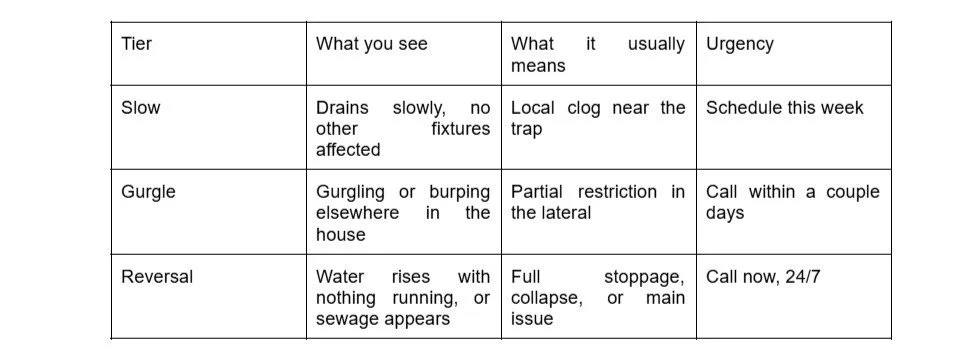
Why three tiers and not five? Because in my experience, homeowners misjudge the middle. People treat a gurgle as a slow drain and wait two weeks, then it becomes a reversal on a Saturday night. The gurgle tier is the one where a scheduled visit actually saves you real money.
What a proper fix looks like
You should expect a real diagnosis first, and it should feel like a conversation, not a sales pitch. Here's the sequence that earns trust.
A technician checks whether the problem is local or main-line before touching anything.
Standard cabling clears the easy stuff. Ask how much line length is covered upfront.
If the cabling hits resistance, you want footage from a camera before anyone recommends digging.
Hydro jetting is for grease, roots, and scale buildup, not for a broken pipe.
You get plain pricing before work starts, and a walkthrough of what the camera showed.
One more practical point about materials. Drain and sewer lines fall under local plumbing codes, and the National Institute of Standards and Technology maintains the standards framework that many of those material and testing specifications reference. If a contractor starts suggesting a material without knowing your home's era or existing pipe type, that's your cue to ask harder questions.
And while they're on site, ask about the sump pump and the floor drain trap separately. They're related systems with different failure modes, and a finished basement makes both of them worth a look at the same visit.
Draining the worry too
Your floor drain is the lowest point in the house and the first honest witness to anything going wrong underground. Slow means a clog. Gurgle means a restriction. Rising water with nothing running means stop and call. That's the whole language, and now you speak it.
So here's my challenge for this weekend: go look at your basement drain. Check for a dry trap, a cracked grate, or a ring of mineral staining that shouldn't be there. If anything looks off, get it on the schedule now, while it's still a nuisance and not a waterlogged Monday morning. What's your drain saying?