7 Mistakes that Sink a Small Claims Case ( and how to avoid them)

Small claims courts are meant to be easy enough to navigate without an attorney, but that ease comes at the price of zero patience for sloppiness. That means that despite a legitimate claim in their hands, the filing court sees people lose every year – the dispute was legit, but someone missed a deadline or skipped a basic step. 

Here is what goes wrong when it happens with unpaid invoices, unrefunded security deposits, and other disagreements that end up in the filing courts.


Fix it: A free demand letter generator can help turn the invoice amount, payment deadline, completed work, and previous follow-ups into a clearer written demand, so you're not sending an angry text and calling it done. DemandLetter.ai helps users create a structured demand letter from the dates, amounts, agreement, requested resolution, and other dispute facts, with legal references matched to your state, and can send it via USPS Certified Mail with tracking so you have proof of delivery.

Mistake 2: Waiting Too Long to Act

Every state has a statute of limitations for different types of claims—often a few years, but sometimes shorter. Waiting too long to send the demand or file the claim: A slam-dunk case can be moot if it is too old to enforce. Remedy: Research the statute of limitations in your state for the type of claim you have (e.g., contract dispute, property damage, collection) once the problem occurs, and do not let the months slip into years. 

Mistake 3: Not keeping small claims evidence organized from day one. 

Small claims cases often fall apart ot dbecause ofa bad legal case, but because of poor evidence management.

Often litigants appear with a shoebox full of crumpled receipts, search for the relevant screenshot of a text message on their smartphone in a frantic search, or just can’t find the original contract.

Remedy: Start organizing your small claims evidence as soon as the dispute develops, not the night before trial.

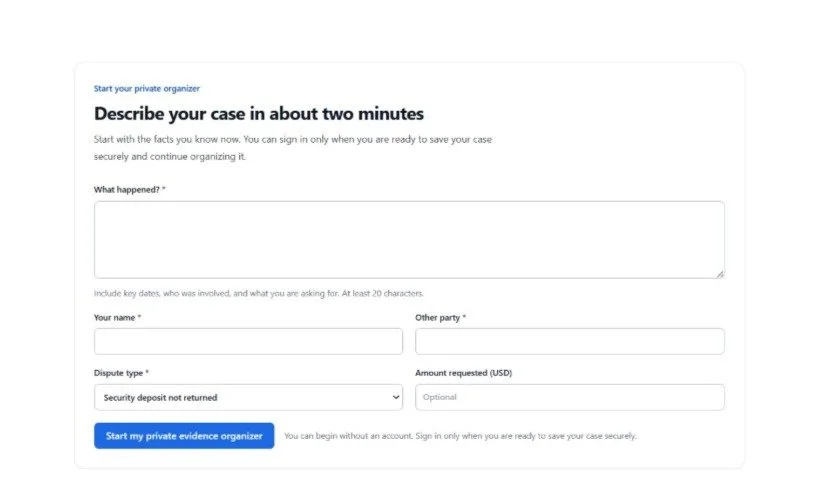
 ClaimResolver helps organize contracts, invoices, delivery records, communications, and other small claims evidence into a factual case record. You can describe what happened in about two minutes and start without creating an account, so there's no reason to put it off. ClaimResolver helps users keep small claims evidence — including leases, contracts, payment records, photos, messages, and timelines — organized in one case workspace, so nothing gets lost between the dispute starting and your court date.

Mistake 4: Suing the Wrong Party

Filing against an individual when the agreement was actually with their business (or vice versa) is a common and costly error — it can get your case dismissed or make any judgment uncollectible.

Fix it: Confirm exactly who or what entity you have an agreement with. Check contracts, invoices, and business registrations before you file, not after.

Mistake 5: Overstating the Claim

Asking for more than you're actually owed — including speculative damages or emotional distress that small claims court typically doesn't cover — can undermine your credibility with the judge, even on the parts of your claim that are legitimate.

Fix it: Stick to documented, provable amounts: unpaid invoices, repair receipts, and security deposit amounts specified in a lease. If you're unsure what's recoverable, keep the number conservative and well-supported.

Mistake 6: Talking too much at the hearing. 

Judges usually hear several cases during the session. You will have just a few minutes. Most people tend to talk too much, start crying or place the relevant information buried within a story and therefore lose the attention of the judge when you most need it.
This fix: Develop a two-minute speech presenting the narrative chronologically; i.e., 1. Agreement made. 2. What was performed. 3. What is owed to you. This will provide a succinct, chronological report that you can supplement with the evidence already organized and handed to the judge.

Mistake 7: Not predicting your opponent’s defense.

 Many people arrive at small claims without knowing what evidence to present to rebut a defense claim, as is very often seen: that it was not performed correctly, or that damages were already present. The other side does not take notice that amounts are higher or lower, etc.
This fix: Anticipate what the other side will say and gather evidence that directly refutes those allegations in advance.

The End Of It All:

These are not mistakes that are hard to avoid; you just need to foresee them. Send a letter demanding repayment of debt before filing your document. Collect evidence from day one.

Take your documents with a summary of facts to the hearing.

Normally, the people who win small claims cases are not the most convincing, but the most prepared.

/
script>

Why You Should Be Careful When Discussing a Car Accident Claim

In the event of a car accident, it is quite likely that you will feel the need to let everyone know what happened in the process. However, it is possible that in the aftermath of such an incident, the way you talk about it might impact the process of your case moving forward. It would be in your best interest to choose your words carefully and stick to the facts.

Limit Discussions With Insurance Representatives

Nevertheless, there will be a need for you to give the insurance company the information regarding the accident, if it requires one in order to evaluate your claim. However, you need to be cautious and avoid guessing things, as well as giving any information which may turn out to be misleading. This is because you need to give the real facts about the things which you know, without speculating about the speed of the cars and their distance from each other.

Another thing you should be careful about is to avoid making any comments regarding injuries and the consequences thereof. Some injuries may take some time before becoming noticeable. Your health state may also change while you recover. Therefore, instead of giving estimates of your health, you should only base yourself on medical facts.

Avoid Discussing Fault Without Complete Information

Determining who is responsible for causing the accident will depend on a variety of issues, such as the nature of traffic, road conditions, positions of vehicles involved, witness statements, and the evidence available. Right after an accident, you may not be able to know the complete story behind the causes of the accident. Therefore, you should not take the blame for yourself or decide whether the other person is responsible when all the facts are not known.

Your remarks can also be misunderstood. Telling that you got distracted momentarily, you should have acted faster, or you are to blame for something will not correctly portray what really happened in the accident. In case you have doubts regarding your rights in this situation, consulting an experienced car accident lawyer Hamilton can assist you in knowing what facts are important in discussing your case.

Be Careful With Public Statements

Social media use may also bring in extra complications for a car accident claim. Pictures, posts, comments, and status updates that relate to how you are spending your time and other issues may all be considered to provide proof related to your physical state or the consequences of your injury. Content that has nothing to do with the case might raise doubts about the things you have been saying in other places.

It is also better not to mention your claims in your online communications. While friends and relatives are willing to be helpful, talking too much about the issue makes it difficult to control who knows about your situation. Limiting the number of people who know about your case is good while you are making a claim. A personal injury lawyer can advise who and who not to tell if you are ever confused.

Keep Your Information Consistent

Accurate documentation could help you maintain consistency during the entire claim process. Record everything that happened in the accident while the facts are relatively fresh in your mind. Keep copies of the medical reports, bills, letters, and other related papers which could help you to recall important details.

If there have been any problems with your ability to work, run errands around the house, move around, or go about your regular daily activities, record this as accurately as possible. The personal injury attorney may use this information to understand the consequences of the accident better. For individuals who suffer from symptoms of a brain or head injury, it may be helpful to discuss your problems with a suitable doctor and brain injury lawyer hamilton.

Seek Advice Before Important Conversations

It is not always necessary to seek legal advice when having a discussion, but at times it will prove useful to get legal guidance before saying anything substantial on an issue that is being discussed. It may prove useful for you to know what information is important and what questions need answering in addition to any paperwork that could substantiate your claims.

Being cautious doesn’t mean being reluctant to communicate and sharing information. It means sharing only true, appropriate, and factual information. Without speculating too much, you can save yourself from misunderstandings and make your claim process much easier.

It is important to handle a claim for an auto accident carefully since anything that one says during the entire procedure will have serious ramifications in the future. It is also crucial to be honest, avoid speculations, minimize public talks and maintain proper documentation. In cases where the claim is complex or injury is involved, it is also important to seek legal counsel.

/
script>

How to Conceal Internet Equipment in an Open-Plan Home

Open-plan houses have large and versatile rooms but these layouts make it difficult to hide internet hardware. Modems and wires are often visible in kitchens and shared work areas. Residents can keep this equipment accessible while they integrate it into the room design through careful planning. The objective is to arrange devices in a way that allows for strong signals, airflow and simple maintenance.

Use Existing Furniture

Furniture provides locations to hide home internet hardware without making permanent changes to the house. Console tables, media units and bookshelves often have space for modems or routers. Choosing items with open backs or holes for wires helps residents organize connections - this prevents the devices from being in completely trapped spaces. 

Location is important for both performance and appearance - A cabinet in the middle of a large room is a helpful balance between hiding the hardware and providing wireless coverage. Residents should ensure there is enough air movement around the device before they place it inside a cabinet. Electronic hardware is more reliable when it is not surrounded by objects that block air or signals. Keeping the area around the device clear makes the setup functional and tidy.

Manage Visible Cables

Wires are often more noticeable than the hardware itself in rooms with few walls. Sleeves and clips help residents organize wires along the back of furniture. Matching the color of these organizers to the furniture makes them less visible - this prevents loose wires from spreading across the floor. 

Planning where wires will go before moving furniture prevents a messy appearance. Residents can direct wires along the baseboards or behind cabinets instead of across walking paths. It is important not to bend wires sharply or place them where furniture might crush them. A hidden setup is only successful if the connections remain safe and easy to replace.

Choose Decorative Storage

Decorative containers help internet hardware match the room style while remaining easy to reach. Ventilated baskets or boxes with open backs create a barrier between the hardware and the rest of the room. Using materials that look like the existing furniture makes the equipment less noticeable. 

Closed containers are risky because routers and modems produce heat. A solid box without airflow causes heat to collect around the hardware. Residents should choose containers with holes or remove the back panel of a box - these openings allow the hardware to stay cool while it remains hidden from view.

Consider Wall Mounted Options

Wall mounting is helpful when there is little space on the floor or tables. A router is often less visible when it is on a wall behind or beside a cabinet. The chosen spot must allow for a strong wireless signal and have enough space for air to move around the hardware. 

Wall placement makes wire organization simpler if the internet line enters the house near a wall. Residents should check the location of power outlets before they install mounting hardware. Hardware is easier to fix or reset when it is not behind heavy furniture that is difficult to move.

Maintain Wireless Performance

Hiding hardware must not ruin the internet connection - Thick wood, metal furniture and kitchen appliances block wireless signals as they travel through a house. A hidden location might look better but it can cause slow internet in areas where residents use computers, mobile phones or televisions. 

Residents can solve this problem - choosing a central location that is relatively open. It is helpful to think about how the signal travels to other rooms or different floors. Internet providers often give specific instructions for their hardware and residents should follow the rules before they put a device inside a cabinet.

Plan For Future Access

Internet hardware is easier to use when residents can inspect it quickly. Technology changes and residents will eventually need to replace a router or fix a connection. A storage method that is difficult to take apart is inconvenient for these tasks. 

Planning for future needs makes the room more adaptable - Residents should leave enough space to reach power switches and ports without moving heavy objects. Combining accessible storage with organized wires and good airflow allows residents to hide hardware while keeping the connection reliable.

Conclusion

Concealing internet hardware in an open plan house involves more than putting a router behind a door. The best methods combine attractive containers with proper air movement and organized wires. Residents can lower visual clutter and maintain a fast connection - treating networking hardware as a part of the room layout.

/
script>

7 Types of Stores Where SNAP EBT Benefits May Be Accepted

Not every grocery trip looks the same. Some families shop once a week at a large supermarket, while others pick up food from smaller stores throughout the week. SNAP benefits can work with both habits because many different types of approved food retailers accept EBT cards.

People who ask where can I use my EBT food stamps card have several options beyond a regular supermarket. SNAP-authorized locations may include grocery stores, big-box retailers, warehouse clubs, neighborhood markets, farmers markets, and participating online grocery stores. Here are seven places worth knowing about.

1. Full-Service Supermarkets and Grocery Stores

For a regular grocery run, supermarkets are usually the easiest place to start. Most carry enough food to cover breakfast, lunch, dinner, and snacks without requiring another stop. Fresh fruit and vegetables, milk, cheese, meat, fish, bread, cereal, frozen foods, and canned goods are among the common SNAP-eligible choices. Non-alcoholic drinks and many snack foods may qualify as well. Since supermarkets carry several brands of the same product, shoppers also have more room to compare prices.

2. Big-Box Superstores

Some large retail stores have full grocery departments along with clothing, electronics, cleaning products, and other household goods. SNAP can generally be used for eligible food sold in these stores. The important part is knowing that everything in the cart does not qualify. A bag of rice or a carton of milk may be eligible, while paper towels and shampoo are not. If both types of products are purchased together, another payment method is needed for the non-SNAP items.

3. Membership Warehouse Clubs

Warehouse clubs are known for large packages. Instead of one small box of cereal or a single bag of rice, shoppers may find bigger quantities or multipacks. SNAP benefits may be accepted for qualifying foods at participating warehouse clubs. A household that uses a lot of rice, pasta, canned food, frozen vegetables, or similar staples may find bulk sizes useful. However, buying more is not automatically a better deal. Checking the unit price and considering how much food the household will actually use can help prevent waste.

A store membership may still be required to shop at the warehouse.

4. Corner and Convenience Stores

A gallon of milk runs out. Bread is needed for the next morning. There may not be enough time, transportation, or reason to make a full supermarket trip. In situations like these, an approved corner or convenience store can be useful. Selection varies widely, but some locations sell SNAP-eligible basics such as milk, bread, cereal, canned foods, eggs, and snacks. These smaller stores may not replace a weekly grocery trip, but they can fill the gap when only a few items are needed.

5. Independent Neighborhood Grocery Stores

Not every grocery store belongs to a large national chain. Many communities have independent markets that serve a particular neighborhood or carry foods commonly used by local families. If the store is authorized to accept SNAP, eligible groceries can be purchased there with an EBT card. Depending on the shop, the shelves may include fresh vegetables, meat, dairy products, grains, spices, frozen foods, and packaged staples. Independent grocers can also be useful when shoppers are looking for ingredients that are harder to find at larger stores. SNAP acceptance should be checked at the individual location rather than assumed.

6. Farmers Markets and Local Food Sellers

A farmers market can be a good place to look for seasonal fruits and vegetables. Some markets and participating vendors are authorized to accept SNAP, although the way EBT payments are handled can differ from one market to another.

SNAP-eligible purchases can include foods such as:

  • Fruits and vegetables

  • Meat, poultry, and fish

  • Dairy products

  • Bread and cereals

  • Snacks and non-alcoholic drinks

  • Seeds and plants used to grow food

Some farmers markets also take part in local incentive programs that provide extra value for certain purchases, such as fresh produce. These programs are not available everywhere, so shoppers should check the rules for the market they plan to visit.

7. Online Grocery Stores and Pickup Services

Going to a store is not always practical. Online grocery ordering gives SNAP households another option, and approved retailers in participating areas may allow eligible purchases to be paid for with an EBT card online. The same basic SNAP rules still apply. Food such as vegetables, cereal, dairy products, meat, and pantry staples may qualify, while non-food products do not. 

Delivery charges and other fees generally cannot be paid with SNAP benefits, so another payment method may be required. Online availability also depends on the retailer and location. When checking where can I use my EBT food stamps card, online grocery stores should be considered alongside physical retailers. Some SNAP-authorized stores allow eligible groceries to be ordered online for delivery or pickup, although availability varies by retailer and location.

SNAP benefits are not limited to one kind of grocery store. Depending on the location, shoppers may have access to supermarkets, warehouse clubs, small neighborhood stores, farmers markets, and online grocery services. Still, SNAP acceptance can differ from one retailer or location to another. Checking whether a store is SNAP-authorized before shopping can prevent problems at checkout. Knowing the available options also makes it easier to plan grocery trips around price, food selection, transportation, and household needs.

/
script>